What Is a Threat Intelligence Lab? Purpose, Types, and Design
A threat intelligence lab is a bounded environment for turning threat information into tested analysis, repeatable workflows, and decision-ready outputs.
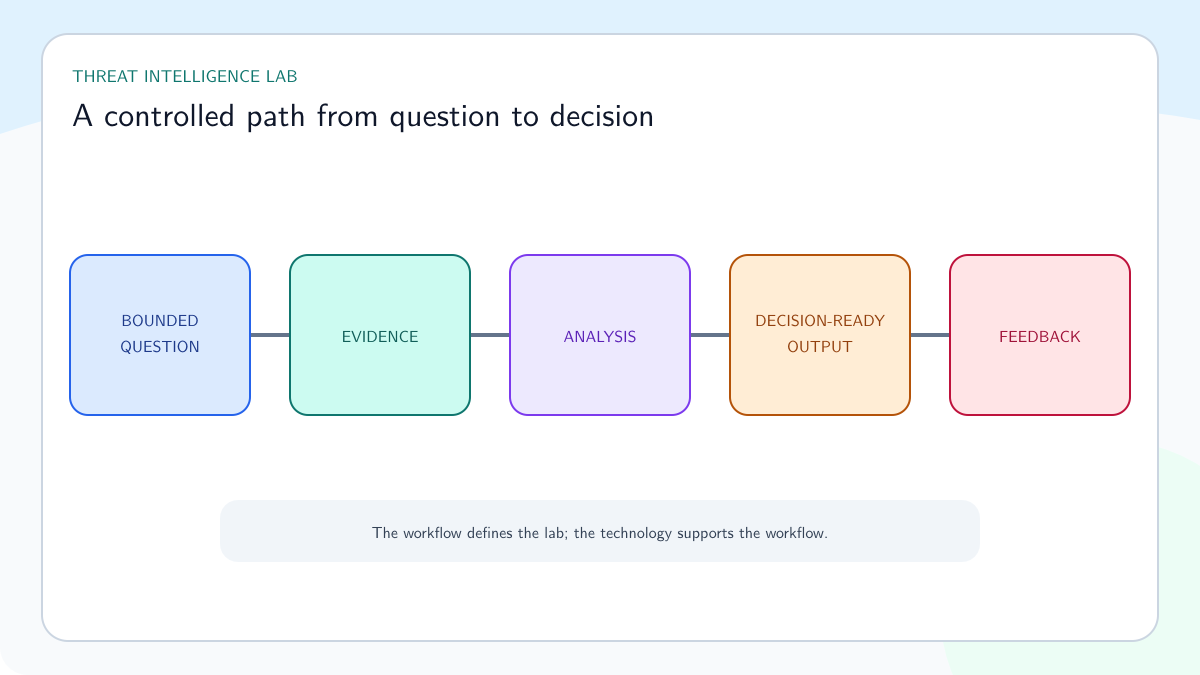
A threat intelligence lab is a bounded environment in which people turn cyber threat information into tested analysis, repeatable workflows, and outputs that support a decision. The boundary may be technical, organizational, educational, or all three. A lab can be a laptop used for structured practice, an enterprise workspace connected to defensive teams, an academic facility, or a vendor research group.
The phrase does not name one formally standardized type of facility. Organizations use it differently. Some mean an isolated training environment; some mean a research team that studies adversaries; others mean a production capability that collects, enriches, analyzes, and publishes intelligence. A useful definition therefore begins with purpose and responsibility, not a list of products.
NIST defines cyber threat intelligence as threat information that has been aggregated, transformed, analyzed, interpreted, or enriched to provide context for decisions. A lab gives that transformation a controlled place to happen. It should make the question, evidence, reasoning, output, handling rules, and feedback inspectable.
That distinction matters. A dashboard full of indicators is not automatically intelligence, and a server running a threat intelligence platform is not automatically a lab. The environment earns the name when it supports disciplined work from a bounded question to a defensible result.
Start With the Decision the Lab Exists to Improve
Before selecting infrastructure, name the consumer and the decision. An aspiring analyst may need to decide whether public reporting supports a campaign assessment. A detection engineer may need behaviors and data requirements for a validation exercise. A vulnerability team may need to decide whether new exploitation evidence changes remediation priority. An executive may need warning about a plausible change in threat exposure.
Each purpose creates a different lab. The campaign exercise needs source comparison, timelines, entity relationships, and confidence. Detection work needs telemetry, hypotheses, queries, known-good test data, and failure analysis. Vulnerability intelligence needs product context, exposure, exploitation evidence, compensating controls, and decision thresholds. Strategic work needs scenarios, indicators, assumptions, alternatives, and review triggers.
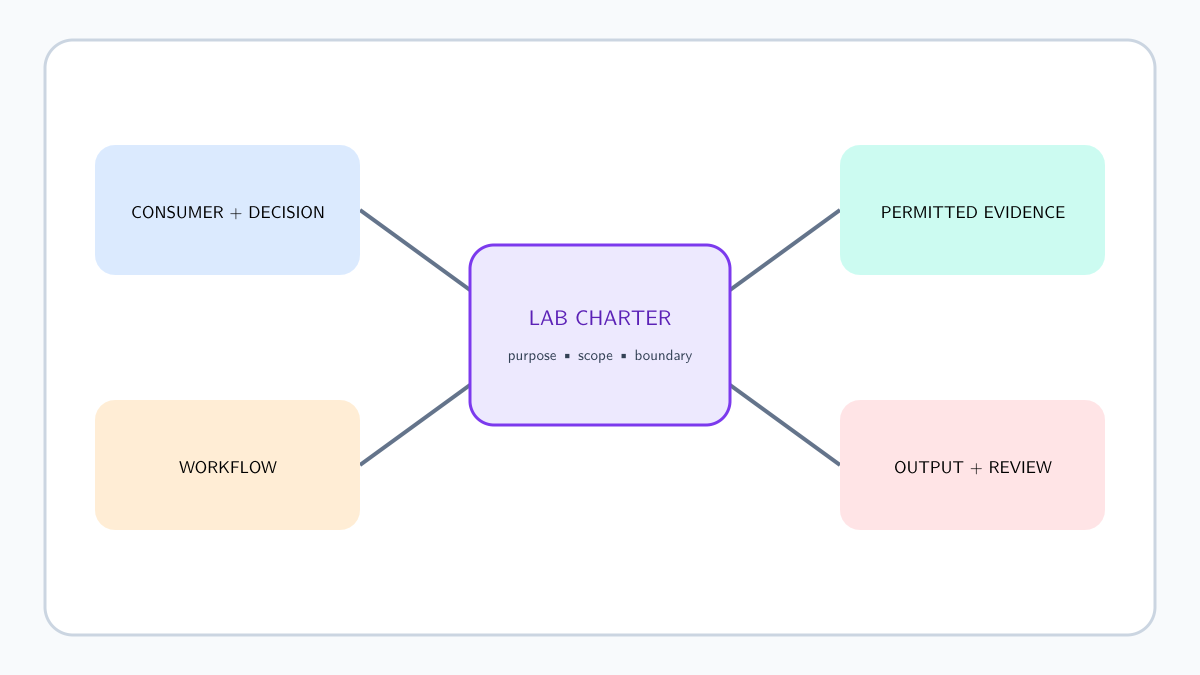
Write a one-sentence charter before installing anything:
This lab enables [people] to practice or perform [workflow] using [permitted evidence] so they can produce [output] for [decision] within [boundary].
The charter prevents a common failure: building an impressive stack that has no stable consumer, no deliverable, and no way to judge whether the work improved a decision.
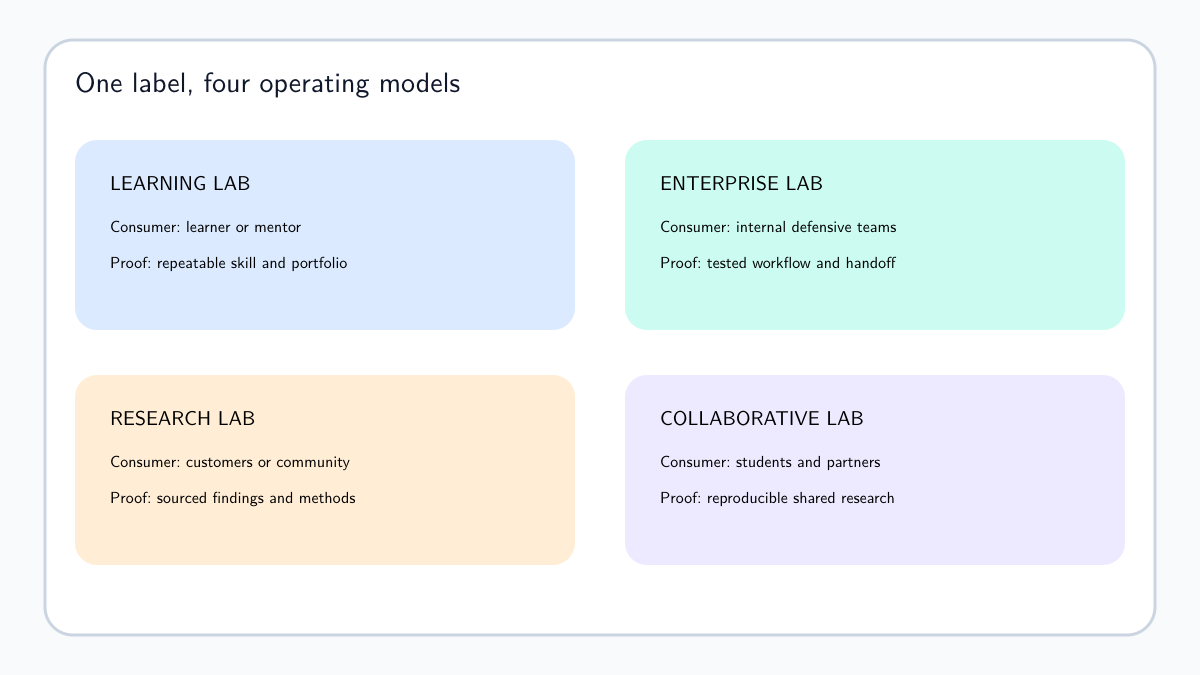
Four Different Things Can Be Called a Threat Intelligence Lab
A learning or home lab develops individual skill. It should use bounded, permitted data and exercises that expose the learner’s reasoning. Its success is demonstrated by reproducible analysis and better work products, not by the number of feeds or virtual machines installed.
An enterprise CTI lab tests workflows, integrations, data models, analytic methods, and handoffs before or alongside production use. It may connect to a SOC, incident response, vulnerability management, detection engineering, fraud, or risk teams. Its boundaries must distinguish experiments from production services and clearly state who owns operational action.
A vendor or research lab studies threats, malware, infrastructure, vulnerabilities, or adversary behavior and publishes findings, detections, feeds, or products. It may operate collection and analysis systems at significant scale. The label describes a research function; it does not by itself reveal the organization’s evidence standards, coverage, independence, or access.
An academic or collaborative lab supports teaching, shared research, method development, and controlled experimentation across students, researchers, public bodies, or industry partners. Its design must account for research ethics, data agreements, publication review, reproducibility, and the different access rights of participants.
These models can overlap, but their promises should not. A home lab should not be represented as continuous threat monitoring. A research team should not imply access to customer telemetry it does not have. An enterprise test environment should not silently become a production intelligence service without operational ownership and governance.
Notable Threat Intelligence and Cybersecurity Labs to Know
There is no neutral global ranking of the “top” cybersecurity labs, and the organizations below do not all provide the same service. This curated list illustrates respected and useful examples of the learning and research models described above. Inclusion is not an accreditation or a claim that one lab is better than another.
Hands-on learning and practice environments
-
Threat Intelligence Lab — This is our own service. It provides free cybersecurity and threat-intelligence courses, assessments, practical resources, and simulated missions built around evidence, decisions, and review. It is best understood as a learning and capability-development platform rather than a claim of continuous global threat monitoring.
-
Mobile Hacking Lab — A specialized mobile-security training platform covering Android and iOS from application security through reverse engineering, fuzzing, exploit development, and kernel research. Its cloud labs, device access, courses, and certification paths illustrate a deep domain-specific learning lab rather than a general CTI research function.
-
CyberDefenders — A blue-team training and cyber-range platform with scenario-based labs across threat intelligence, malware analysis, network and endpoint forensics, detection engineering, threat hunting, and cloud forensics. It is particularly relevant when a learner wants to practise investigation against prepared evidence and compare performance with defined tasks.
Threat research and intelligence organizations
-
Hasso Plattner Institute Cyber Threat Intelligence Lab — An academic research lab that studies adversaries, tactics, secure intelligence sharing, ransomware, cryptojacking, and defensive methods while supporting university education. It is a strong example of the academic and collaborative model.
-
Unit 42 — Palo Alto Networks’ threat-intelligence and incident-response organization. Its public research covers campaigns, actors, malware, vulnerabilities, cloud threats, and defensive implications, while its services connect intelligence with frontline response experience.
-
Cisco Talos — Cisco’s threat-intelligence and security-research organization, bringing together researchers, analysts, engineers, vulnerability research, telemetry, detection development, and public community resources. Talos illustrates a research function whose intelligence also informs a large security-product portfolio.
-
FortiGuard Labs — Fortinet’s threat-research and intelligence organization. It publishes threat research, outbreak alerts, landscape reports, vulnerability analysis, and defensive guidance while using research and telemetry to support FortiGuard security services.
-
SentinelLABS — SentinelOne’s threat-research group, publishing work on advanced persistent threats, crimeware, malware, adversary activity, reverse engineering, and AI security. It is an example of a vendor research lab that makes substantial technical findings available to the wider community.
Evaluate any lab against your purpose. For training, inspect exercise quality, feedback, safety, instructor expertise, access terms, and whether the work produces transferable skill. For research, inspect sourcing, methods, corrections, evidence boundaries, conflicts of interest, and whether conclusions distinguish observation from inference. Brand recognition alone does not establish analytical quality.
Separate the Lab From the SOC, CTI Program, and Malware Sandbox
A lab describes a bounded environment or research function. A CTI program describes an organizational capability with consumers, requirements, services, staffing, governance, delivery, feedback, and measures. A SOC monitors and investigates an operational environment. A malware-analysis sandbox executes or examines suspicious code under specialized containment. One organization may operate all four, but they are not interchangeable.
The boundary becomes clear by asking what happens when the work finds something urgent. Who validates it against internal telemetry? Who declares an incident? Who blocks infrastructure? Who contacts an affected party? Who approves public attribution? Who owns an intelligence gap after the exercise ends? If those responsibilities are missing, the lab has produced a finding without an operational route.
A lab can support a SOC by evaluating sources, modeling behavior, developing hypotheses, testing enrichment, or preparing a detection handoff. The SOC can provide sanitized lessons and recurring intelligence requirements in return. The relationship between threat intelligence and threat hunting works the same way: intelligence frames relevance and hypotheses; hunting tests for behavior in available telemetry.
If the objective is a standing organizational service rather than a bounded environment, use the operating model in How to Build a Cyber Threat Intelligence Program. Calling an under-governed production system a lab does not remove its security, privacy, retention, or response obligations.
Build the Lab Around an Inspectable Intelligence Workflow
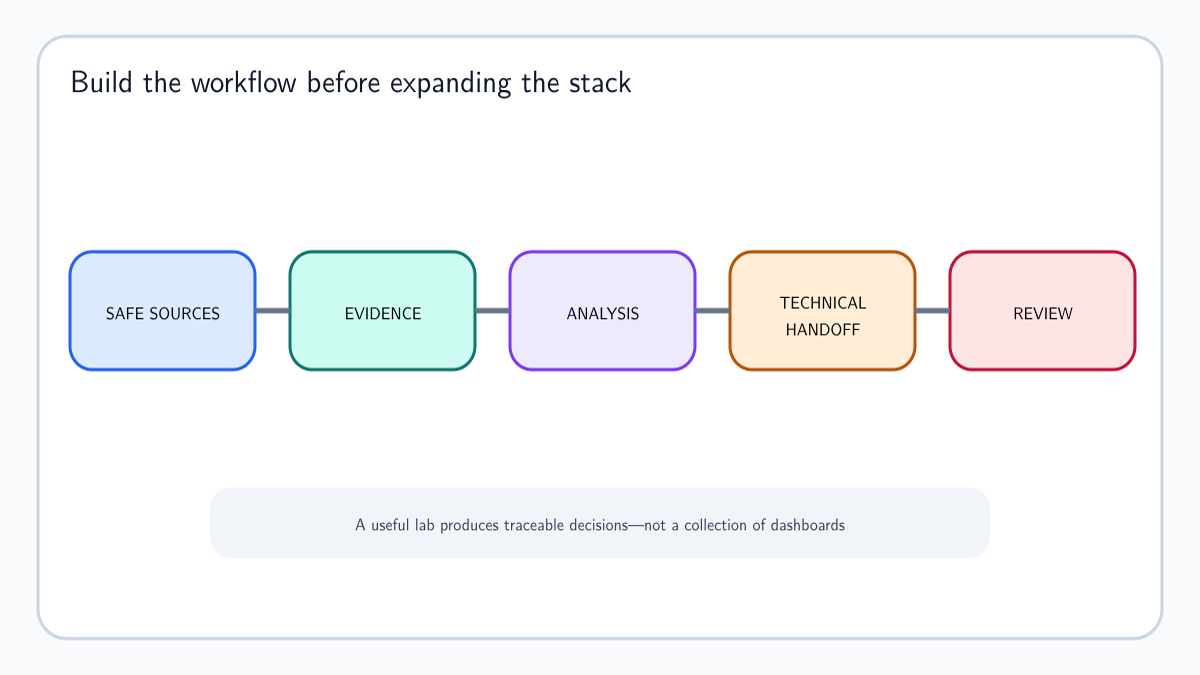
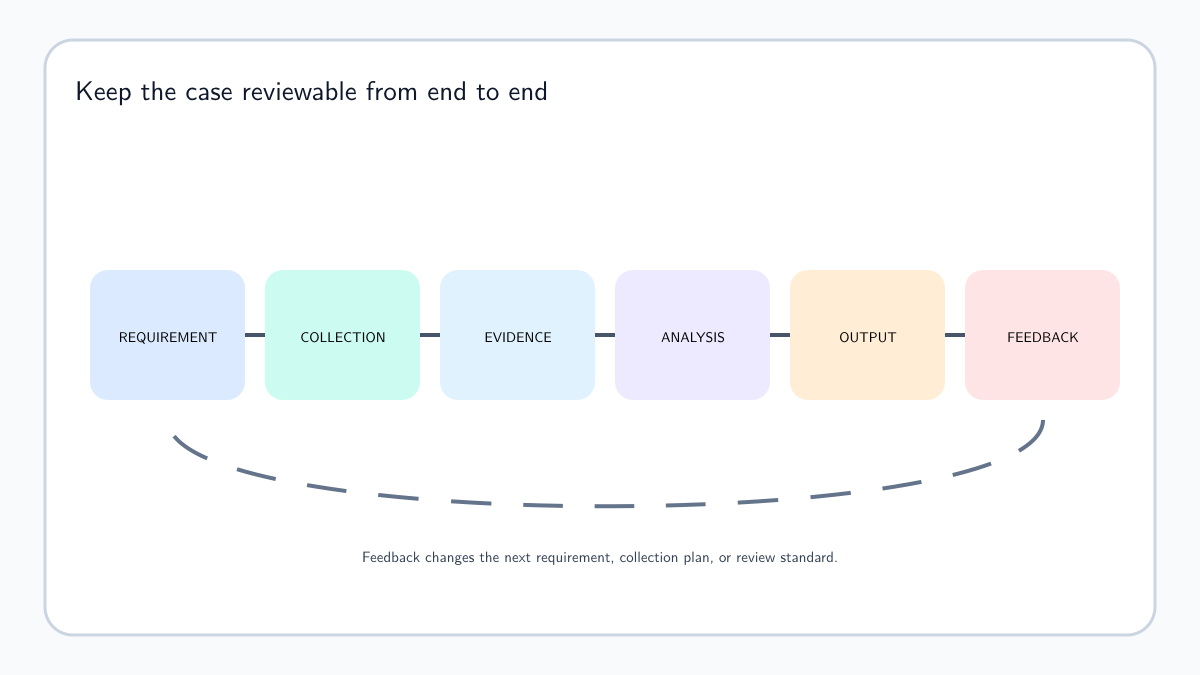
A useful lab preserves the path from requirement to feedback. Begin with the decision question, scope, deadline, consumer, and success criteria. Create a collection plan that names permitted sources and the gaps each source might address. Keep original source material or durable references separate from extracted observations and analyst judgments.
During processing, normalize only what the analysis requires and preserve provenance. During analysis, state assumptions, compare explanations, record confidence, and identify what would change the judgment. The output should answer the requirement in a form its consumer can use: an assessment, timeline, relationship model, indicator package with context, detection handoff, vulnerability priority, or briefing.
Close the loop. Record whether the output arrived in time, was understood, influenced action, exposed a missing source, or created a new question. That feedback becomes the next requirement. The complete threat intelligence lifecycle provides a deeper model for this loop.
MITRE’s ATT&CK CTI training is a useful example of lab-style learning: learners map narrative reporting, store and compare ATT&CK-mapped data, perform analysis, and make defensive recommendations. ATT&CK supplies a shared vocabulary; the source evidence and analytical reasoning still determine what can be claimed.
Choose Capabilities Before Choosing Products
Design the stack as a set of capabilities. Source management records origin, access, time, terms, and handling. Evidence storage preserves original material and extracted observations. Analysis supports timelines, entities, relationships, hypotheses, confidence, and alternatives. Collaboration assigns work and records review. Delivery produces human and machine-readable outputs. Validation tests whether a recommendation works. Governance controls access, retention, sharing, audit, and deletion.
A small lab can provide these capabilities with folders, Markdown, spreadsheets, scripts, and version control. A larger lab may need a cyber threat intelligence platform, case management, search, object storage, enrichment, ATT&CK Navigator, a SIEM, notebooks, automation, and reporting systems.
MISP and OpenCTI solve overlapping but not identical problems. The official MISP documentation covers its formats, objects, taxonomies, galaxies, APIs, sharing, and training materials. OpenCTI documentation describes a knowledge graph that can take feeds, sightings, alerts, vulnerabilities, assets, and artifacts as inputs and support technical and strategic outputs. Neither product supplies a mission, relevance, reliable sourcing, or sound judgment by itself.
Add a component when an exercise exposes a concrete constraint: repeated manual transformation, lost provenance, inconsistent entity meaning, access-control needs, review bottlenecks, scale, or a required integration. Record the reason, owner, security model, backup, update path, and removal criteria. Every new connector and service becomes something the lab must secure and maintain.
Set Safety, Data, and Sharing Boundaries Before Collection
Use data you are authorized to access and reuse. A public URL does not automatically grant unrestricted redistribution. Record source terms, collection time, permitted use, attribution requirements, personal-data concerns, and retention. Keep employer, customer, victim, credential, and restricted community data out of a personal learning environment.
Apply handling markings consistently. FIRST Traffic Light Protocol 2.0 communicates how recipients may share information, but TLP is not a substitute for law, contract, source terms, privacy controls, or a complete information-exchange policy. Preserve the original marking and do not infer that information is public merely because it reached the lab.
Separate general CTI analysis from live malware execution, exploit testing, internet scanning, undercover collection, or access to criminal services. Those activities change the risk model and may require specialist containment, authorization, legal review, monitoring, safe egress, recovery, and reporting procedures. Most CTI exercises need none of them.
Secure the lab like any other environment: unique identities, least privilege, multifactor authentication where supported, encrypted storage, secret management, patching, restricted network exposure, logs, backups, restore tests, and a rebuild plan. Never expose a default MISP, OpenCTI, notebook, search, or case-management interface directly to the internet.
Build the Smallest Lab That Can Complete One Case
1. Select one consumer and decision. Avoid a mission such as “monitor every cyber threat.” Choose a question with scope, time, and a usable output.
2. Define the evidence boundary. Name the public, synthetic, internal, or licensed sources allowed in the exercise, together with handling and retention rules.
3. Write the workflow on paper. Show how a source becomes an observation, how observations become evidence, how evidence supports or weakens a judgment, and how the result reaches its consumer.
4. Choose the minimum tools. Start manually when that makes reasoning visible. Add platforms or automation only when the exercise requires correlation, structured sharing, scale, repeatability, or integration.
5. Run a complete case. Preserve the requirement, sources, extraction notes, evidence table, assumptions, alternatives, output, review, and retrospective together. A second person should be able to inspect the path without reconstructing it from screenshots.
6. Test a change. Correct one source, expire an indicator, alter the time window, or introduce an alternative explanation. The result should update transparently. If the lab cannot incorporate correction, it is demonstrating presentation rather than intelligence practice.
The detailed Build a Threat Intelligence Home Lab guide provides safe stack sizes, platform choices, exercises, validation, automation boundaries, maintenance, and portfolio structure. This page defines the concept; that guide implements the individual learning environment.
Measure Decisions and Learning, Not Feed Volume
A learning lab can measure complete cases, claims traced to original sources, provenance coverage, hypotheses tested, corrections incorporated, outputs reviewed, and skills demonstrated without assistance. An enterprise lab can measure time to test an integration, defects found before production, handoffs accepted, requirements answered, repeatable analyses, and operational improvements that followed.
A research lab can measure reproducibility, correction handling, source diversity, disclosed limitations, review time, responsible publication, and whether detections or recommendations were independently useful. A collaborative lab may also measure participation, method reuse, dataset quality, research outputs, and whether access and publication rules were followed.
Indicator count, feed count, connector count, graph size, dashboard count, or reports published can describe activity. They do not prove intelligence value. The NIST Guide to Cyber Threat Information Sharing emphasizes using threat information to improve cybersecurity and risk decisions; the lab should be evaluated against the same outcome.
How Threat Intelligence Lab Uses the Lab Idea
Threat Intelligence Lab is also the name of this platform and organization. Here, the lab idea is applied as a learning model: begin with a bounded security question, inspect evidence, make a decision, and review the consequences and limitations. The objective is not to make a course page resemble a live operations center. It is to make analytical reasoning and defensive choices practiceable.
Readers who are new to the discipline can browse the free threat intelligence courses and choose a foundation, operational, or strategic route. Practical investigation missions place the learner inside bounded scenarios where evidence, decisions, and debriefs matter. The resource library supplies deeper explanations and implementation guidance.
For organizations, the same principle scales only when ownership scales with it. A production CTI capability needs requirements, services, people, governance, integrations, feedback, and measures. Training can develop the skills; it does not replace the operating model or the authority to act.
Choose the Next Guide by the Lab You Mean
If you mean a personal learning environment, continue with Build a Threat Intelligence Home Lab. It covers the architecture, safe data, lightweight and platform stacks, six progressive exercises, and portfolio outputs.
If you mean an organizational CTI capability, use How to Build a Cyber Threat Intelligence Program. It covers consumers, services, staffing, sources, governance, stakeholder integration, metrics, and phased implementation.
If the terminology itself is new, begin with What Is Cyber Threat Intelligence?, then follow the intelligence lifecycle. The durable principle across every version is simple: define the decision and boundary, preserve the evidence and reasoning, deliver something another person can use, and learn from what happens next.
Frequently asked questions
What is a threat intelligence lab?
A threat intelligence lab is a bounded environment in which people turn cyber threat information into tested analysis, repeatable workflows, and decision-ready outputs. Depending on its purpose, it may be a learning environment, an enterprise capability, a research team, or a collaborative academic facility. The term is descriptive rather than a formally standardized facility type.
What is the difference between a threat intelligence lab and a SOC?
A security operations center continuously monitors an environment, triages alerts, investigates activity, and coordinates response. A threat intelligence lab is usually bounded around research, learning, workflow design, tool evaluation, or intelligence production. They can share data and personnel, but a lab should not claim operational monitoring responsibilities it does not perform.
Does a threat intelligence lab need live malware?
No. Core CTI skills can be practiced with official advisories, public reporting, structured threat data, synthetic telemetry, benign packet captures, and authorized test activity. Malware analysis requires a separately designed and contained environment with the appropriate expertise, controls, and authorization.
Which tools does a beginner threat intelligence lab need?
A beginner can start with a browser, note-taking or spreadsheet software, version control, and a clearly defined exercise. Add tools such as ATT&CK Navigator, MISP, OpenCTI, case management, enrichment, or a SIEM only when the workflow requires their specific capabilities.
Can a threat intelligence lab run on one laptop?
Yes, if the exercise uses bounded public or synthetic data and lightweight tools. Large feed collections, search clusters, connectors, malware execution, and enterprise telemetry have different compute, security, legal, and maintenance requirements.
How much does a threat intelligence lab cost?
The cost ranges from almost nothing for a document-based learning lab to substantial staffing, infrastructure, data, licensing, governance, and assurance costs for an enterprise or research lab. Define the decision, exercise, users, and outputs before estimating the stack.