What Is Cyber Threat Intelligence? Definition and Uses
Understand cyber threat intelligence: its definition, lifecycle, tactical, operational and strategic types, evidence, use cases, value, and limits.
Cyber Threat Intelligence helps an organization make better decisions about cyber threats. It takes scattered evidence—security events, attacker infrastructure, malware behavior, vulnerabilities, victim reports, criminal discussions, geopolitical developments—and turns it into a reasoned explanation of what matters, why it matters, and what to do next.
That final part is essential. A database can contain millions of threat indicators without containing much intelligence. Intelligence exists when information has been selected, evaluated, interpreted, and communicated for a particular reader and decision. The same intrusion may therefore produce a short blocklist for a SOC, a campaign assessment for an incident-response lead, and a risk briefing for executives. Each product uses some of the same evidence, but it answers a different question.
This guide explains the complete concept without assuming an intelligence or cybersecurity background. You will learn how threat data becomes intelligence, how tactical, operational, and strategic intelligence fit together, how the intelligence lifecycle works, which evidence analysts use, where CTI creates value, and where its limits begin.
Cyber Threat Intelligence Definition: Evidence for a Decision
Cyber Threat Intelligence, usually shortened to CTI, is evidence-based knowledge about cyber threats that is produced for a specific decision. A CTI definition is incomplete if it stops at data collection: the evidence must be evaluated, analyzed, and connected to a consumer who can act on it.
A complete intelligence product normally contains six elements:
- A requirement. The question or decision the work is meant to support.
- Relevant evidence. Information selected because it can help answer that requirement.
- Evaluation. An assessment of source reliability, information credibility, provenance, timing, gaps, and possible bias.
- Analysis. Reasoning that explains relationships, tests alternatives, and turns observations into judgments.
- Uncertainty. Clear language about likelihood, confidence, assumptions, and what remains unknown.
- Implications. An explanation of why the result matters to the consumer and which decisions it may inform.
This definition prevents two common errors. The first is calling every security datum “intelligence.” The second is treating intelligence as a collection of facts with no connection to the organization. A report about a capable threat actor can be accurate yet irrelevant if the actor does not target the organization’s region, sector, technology, people, or strategic interests.
CTI is also more than attribution. Identifying who conducted an operation can be useful, but many decisions do not require a named actor. Defenders may be able to close an exposed access path, detect a behavior, prioritize a vulnerability, or prepare for extortion based on reliable knowledge of how an intrusion works and who is exposed, even when actor identity remains unresolved.
Threat Data, Threat Information, and Threat Intelligence Are Not the Same
The distinction is easiest to understand as a progression.
Threat data is a raw observation. Examples include an IP address, a domain, a file hash, a suspicious process command, a vulnerability identifier, an authentication event, or a post on a criminal forum. Data may be accurate, inaccurate, old, incomplete, or irrelevant. By itself, it says little about the decision a defender should make.
Threat information adds descriptive context. An analyst may learn that the domain hosted a credential-phishing page on a particular date, that the file created a scheduled task, or that a criminal seller advertised access to organizations in a certain sector. The observation now has meaning, but its relevance and implications may still be unclear.
Threat intelligence connects evaluated information to a requirement. For example:
A financially motivated cluster is likely targeting externally exposed remote-management systems used in our sector. Our inventory shows three reachable instances running an affected configuration. We assess with moderate confidence that these systems face elevated near-term exposure. Prioritize access restriction, review authentication telemetry from the last 30 days, and monitor for the described post-access behaviors.
The assessment does not merely repeat an indicator. It identifies the actor’s objective, connects behavior to organizational exposure, expresses confidence, defines a time horizon, and supports specific decisions.
The boundary is not determined by file format. A machine-readable STIX object can carry useful intelligence if it preserves context and relationships. A beautifully written PDF can still be little more than unfiltered information if it lacks a requirement, reasoning, uncertainty, and implications.
The Three Main Types: Tactical, Operational, and Strategic CTI
CTI is often divided into three layers. These are not rigid containers; they are a way to match detail, timing, and language to a consumer.
| Layer | Main question | Typical consumers | Examples | Time horizon |
|---|---|---|---|---|
| Tactical | What should we detect, block, enrich, or investigate now? | SOC analysts, incident responders, detection engineers | Indicators, signatures, observable procedures, detection logic, enrichment context | Minutes to days |
| Operational | How is an adversary or campaign operating, and what may it do next? | CTI analysts, hunters, response leads, security managers | Campaigns, access methods, infrastructure patterns, malware roles, victimology, TTPs | Days to months |
| Strategic | Why does the threat matter to the organization, and which longer-term decision should change? | CISOs, executives, risk leaders, business owners | Threat scenarios, geopolitical drivers, sector exposure, business impact, warning indicators | Months to years |
Tactical intelligence is closest to security telemetry. Its strength is speed and precision. Its weakness is decay: domains are abandoned, servers are reassigned, files are rebuilt, and attackers alter small details. Tactical products are strongest when they include observation time, provenance, confidence, role, expected lifetime, and a connection to behavior.
Operational intelligence explains activity rather than isolated artifacts. It may reconstruct a phishing-to-exfiltration chain, compare incidents, describe how a ransomware affiliate gains access, or assess whether a new intrusion belongs to a tracked cluster. Operational CTI helps teams hunt, scope, detect, prepare playbooks, and anticipate likely next steps.
Strategic intelligence connects the threat environment to the organization’s objectives, dependencies, markets, investments, and risk decisions. It should not be a simplified technical report. It needs scenarios, likelihood, impact, warning, assumptions, and options written in language the decision-maker uses.
Some organizations add technical intelligence as a fourth label for malware internals, protocol details, exploits, and forensic artifacts. That can be useful for organizing expertise, but technical depth can serve any layer. A malware behavior may support a tactical detection, an operational campaign assessment, and a strategic judgment about capability.
How Cyber Threat Intelligence Is Produced
Intelligence is produced through a repeatable cycle rather than a single research step:
- Direction and requirements: define the decision, consumer, scope, time horizon, priority, and what a useful answer must contain.
- Collection planning: identify the evidence needed, available sources, gaps, access constraints, and collection responsibilities.
- Collection: acquire relevant internal and external information lawfully and proportionately.
- Processing: normalize, translate, deduplicate, enrich, preserve provenance, and make the material ready for analysis.
- Analysis and production: evaluate evidence, test explanations, make judgments, express uncertainty, and build a product for the intended audience.
- Dissemination: deliver the intelligence through the channel and at the time the consumer can use it.
- Feedback and evaluation: learn whether the product answered the requirement, affected a decision, revealed a new gap, or needs revision.
The cycle is drawn as a circle because feedback produces better requirements and collection. In practice, the stages overlap. A new analytic hypothesis may create a collection task; an urgent incident may require preliminary dissemination before collection is complete; new evidence may force analysts to revise an earlier judgment.
The most frequent failure occurs at the beginning. If a team starts by collecting whatever is available, it accumulates feeds and reports without knowing which problem they should solve. A clear requirement keeps the work selective. Our detailed guide to the Cyber Threat Intelligence lifecycle explains every stage, its outputs, handoffs, and failure modes.
The Core Evidence CTI Analysts Work With
Threat intelligence rarely comes from one decisive artifact. Analysts combine different evidence types, each of which answers a different question.
Indicators and observables include domains, IP addresses, URLs, file hashes, email addresses, certificates, registry paths, mutexes, user agents, and process commands. They can support searching and detection, but their meaning depends on provenance, time, infrastructure context, and role. A shared hosting address is not equivalent to an attacker-controlled command server.
Tactics, techniques, and procedures—TTPs describe adversary objectives, methods, and concrete implementations. They are often more durable than indicators because an attacker can change a domain more easily than an operating method. However, broad behavioral descriptions can create false positives unless translated into specific observable patterns and environmental context. See Indicators of Compromise and TTPs for the complete relationship between evidence and detection.
Malware evidence includes code, capabilities, configuration, execution behavior, communication patterns, build artifacts, and relationships among samples and families. Code similarity can support clustering but does not automatically prove a shared operator or campaign.
Infrastructure evidence includes passive DNS, certificates, registration history, hosting, autonomous systems, server configurations, redirect chains, and temporal relationships. Infrastructure can be rented, compromised, reassigned, shared, or intentionally imitated, so time and control must be assessed.
Identity and access evidence includes authentication attempts, session tokens, consent grants, device registrations, privileged role changes, exposed credentials, service accounts, and federated trust. In cloud and SaaS incidents, identity events may be more important than malware.
Victimology and targeting explain which organizations, sectors, roles, regions, technologies, or business events attract attention. This helps determine exposure and can reveal an actor’s objectives.
Human and contextual reporting includes incident reports, source interviews, criminal communications, government statements, vulnerability research, business context, and geopolitical developments. Such reporting requires source evaluation and careful separation of direct evidence from claims, repetition, and interpretation.
Internal and External Sources Must Be Combined
External sources reveal what is happening beyond the organization. Internal sources reveal whether it matters inside the organization. CTI reaches its full value when the two meet.
External inputs can include public technical research, government advisories, information-sharing communities, vendor reporting, commercial feeds, malware repositories, passive internet datasets, vulnerability publications, code repositories, news, legal records, and responsibly collected material from criminal ecosystems.
Internal inputs can include asset and identity inventories, security alerts, endpoint and network telemetry, incidents, vulnerability and exposure data, email telemetry, cloud audit records, fraud cases, third-party dependencies, business-critical processes, and stakeholder plans.
Suppose external reporting says an actor is exploiting a remote-access product. That is threat information. The intelligence question is whether the organization uses the affected product, whether it is exposed, whether the relevant conditions exist, whether exploitation indicators appear in retained telemetry, which business process depends on it, and what response is proportionate.
More sources do not automatically produce more confidence. Ten reports may repeat one original claim. A technically detailed source may have no visibility into victim selection. A historically reliable provider may still publish an uncorroborated new assessment. Analysts need to evaluate reliability, credibility, access, motivation, recency, independence, and relevance separately. Our guide to Cyber Threat Intelligence sources provides a practical collection and corroboration method.
Where Cyber Threat Intelligence Creates Practical Value
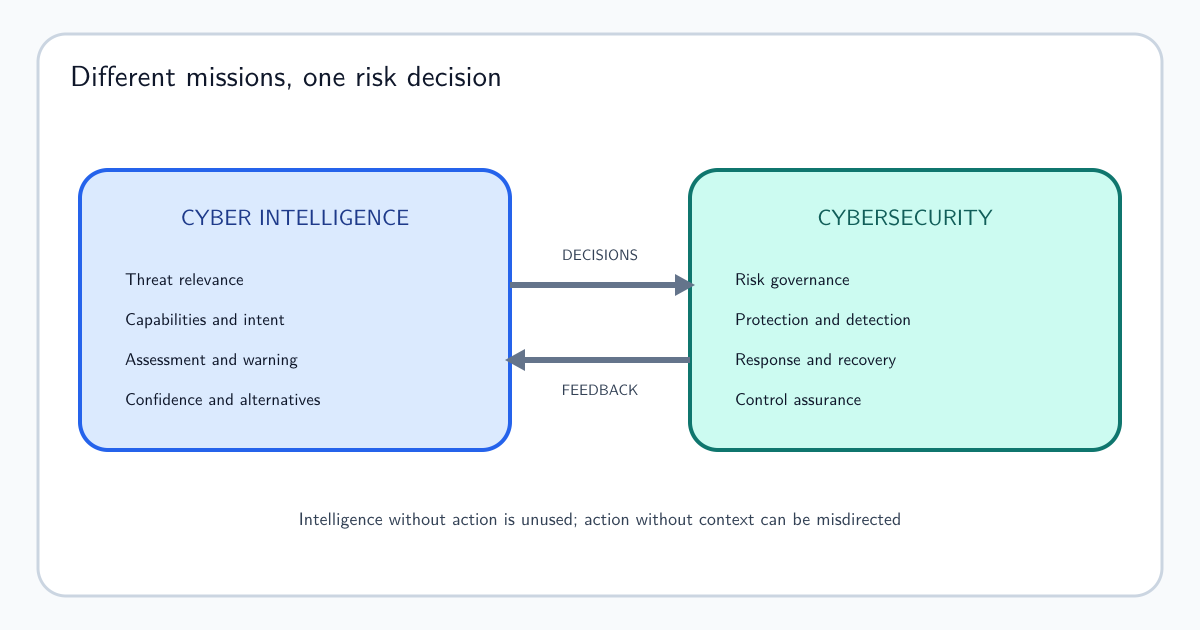
CTI supports many functions, but its contribution should always be described as a decision or changed action. The comparison of cyber intelligence and cybersecurity clarifies where intelligence analysis ends, where control ownership begins, and how evidence should move between them.
Security operations: enrich alerts, distinguish likely malicious activity from noise, identify related artifacts, prioritize triage, and provide context for escalation.
Detection engineering and threat hunting: translate adversary behavior into data requirements, analytics, hunt hypotheses, test cases, and coverage priorities. Intelligence supplies the behavior and relevance; engineering determines how to observe it reliably.
Incident response: provide likely next steps, historical behavior, related infrastructure, victim patterns, and campaign context while using incident evidence to confirm, refine, or disprove external reporting.
Vulnerability management: combine technical severity with exploitation evidence, adversary interest, asset exposure, control strength, business criticality, and remediation constraints. CTI helps answer which vulnerability creates the most relevant risk now, not simply which score is highest.
Identity, cloud, and third-party defense: identify access tradecraft, abused trust relationships, exposed credentials, malicious applications, supplier targeting, and control-plane behavior that traditional malware-focused intelligence may miss.
Fraud and brand protection: analyze impersonation, account takeover, payment diversion, counterfeit services, credential markets, and the criminal infrastructure supporting them.
Security architecture and investment: reveal recurring adversary objectives and control gaps, helping leaders prioritize capabilities that address durable behaviors rather than individual incidents.
Executive and business risk: explain plausible threat scenarios, exposed operations, potential impact, warning indicators, and choices. Strategic CTI can inform market entry, acquisitions, crisis planning, travel, product launches, and supplier decisions when the cyber threat is materially connected to them.
What Good Threat Intelligence Looks Like
Useful intelligence is not defined by how secret, technical, or lengthy it appears. It has recognizable qualities:
- Relevant: it answers a prioritized question for an identified consumer.
- Timely: it arrives early enough to affect the decision.
- Accurate and traceable: claims are supported, sources and transformations are preserved, and corrections are possible.
- Analytically sound: observations, assumptions, alternatives, judgments, likelihood, and confidence are not blurred together.
- Audience-appropriate: the product contains the detail, language, format, and implications the consumer needs.
- Actionable: it enables a useful action, priority change, preparedness step, or justified decision not to act.
- Proportionate: the confidence and specificity of the conclusion do not exceed the evidence.
Actionable does not mean every report must end with a block rule. A strategic assessment may help leadership retain an existing plan because the evidence does not justify a costly change. An investigation may conclude that a suspected link is too weak to use. Reducing uncertainty and preventing an unsound decision are legitimate forms of value.
CTI quality is also visible in what the analyst refuses to claim. A domain overlap does not automatically identify an actor. A successful detection does not establish campaign scope. A public proof of concept does not prove exploitation in real intrusions. A government attribution does not become the analyst’s independent assessment unless the team has evidence to support it.
The Limits, Risks, and Responsibilities of CTI
CTI operates under persistent uncertainty. Visibility is incomplete, adversaries deceive, infrastructure changes, victims underreport, sources repeat one another, and defenders observe only the telemetry they collect. An intelligence product should narrow uncertainty, not hide it.
Attribution has levels. Analysts may have strong evidence that several events form one cluster, moderate evidence that the cluster matches a public group, and weak evidence about state sponsorship or a specific organization. Each claim needs its own confidence. The dedicated guide to cyber threat attribution explains how to build and communicate that case.
Collection creates legal and ethical responsibilities. Access does not equal authorization. Teams should define legitimate purpose, collection authority, minimization, access controls, retention, handling restrictions, and escalation paths—especially when collecting personal data, leaked material, or content from criminal spaces. Analysts should not interact with threat actors, acquire illicit material, or access restricted systems without explicit authorization and specialist oversight.
Indicators can cause harm when misused. Blocking a shared service can disrupt legitimate users. Publishing victim data can increase exposure. Removing provenance can turn a time-bounded observation into a permanent allegation. Intelligence handling must account for false positives, privacy, source protection, operational sensitivity, and downstream use.
Automation has boundaries. Machines are excellent at collecting, normalizing, matching, scoring, and distributing structured data. Human judgment remains essential when meaning depends on business context, source motivation, deception, competing explanations, or disproportionate consequences.
How to Start Using Cyber Threat Intelligence
An organization does not need a large platform or dedicated global team to begin. It needs a decision, an owner, relevant evidence, and a feedback loop.
Start with three questions:
- Which decisions repeatedly lack threat context? Examples include vulnerability priorities, exposed services, sector-focused phishing, third-party access, executive travel, or detection coverage.
- Who owns those decisions, and when do they need an answer? This defines the consumer, product, and service level.
- Which internal and external evidence could change the answer? This creates a focused collection plan.
Produce a small number of repeatable products, track whether they affect decisions, and improve them through feedback. Do not buy more feeds than the team can evaluate and use. Do not automate a workflow whose purpose is unclear. Do not measure success only by reports, indicators, or alerts produced.
For the operating model, roles, technology choices, governance, and metrics, continue with How to Build a Cyber Threat Intelligence Program. If you are considering the profession itself, Working in Cyber Threat Intelligence explains the roles, skills, and day-to-day reality.
The central principle is simple: Cyber Threat Intelligence is not the information an organization possesses. It is the understanding the organization can use. When every collection task, analytic judgment, product, and metric remains connected to that purpose, CTI becomes a decision capability rather than another stream of security data.
Frequently asked questions
What is Cyber Threat Intelligence in simple terms?
Cyber Threat Intelligence is evidence-based knowledge about cyber threats that is produced for a specific decision. It explains what is happening, why it matters to a particular organization, what may happen next, and what the reader can reasonably do with that knowledge.
What is the difference between threat data and threat intelligence?
Threat data is an observation such as an IP address, file hash, vulnerability identifier, or forum post. It becomes intelligence only after analysts validate it, add context, interpret its meaning, connect it to a requirement, express uncertainty, and communicate it in time for a decision.
What are the main types of Cyber Threat Intelligence?
The most common model uses tactical, operational, and strategic intelligence. Tactical intelligence supports immediate technical action; operational intelligence explains campaigns and adversary behavior; strategic intelligence explains longer-term risk and implications for leaders. Many teams also use technical as a label for highly detailed evidence, but the categories can overlap.
Is an indicator of compromise the same as threat intelligence?
Not by itself. An indicator becomes more useful intelligence when it includes provenance, observation time, role in the intrusion, confidence, expected lifetime, relevant behaviors, and guidance about how it should be used.
Does threat intelligence predict attacks?
It can provide warning and assess plausible future activity, but it cannot predict every attack with certainty. Good CTI narrows uncertainty, identifies observable indicators, and helps organizations prepare for credible scenarios without presenting estimates as guarantees.
Who uses Cyber Threat Intelligence?
Users include SOC analysts, incident responders, threat hunters, detection engineers, vulnerability teams, security architects, fraud teams, risk leaders, CISOs, executives, and sometimes legal, communications, procurement, or business-continuity teams. Each audience needs different detail, timing, and language.
Can a small organization benefit from CTI without a dedicated team?
Yes. A small organization can begin with a few priority intelligence requirements, trusted public and commercial sources, clear ownership, and a repeatable process for turning relevant findings into defensive or business action. It should scale collection to its ability to analyze and use the information.
How do you know whether threat intelligence is good?
Good intelligence is relevant to a real requirement, timely enough to affect a decision, clear about evidence and uncertainty, tailored to its audience, traceable to its sources, and capable of producing a useful action, changed priority, better understanding, or justified decision not to act.