How to Build a Cyber Threat Intelligence Program: Team, Process, Technology, and Metrics
Build a practical Cyber Threat Intelligence program from mission and requirements through services, staffing, sources, workflows, technology, governance, stakeholder integration, metrics, maturity, and a phased implementation roadmap.
A Cyber Threat Intelligence program is not a collection of feeds, a threat intelligence platform, or a team that publishes actor reports. It is an organizational capability that answers priority questions about cyber threats and turns the answers into better security and business decisions.
Building that capability requires alignment across mission, consumers, requirements, services, people, sources, process, technology, governance, and measurement. Starting with tools creates a warehouse of information. Starting with a mission and decisions creates a program.
This guide provides a complete operating model and phased roadmap. It covers what to assess before launch, which services to offer, how to size and organize the team, how to integrate with stakeholders, what technology is actually needed, how to govern sensitive work, and which metrics reveal value. If CTI terminology is new, read What Is Cyber Threat Intelligence? first.
Define the Mission in Terms of Decisions and Outcomes
A useful mission statement describes who the program serves, which decisions it improves, and what value it creates.
Weak mission:
Collect and analyze global cyber threats and provide best-in-class intelligence.
Stronger mission:
Provide timely, evidence-based intelligence that helps security operations detect relevant adversary behavior, vulnerability teams prioritize exploitable exposure, incident leaders anticipate and scope attacks, and executives prepare for cyber threats to critical business services.
The stronger version sets boundaries and names consumers. It can be translated into requirements, services, staffing, and measures.
Agree on:
- priority consumers and decisions;
- threat, geography, sector, technology, and business scope;
- tactical, operational, and strategic responsibilities;
- hours and response expectations;
- products and channels;
- work the program will not perform;
- authorities, risk ownership, and escalation;
- evidence of success after 6, 12, and 24 months.
Scope is a strategic control. A two-person team cannot provide 24/7 monitoring, malware reverse engineering, geopolitical assessment, global criminal-source coverage, vulnerability intelligence, executive briefings, detection engineering, and every ad hoc request at high quality. Choose the services that address the most consequential uncertainty and expand only when capacity and evidence justify it.
Assess the Current State Before Designing the Future State
Most organizations already perform fragments of CTI. SOC analysts enrich indicators, incident responders research actors, vulnerability teams monitor exploitation, fraud teams track criminal infrastructure, and risk teams brief leadership. A new program should connect and improve this work rather than duplicate it.
Assess:
Stakeholders and decisions: who currently needs threat context, what decisions recur, what arrives too late, and where uncertainty causes cost or delay?
Existing services and products: which teams produce alerts, assessments, briefings, feeds, hunts, vulnerability priorities, and supplier reporting? Who uses them?
Sources and access: what internal telemetry, business context, sharing, public, government, community, and commercial sources exist? What are their limitations and restrictions?
People and skills: who has analytic, technical, regional, linguistic, writing, automation, stakeholder, legal, or domain expertise? Where is knowledge concentrated in one person?
Technology and workflow: which systems hold cases, telemetry, entities, relationships, documents, requirements, detections, and feedback? Where is provenance lost?
Governance: which policies cover collection, privacy, source protection, sharing, retention, public attribution, criminal ecosystems, and incident escalation?
Performance: which outputs affect decisions, which are habitual, and which requests create recurring backlogs?
The baseline should produce a gap register and dependency map, not a maturity score alone. A numerical maturity level is useful only if it leads to specific capability decisions.
Establish Requirements and a Governed Intake Process
Requirements prevent the program from becoming an on-demand research desk or feed-processing factory.
Maintain a requirements register with:
- question and decision supported;
- consumer and accountable owner;
- priority and rationale;
- scope, terms, exclusions, and time horizon;
- delivery deadline, cadence, and product;
- subordinate intelligence and collection questions;
- current gaps, status, review date, and satisfaction criteria.
Create an intake route for ad hoc requests. Capture the decision, deadline, consequence, work already done, sensitivity, and expected output. Triage requests against priority requirements, urgency, effort, and available evidence. Not every request deserves immediate custom analysis.
Requirements governance should include a stakeholder forum that approves priorities and resolves conflicts. CTI can advise, but business and security leaders own the decisions the requirements support.
Review requirements on a known cadence and when triggers occur: organizational change, new markets, incidents, architecture shifts, geopolitical events, supplier changes, or evidence that a requirement no longer affects action.
The operational process for turning requirements into collection, analysis, dissemination, and feedback is covered in the Cyber Threat Intelligence lifecycle.
Design a Service Catalog Around Consumer Decisions
A service catalog tells stakeholders what the program provides, to whom, under which conditions, and within which service level.
Common services include:
Alert and indicator enrichment: context, confidence, role, and related activity for operational triage.
Incident intelligence support: actor and campaign context, likely next actions, pivots, external sightings, warning, and post-incident learning.
Detection and hunting support: relevant behaviors, hypotheses, telemetry needs, procedure variants, and coverage priorities.
Vulnerability intelligence: exploitation evidence, actor interest, affected exposure, business context, and remediation priority.
Threat actor and campaign tracking: maintained clusters, profiles, victimology, infrastructure, malware, TTPs, objectives, confidence, and change indicators.
Strategic threat assessment: scenarios, drivers, business exposure, potential impact, warning, and decisions for leaders.
Third-party and supply-chain intelligence: provider targeting, trust paths, dependencies, upstream incidents, and exposure implications.
Executive and crisis briefing: concise, timely judgment for significant developments and decision points.
Each service definition should include consumers, trigger or cadence, inputs, workflow, product, review standard, delivery channel, handling, owner, dependencies, service level, feedback, and measures.
Begin with two or three high-value services. Standardize them before adding more. A repeatable product with clear ownership and feedback creates more trust than a wide catalog delivered inconsistently.
Build the Team Around Capabilities, Not Job Titles
Core capabilities include:
- requirements management and stakeholder engagement;
- collection planning and source operations;
- technical investigation and infrastructure analysis;
- malware and vulnerability understanding;
- analytic tradecraft and structured reasoning;
- threat actor, campaign, victimology, and geopolitical analysis;
- intelligence writing, visualization, and briefing;
- data engineering, automation, and platform administration;
- governance, sharing, privacy, and source handling;
- program management, quality review, and measurement.
One person may cover several capabilities in a small program. Document primary and secondary ownership, backup, and escalation. Identify knowledge that depends on one analyst, one language, one vendor, or one undocumented script.
Common roles include CTI analyst, senior or principal analyst, intelligence collection or operations analyst, technical analyst, threat researcher, malware analyst, data or automation engineer, and program manager. Titles vary widely; hiring should follow the service catalog and skills gap.
Establish review and mentoring. Junior analysts need clear standards and scoped ownership. Senior analysts should handle ambiguity, challenge key judgments, develop methods, and raise team quality—not merely produce more reports. Managers own mission, priorities, service health, stakeholder trust, staffing, budget, and governance.
If you are designing role levels or your own progression, Cyber Threat Intelligence Career Paths explains how analyst, expert, and leadership responsibilities differ.
Integrate CTI Into the Teams That Can Act
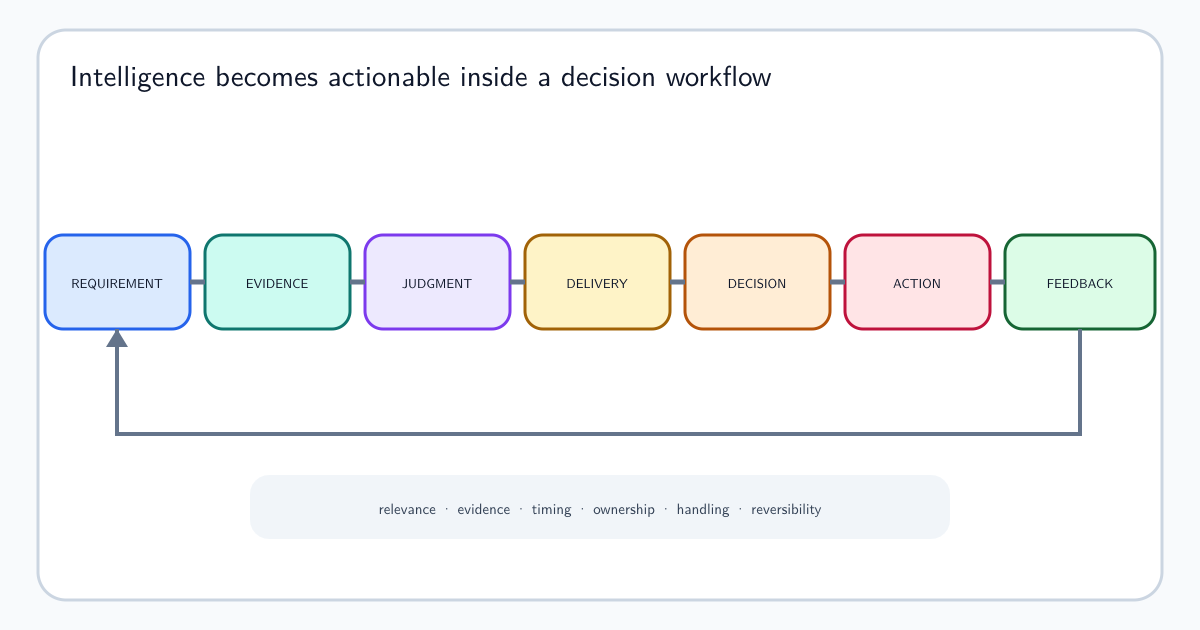
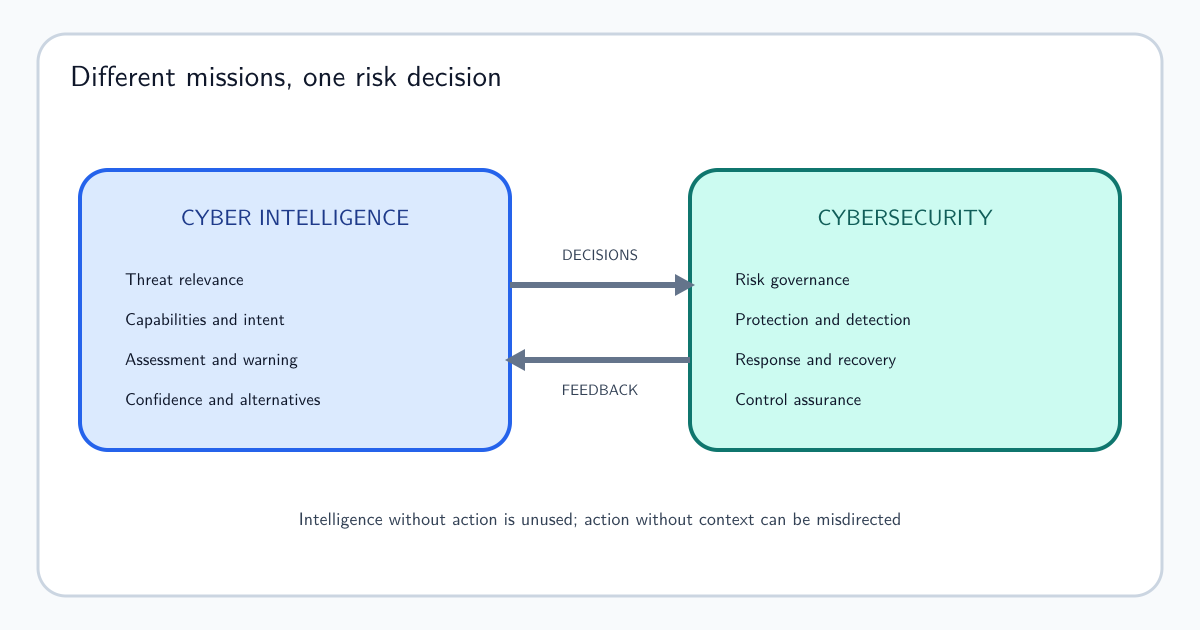
CTI creates value through relationships and workflows, not by publishing from a distance. Use the actionable threat intelligence framework to connect each requirement and assessment to a named decision, delivery point, owner, response, and feedback signal. The guide to cyber intelligence vs cybersecurity provides a practical boundary for assessment ownership, control ownership, operational handoffs, and feedback.
SOC and incident response: define enrichment and escalation paths, shared case records, priority intelligence updates, evidence feedback, and post-incident learning.
Detection engineering and threat hunting: maintain a pipeline from relevant behavior to hypotheses, telemetry, analytics, tests, coverage, and results. The guide to Indicators of Compromise and TTPs provides the detailed workflow.
Vulnerability and exposure management: combine exploitation evidence and actor interest with inventory, reachability, controls, criticality, and remediation constraints.
Identity, cloud, architecture, and engineering: share emerging access patterns, control-plane behavior, abused trust, and design implications before implementation choices are fixed.
Risk, business continuity, and leadership: agree on scenarios, impact language, warning thresholds, briefing cadence, and how intelligence enters risk decisions.
Third-party, procurement, and legal: define supplier collection, incident notification, evidence access, sharing, contractual requirements, and public-attribution coordination.
Assign relationship owners and recurring forums. Embedded CTI liaisons can improve understanding, but they should remain connected to common analytic standards and shared knowledge. Integration is successful when intelligence appears inside the consumer’s decision process—not only in a separate portal.
Build the Source Portfolio After Requirements Are Clear
Sources should fill documented requirement gaps. Balance:
- internal telemetry, incidents, assets, identities, vulnerabilities, suppliers, and business context;
- public and government reporting;
- sector and trusted-sharing communities;
- commercial finished intelligence and data;
- technical infrastructure, malware, code, and vulnerability sources;
- regional, linguistic, geopolitical, and specialist expertise;
- carefully governed criminal-ecosystem collection where justified.
Evaluate sources for requirement coverage, unique access, timeliness, provenance, reliability, claim quality, overlap, restrictions, integration, processing burden, decision contribution, and total cost.
Separate acquisition from adoption. Run a time-bounded evaluation with real requirements and users. Determine whether the source changes answers or merely adds records. Confirm licensing, redistribution, retention, data protection, support, availability, export, and exit terms.
The detailed source-selection, provenance, corroboration, and responsible-collection framework is in Cyber Threat Intelligence Sources.
Choose Technology to Support the Operating Model
Start with capabilities, integration, and ownership—not category labels.
A CTI technology stack may need to support:
- requirements, tasks, cases, approvals, and feedback;
- source ingestion, normalization, deduplication, enrichment, and scoring;
- entities, relationships, timelines, sightings, confidence, and provenance;
- structured intelligence exchange;
- search, graph analysis, notebooks, queries, and automation;
- indicator lifecycle and downstream distribution;
- documents, review, publishing, briefing, and audience delivery;
- access control, markings, audit, retention, backup, and export;
- integrations with SIEM, EDR, SOAR, vulnerability, identity, cloud, ticketing, and collaboration systems;
- operational monitoring and data-quality alerts.
A TIP can centralize structured entities, indicators, relationships, sources, and sharing. A case platform can coordinate investigations. Data warehouses and notebooks support analysis at scale. Knowledge systems preserve finished assessments and methods. No single product necessarily performs all functions well.
Before purchase, test real workflows: trace an indicator to its source, merge and split entities, revoke a bad record downstream, enforce sharing restrictions, connect a requirement to a product, export data, measure source overlap, and recover from an integration failure.
Account for total ownership: engineering, administration, data modeling, source integration, analyst training, content migration, monitoring, support, and exit. Unowned automation becomes silent failure.
Establish Governance Before Sensitive Work Becomes Routine
Governance protects sources, subjects, analysts, consumers, and the organization.
Define policies and ownership for:
- lawful purpose, collection authority, and minimization;
- personal, victim, leaked, credential, health, financial, and illicit data;
- criminal-source access, interaction, transactions, and escalation;
- source protection and operational security;
- classifications, traffic-light or handling markings, and redistribution;
- licensing, copyright, platform terms, and vendor restrictions;
- retention, deletion, correction, and subject rights where applicable;
- access control, privileged administration, audit, and monitoring;
- analyst safety and exposure to disturbing material;
- attribution thresholds and public communications;
- law-enforcement, legal, privacy, safeguarding, and crisis escalation;
- quality review, dissent, conflicts of interest, and corrections.
Create decision rights. Analysts can assess; risk owners decide acceptance or treatment; legal functions interpret legal obligations; communications owns public messaging; executives authorize high-consequence positions. CTI informs these functions without silently assuming their authority.
Review governance against actual workflows. A policy that says “handle sensitive data appropriately” is not enough. Analysts need approved tools, concrete examples, prohibited actions, stop conditions, contacts, and response times.
Measure Activity, Quality, Outcomes, and Program Health
A balanced measurement system answers four different questions.
Activity: Are we delivering the agreed service? Track request volume, priority, backlog, response time, product cadence, collection tasks, and service-level performance. Activity shows capacity and demand, not value by itself.
Quality: Can consumers trust the work? Track review findings, source and provenance completeness, corrections, confidence calibration, analytic-standard compliance, data quality, and consumer comprehension.
Outcomes: What changed because of the intelligence? Track decisions informed, detections created or improved, hunts prioritized, incidents scoped faster, exposures remediated, supplier or investment decisions changed, and uncertainty reduced.
Health: Can the capability continue? Track requirement coverage, source concentration, collection gaps, integration failures, analyst workload, skill coverage, key-person dependencies, stakeholder engagement, automation reliability, and governance exceptions.
Define the causal claim carefully. CTI may contribute to a detection that contributes to earlier response; it should not claim sole credit for preventing an incident. Capture short decision stories alongside metrics: the requirement, judgment, decision, action, and outcome.
Avoid measures that reward harmful behavior. Counting reports encourages volume. Counting indicators encourages low-context ingestion. Measuring only speed encourages shallow analysis. Pair timeliness with priority, quality, and usefulness.
Choose an In-House, Outsourced, or Hybrid Operating Model
Few organizations build every CTI capability internally. The right model depends on which knowledge must remain close to the organization and which capabilities benefit from external scale or specialization.
Keep requirement ownership and internal relevance in-house. The organization must decide which questions matter, connect intelligence to assets and business plans, own risk decisions, govern sensitive data, and evaluate outcomes. A provider cannot infer these responsibilities from external threat data alone.
Build internally when the capability is differentiating or context-heavy. Deep integration with incidents, detections, identity, architecture, fraud, executive decisions, or sensitive business strategy usually benefits from trusted internal relationships and direct evidence access.
Use external providers for scale, continuity, data, or specialist access. Examples include 24/7 monitoring, language and regional expertise, malware analysis, infrastructure datasets, criminal-ecosystem coverage, surge support, platform operations, or independent review.
Use a hybrid model deliberately. Define which party owns requirements, collection, analysis, review, dissemination, escalation, records, source restrictions, corrections, and feedback. Require providers to show provenance, uncertainty, scope, service levels, and how their output integrates with internal workflows.
Evaluate providers with realistic scenarios rather than polished demonstrations. Test whether they can answer one of your priority requirements, handle an urgent correction, preserve source restrictions, explain confidence, export your data, and cooperate during an incident. Check subcontractors, data location, resilience, access controls, audit, licensing, retention, and termination support.
Build the budget from the service model. Include people, on-call coverage, sources, communities, technology, integration engineering, cloud and storage, training, travel, legal and privacy support, provider services, assurance, and contingency. Compare cost with the decisions and exposures the capability addresses; do not justify the program by multiplying indicator volume by an invented value.
Maintain exit options. Preserve requirements, source records, analytic history, data models, detections, product templates, and stakeholder relationships in forms the organization can retain. Outsourcing delivery should not outsource institutional memory.
A Phased Roadmap for Building the Program
Phase 1 — Discover and align (weeks 1–6). Map stakeholders, decisions, existing work, sources, technology, governance, and gaps. Approve a mission, scope, sponsor, initial requirements, and success measures.
Phase 2 — Launch a minimum viable service (weeks 7–16). Choose two or three services with clear consumers. Document intake, collection, analysis, review, dissemination, and feedback. Use existing tools where possible. Establish a requirements register, source register, product templates, and governance baseline.
Phase 3 — Integrate and stabilize (months 4–9). Connect CTI to SOC, incident, detection, vulnerability, risk, and supplier workflows. Measure service health, resolve data and ownership gaps, automate repeatable processing, and develop review and training.
Phase 4 — Expand based on evidence (months 9–18). Add services, sources, specialist roles, languages, hours, or technology only where outcomes and gaps justify them. Improve strategic coverage and cross-functional planning.
Phase 5 — Optimize and assure (ongoing). Review requirement relevance, source contribution, analytic quality, metric behavior, technology resilience, governance, calibration, stakeholder trust, and program cost. Exercise urgent workflows and succession plans.
At each phase, define an exit condition. Do not scale a service that is not yet repeatable. Do not automate data whose meaning and ownership are unresolved. Do not add a source without a requirement and processing capacity.
Common Failure Modes and How to Correct Them
Feed-first design: the program measures ingestion rather than decisions. Correct it by establishing requirements and removing sources with no demonstrated contribution.
Report factory: analysts publish regularly, but products are detached from consumer timing and workflows. Correct it through service ownership, embedded feedback, and outcome tracking.
Attribution obsession: named actors receive attention while exploitable behaviors and exposure go unresolved. Require every attribution effort to state the decision it changes.
Tool as strategy: technology is purchased before data models, workflows, ownership, and governance exist. Pilot real use cases and assign operating ownership before expansion.
Everything is priority: urgent requests displace important work and analysts cannot plan. Use transparent requirement governance, intake, service levels, and escalation.
One heroic analyst: undocumented expertise and relationships create fragile capability. Establish peer review, shared records, training, backup, and succession.
No internal context: the team reports external threats without knowing assets, identities, dependencies, controls, or business plans. Build data and stakeholder integrations.
Vanity metrics: indicator, report, and alert counts imply scale but not value. Balance activity with quality, outcome, and health.
Governance after the fact: sensitive collection or sharing grows faster than policy. Pause unsupported workflows and establish authority, minimization, handling, and escalation.
The CTI Program Readiness Checklist
A program is ready to operate when it can answer yes to these questions:
- Is the mission tied to named consumers and decisions?
- Are scope, exclusions, ownership, sponsorship, and funding clear?
- Are priority requirements approved and reviewed?
- Does each service have an owner, workflow, standard, channel, and measure?
- Can collected evidence be traced to its source and permitted use?
- Are internal context and external reporting connected?
- Are analytic judgments reviewed proportionately to their consequence?
- Can consumers distinguish observations, assumptions, likelihood, and confidence?
- Do dissemination and correction reach all downstream users?
- Are sensitive collection, sharing, retention, and attribution governed?
- Are technology integrations monitored and recoverable?
- Is stakeholder feedback captured and used?
- Do metrics show activity, quality, outcomes, and health?
- Can the capability continue through staff absence, vendor failure, or urgent demand?
- Is there an evidence-based roadmap for the next capability gap?
The goal is not to build the largest CTI program. It is to build a trusted capability that answers the organization’s most important threat questions at the moment decisions are made. When requirements govern collection, evidence governs judgments, consumers shape services, and outcomes guide investment, the program can grow without losing its purpose.
For professionals who want to work inside that capability, Working in Cyber Threat Intelligence explains the roles and day-to-day reality, while How to Get Your First Cyber Threat Intelligence Job provides an entry roadmap.
Frequently asked questions
What is the first step in building a CTI program?
Start by identifying the decisions and recurring uncertainties CTI should support. Define consumers, requirements, existing capabilities, and success before buying tools or feeds. The mission should describe the value the program will create, not the information it will collect.
How large should a CTI team be?
Team size depends on mission, service scope, operating hours, languages, technical depth, stakeholder demand, and automation. A small team should deliberately limit services and requirements. It is better to deliver a few reliable services than promise global, continuous coverage without capacity.
Does every CTI program need a threat intelligence platform?
No. A TIP becomes valuable when the program has enough sources, entities, relationships, sharing, and automation to justify it. Requirements, provenance, case management, analysis, stakeholder delivery, and governance must still be designed. A platform supports an operating model; it does not create one.
Where should a CTI team sit in the organization?
CTI can sit in a SOC, incident response, security strategy, risk, fraud, or a central intelligence function. The best placement gives it access to evidence, authority to coordinate, and direct relationships with its priority consumers. Reporting lines matter less than integration and clear accountability.
What products should a CTI program provide?
Products should follow consumer decisions. Common services include alert enrichment, incident support, threat and campaign assessments, vulnerability intelligence, detection and hunting support, executive threat assessments, third-party intelligence, actor tracking, and warning. Not every program needs every service.
How should CTI program success be measured?
Combine activity measures such as timeliness, quality measures such as sourcing and correction, outcome measures such as decisions or detections improved, and health measures such as coverage, backlog, source performance, and stakeholder feedback. Report volume and indicator count alone do not demonstrate value.
Can Cyber Threat Intelligence be outsourced?
Collection, monitoring, analysis, tooling, and specialist research can be outsourced, but the organization must retain ownership of requirements, internal context, risk decisions, governance, and evaluation. Providers cannot determine relevance without access to the organization's assets, priorities, and consumers.
What does a mature CTI program look like?
A mature program has prioritized requirements, documented services, reliable evidence and provenance, repeatable analysis and review, tailored dissemination, stakeholder feedback, responsible governance, measured outcomes, resilient staffing, and a roadmap driven by gaps rather than technology trends.