Threat Intelligence vs Threat Hunting: Which Capability Solves Which Problem?
Decide whether a security problem needs threat intelligence, threat hunting, or both by comparing their questions, evidence, workflows, outputs, staffing, and measures of success.
Threat intelligence and threat hunting work best together, but they solve different problems. CTI asks what threats matter, how they operate, and what decisions the evidence supports. Hunting asks whether a specific behavior may be present in an environment despite not producing a reliable alert.
Confusing them creates gaps. A CTI team can describe an actor without proving activity exists internally. A hunting team can find suspicious behavior without understanding the wider campaign or who else may be exposed. This guide helps you decide which capability to use, how to hand work between them, and what a useful combined operating model looks like.
The Two Core Questions
CTI question: What do we know or assess about the threat, why is it relevant, and which decision should change?
Hunting question: If a defined adversary behavior occurred in this environment, what evidence would it leave, and can we find it?
CTI uses external and internal sources, incidents, victimology, infrastructure, malware, business context, and analytic reasoning. Hunting relies primarily on internal telemetry, environmental knowledge, query logic, baselines, and investigative follow-up.
Use CTI when uncertainty is about the threat or its relevance. Use hunting when uncertainty is about possible activity inside a searchable environment. Use both when external behavior is relevant but no reliable detection exists.
Choose CTI When You Need Context or Priority
CTI is the primary capability when you need to:
- assess which adversaries or campaigns are relevant;
- understand targeting, access, capability, intent, or likely next behavior;
- evaluate sources and competing explanations;
- connect external activity to assets, suppliers, identities, and business plans;
- prioritize vulnerability, detection, collection, or preparedness decisions;
- brief operational or business leaders.
CTI may recommend a hunt, but should not claim the activity exists internally until evidence supports it. The output should define the behavior, relevance, time window, confidence, variations, and collection gaps a hunter needs.
Choose Hunting When Existing Detections Cannot Answer the Question
Hunting is appropriate when:
- the behavior is relevant and observable but no dependable alert exists;
- an incident suggests related activity may remain undiscovered;
- a detection gap needs testing;
- a new data source or analytic idea needs exploration;
- a baseline deviation may reveal stealthy behavior;
- a control change creates a temporary visibility question.
A hunt is not routine alert triage. It begins with a falsifiable hypothesis, defines the data and time scope, documents query logic, investigates results, and records limitations. A search for all “suspicious activity” is not a hunt plan.
Design the Intelligence-to-Hunt Handoff
A CTI-driven hunt package should contain:
- the intelligence requirement and why the behavior matters;
- observed procedures, variants, sequence, and affected platforms;
- relevant actors or campaigns without making identity a prerequisite;
- timeframe, likely targets, and prerequisites;
- expected host, network, identity, cloud, or application evidence;
- known indicators as pivots, not the entire hypothesis;
- confidence, gaps, and alternative explanations;
- priority and decision expected from the result.
The hunter adds telemetry coverage, query method, baselines, exclusions, test evidence, and investigation steps. The IOC and TTP detection guide provides the technical translation method.
Interpret Positive and Negative Results Carefully
A positive match can be benign, malicious, or unresolved. Validate the event, user, asset, sequence, privilege, and surrounding behavior before assigning campaign or actor meaning.
A negative result means only that the hunt did not observe qualifying evidence within its scope. Record:
- systems and identities searched;
- telemetry presence and field quality;
- time range and retention;
- query sensitivity and tested variants;
- unsearched environments;
- whether the behavior should have been observable.
A well-documented negative hunt can reduce a hypothesis or reveal a data gap. It cannot prove an actor is absent from every system.
Close the Feedback Loop
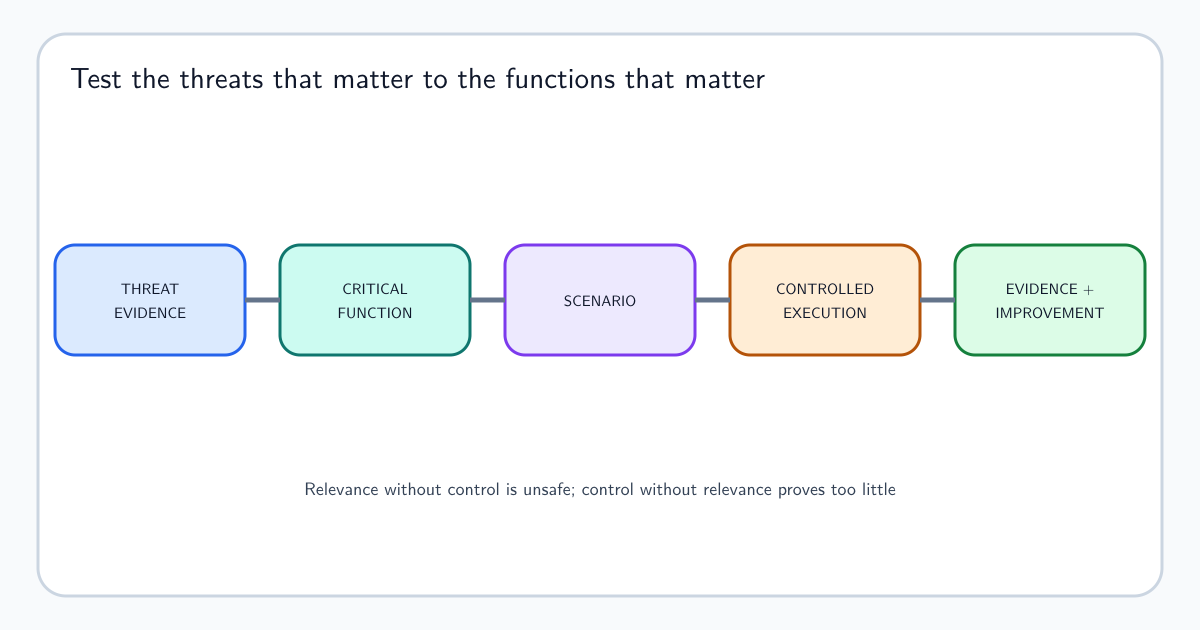
Hunting results should update CTI: sightings, procedure variations, false positives, affected assets, campaign links, and confidence. CTI should update hunts when adversaries change, sources correct reporting, or targeting relevance falls. Where the question requires a controlled end-to-end attack path rather than a search of existing telemetry, the intelligence-led security testing workflow shows how to turn relevant threats into authorized scenarios and defensible evidence.
Results should also enter detection engineering. A recurring, observable behavior with acceptable precision may become a maintained analytic. A behavior that cannot be observed may support a telemetry or architecture decision.
Keep one record connecting the original requirement, intelligence, hunt, findings, detection change, and outcome. This prevents teams from repeating the same search without learning.
Decide the Operating Model
Combine CTI and hunting in one team when scale is small and analysts have both source-analysis and telemetry skills. Separate them when specialist depth, data access, or workload requires it. In either model, define:
- shared priority and intake;
- handoff fields and service levels;
- access to intelligence and telemetry;
- detection and response ownership;
- feedback and review cadence;
- measures across the complete outcome.
The right design is the one that moves a relevant threat question into a testable search and then returns evidence to the assessment. For program-level ownership, use How to Build a CTI Program.
Frequently asked questions
Are threat intelligence and threat hunting the same job?
No. CTI produces knowledge about threats for decisions, while hunting proactively tests hypotheses in organizational telemetry. Some roles perform both, but the questions, evidence, and outputs remain distinct.
Does every threat hunt need external intelligence?
No. Hunts can begin from internal anomalies, incidents, control changes, or data science. External CTI is valuable when it supplies relevant adversary behavior, targeting, procedure variants, or warning.
Does a negative hunt prove the adversary is absent?
No. It shows that the tested hypothesis was not observed within the searched scope, time, telemetry, and query sensitivity. Coverage gaps or a different procedure can explain the result.
Should CTI and hunting be one team?
They may be combined or separate. The important design is a reliable feedback loop, shared priorities, accessible evidence, and clear ownership of analysis, telemetry, detection, and response.
How should a threat hunt be measured?
Measure hypotheses tested, relevant coverage, visibility gaps found, incidents or leads discovered, detections improved, time spent, and lessons returned to intelligence—not only the number of queries or matches.