Cybersecurity Risk in Everyday Life
Use assets, threats, vulnerabilities, likelihood, impact, and defense in depth to make practical everyday security decisions.
Start with what matters
Cybersecurity protects assets: accounts, devices, information, money, services, identity, reputation, and relationships. An asset matters because losing control of it would affect a person or organization. Primary email is often unusually important because it can reset other accounts; a family photo archive may be irreplaceable even when it has little financial value.
Name the consequence before choosing a tool. Confidentiality means information is seen only by authorized people. Integrity means information and decisions remain accurate and trustworthy. Availability means people can use a service or data when needed. A changed payment destination harms integrity, leaked health information harms confidentiality, and locked files harm availability. Many incidents affect all three.
Separate threat, vulnerability, and risk
A threat is something capable of causing harm: a criminal, dishonest insider, software failure, lost phone, fire, or simple mistake. A vulnerability is a weakness or exposure the threat can use, such as a reused password, missing update, excessive permission, public sharing link, or absent backup. Risk combines the plausible event with its likelihood and consequence.
These words guide different actions. You may not control whether phishing exists, but you can reduce vulnerable paths with independent verification and resistant authentication. You may not prevent every device failure, but you can limit impact with tested backups. Avoid treating every theoretical weakness as equally urgent. Give priority to credible paths affecting high-value assets, especially when recovery is difficult.
Compare likelihood and impact honestly
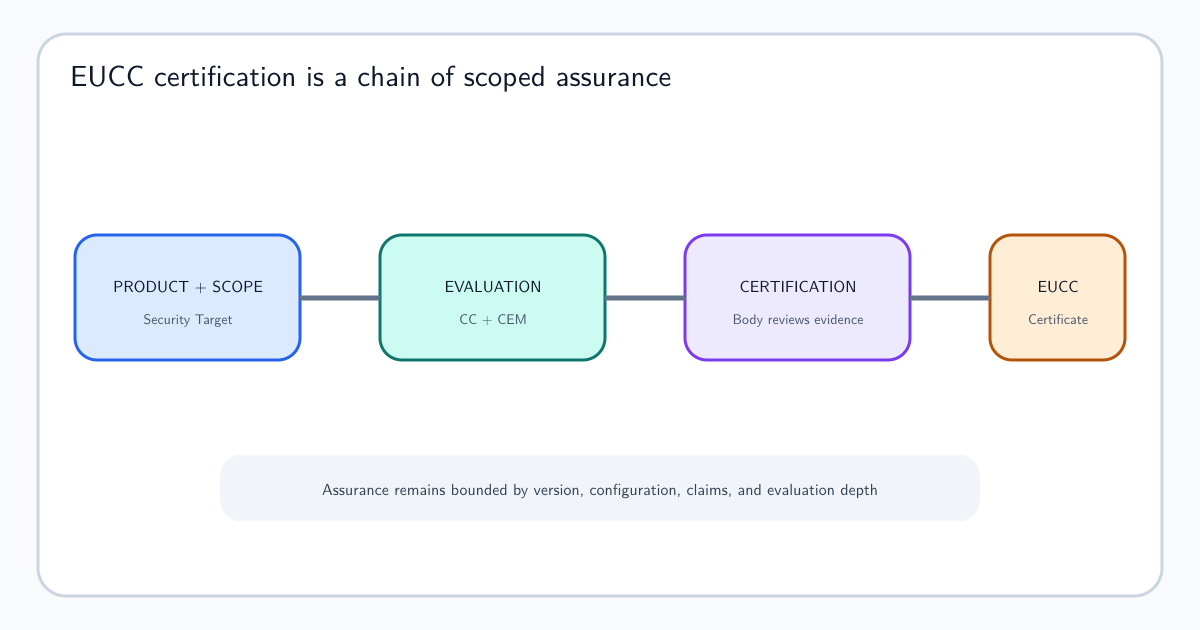
Likelihood asks how plausible the event is within a useful period, given exposure and existing controls. Impact asks what happens if it succeeds: money lost, sensitive data exposed, work interrupted, safety affected, or trust damaged. Both contain uncertainty. Use ranges and plain assumptions instead of inventing precise percentages without evidence. Independent assurance such as EUCC product certification can strengthen one input to the assessment, but its evaluated scope does not decide the likelihood or impact of your deployment.
A frequent nuisance with low consequence may deserve automation, while a rare event with catastrophic consequence may justify preparation and recovery capability. Personal circumstances matter: a journalist, administrator, public figure, or abuse survivor may face targeting that general advice does not capture. Review risk when assets, attackers, technology, or consequences change.
Use layers with different jobs
Defense in depth gives several chances to prevent, detect, limit, and recover from harm. An account might use a unique password, phishing-resistant MFA, sign-in alerts, limited sessions, recovery codes, and a reporting route. Each layer has a different job; repeating weak versions of the same control does not create independence.
Authentication and authorization protect different decisions, and backups do not prevent account takeover. Ask what happens when one control fails. Can suspicious activity be noticed? Can access be revoked? Can important data be restored? Can the user reach help through a trusted route? Prefer layers that are usable under pressure, because a safeguard routinely bypassed is weaker than its diagram suggests.
Turn risk into a small next action
A useful risk decision names the asset, plausible event, current safeguards, likely consequence, uncertainty, owner, and next action. “Cybercrime is increasing” is not actionable. “Primary email lacks a resistant second factor and controls password recovery for twelve important accounts” supports a clear improvement and verification step.
Begin with changes that reduce broad harm: protect primary email, remove password reuse, update exposed devices, verify high-impact requests, and test recovery. Record exceptions and revisit them. When an event occurs, use the incident response lifecycle rather than improvising unrelated fixes. Securing everyday devices and accounts is a continuing practice, not a one-time declaration that risk is gone.