Secrets Management for Development and CI/CD
Control credentials across source, build, deployment, and runtime with scoped identities, short lifetimes, safe injection, monitoring, and rehearsed rotation.
Inventory authority, not strings
A secret is any credential material that lets a workload or person exercise authority: API tokens, database passwords, private keys, certificates, webhook tokens, signing keys, and recovery credentials. The same-looking value can have radically different impact depending on its privileges, accepted environments, network reach, lifetime, and ability to create more credentials. Inventory those properties along with owner and purpose.
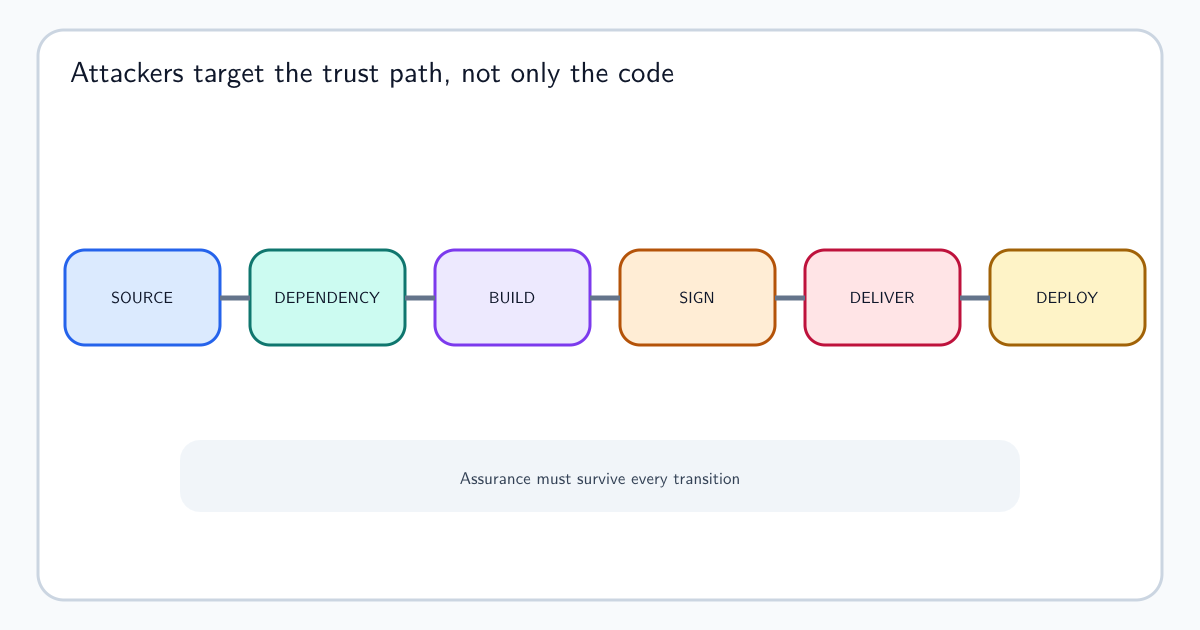
Source repositories, build definitions, container layers, package registries, test output, tickets, chat, and logs can all preserve a secret long after the obvious copy is removed. Encryption of a repository does not make embedded credentials safely distributable to every clone and fork. Prefer references to a controlled secret service or workload identity, and keep only non-sensitive identifiers and configuration in version control. Compromised pipeline credentials are one of several software supply chain attack paths that can turn legitimate delivery into downstream compromise.
Prefer short-lived workload identity
When platforms support federation, use authentication and authorization controls that let the job prove its workload identity and obtain a short-lived credential for one task. Bind trust to the repository, branch or protected environment, workflow, audience, and expected issuer. Limit the resulting role to the required resources and actions. This removes many static keys and makes each use more attributable.
Where a stored secret remains necessary, keep it in a dedicated manager, separate environments, restrict who and what can retrieve it, and inject it only at execution time. Do not pass secrets on command lines that process listings or logs may expose. Avoid one “big secret” shared across projects. Development credentials should not reach production, and pull requests from untrusted forks must not inherit deployment authority.
Prevent disclosure throughout the pipeline
Protect the build system as production infrastructure. Restrict changes to workflows and runners, pin or review third-party actions, isolate jobs with different trust levels, and prevent untrusted code from reading secret-bearing environments. Masking known values in logs helps, but transformations, fragments, debug output, artifacts, and error messages can bypass it. A redacted console is not proof that a credential never left the runner.
Scan source history, build output, images, packages, and collaboration systems, but treat scanners as discovery controls rather than containment. Test with synthetic values and confirm that forks, caches, artifacts, and failed jobs do not expose them. Connect build provenance and artifact signing to the identity that performed the build, while keeping signing authority isolated from arbitrary pull-request execution.
Make use observable and rotation routine
Log secret retrieval, policy changes, failed access, unusual source environments, and privileged effects without logging the secret itself. Useful records identify the workload, run, repository, environment, secret identifier, requested role, decision, and timestamp. Good telemetry quality lets responders distinguish a normal deployment from a copied credential used outside its expected context.
Rotation needs both a new credential and confirmed removal of the old one. Design applications for overlapping validity when necessary, test rollback, update consumers, verify successful use, revoke the predecessor, and search for late calls. Rotate on exposure or ownership change rather than relying only on a calendar. Very short-lived dynamic credentials reduce emergency rotation work because expiry provides an independent containment boundary.
Respond to a leaked secret as an access incident
Assume a published secret may have been collected immediately. Revoke or disable it first when safe, issue replacement authority through a trusted path, and identify every resource it could access or create. Removing the current file or rewriting repository history limits future discovery but does not invalidate copies. Search build logs, artifacts, mirrors, forks, package releases, and downstream deployments for additional exposure.
Review use from the earliest plausible disclosure time, including actions by credentials the leaked secret could mint. Preserve evidence and document scope, owner, revocation, dependent services, and validation. After recovery, replace the design that allowed the leak: static credential with workload federation, broad role with a scoped role, shared value with per-service identity, or silent use with monitored retrieval. Rehearse this path before the affected secret is a production signing key.