Software Supply Chain Attacks: Types, Examples, Prevention
Learn how software supply chain attacks compromise source, dependencies, builds, artifacts, and updates—and how producers and customers reduce the risk.
A software supply chain attack turns a trusted development or delivery relationship into an attack path. Instead of approaching every customer directly, an adversary compromises a component, maintainer, source repository, build service, package, artifact store, signing process, vendor, or update channel that many customers already trust.
That definition is broader than “malware hidden in an update” and narrower than every software vulnerability. The software supply chain includes the steps, people, services, credentials, dependencies, and evidence used to create, transform, assess, distribute, and deploy software. An attacker can manipulate any weak transition between those stages.
This guide answers the main search intents behind software supply chain attacks: what they are, how they differ from ordinary vulnerabilities, which attack vectors recur, how real examples map to those vectors, why the problem has grown, what producers and customers can prevent, and how to respond when trust in an update or component breaks.
Model the Supply Chain as a Series of Trust Transitions
Begin with the path from intent to execution: requirements, developer workstation, source control, code review, third-party dependencies, build orchestration, build workers, test systems, artifact repositories, signing, release approval, distribution, package resolution, deployment, and runtime. Each transition accepts an identity, input, or assertion from the previous stage.
A secure source repository does not compensate for a compromised build worker. A hardened build does not prevent a customer from downloading a look-alike package. A valid signature does not help if the attacker stole the authorized key. Map which system creates each artifact, which identity may change it, which evidence travels with it, and which policy decides that it can move forward.
NIST’s Secure Software Development Framework groups secure development around preparing the organization, protecting software, producing well-secured software, and responding to vulnerabilities. It is a risk-based practice framework rather than a promise that one tool makes a supply chain secure.
Types of Software Supply Chain Attacks
Source compromise changes code, configuration, tests, or release instructions through a stolen developer identity, malicious insider, unprotected branch, review bypass, or compromised source platform.
Dependency attacks introduce an adversarial component through account takeover, malicious maintainership, typosquatting, dependency confusion, namespace mistakes, compromised package publication, or an unsafe transitive dependency.
Build compromise changes what is produced without an authorized source change. An attacker may alter a build script, runner, compiler, plugin, environment variable, cached dependency, container image, or output after tests have completed.
Artifact and signing compromise replaces a release, abuses repository permissions, steals a signing key, or causes an authorized service to sign malicious output. A signature proves a statement about particular bytes; it does not prove every upstream decision was safe.
Distribution and update compromise redirects downloads, tampers with a repository or mirror, abuses update infrastructure, or publishes through a trusted vendor channel. Customer-side compromise then exploits permissive auto-update, weak verification, overprivileged installers, or inadequate deployment controls.
Read Examples as Control Failures, Not Brand Stories
High-profile incidents are useful when they reveal a reusable attack pattern. The SolarWinds compromise illustrated how malicious changes delivered through trusted vendor updates can reach many downstream environments. The Codecov incident illustrated risk in development tooling and credential exposure. Package-ecosystem incidents repeatedly show maintainer compromise, malicious releases, look-alike packages, and dependency-resolution abuse. SLSA cites SolarWinds and Codecov as examples of integrity weaknesses that its controls are designed to address.
Do not copy an incident’s surface indicators and assume the lesson transfers. Ask which stage was compromised, which identity or service was trusted, what evidence should have exposed the change, why the malicious artifact passed, what privilege it received downstream, and which control would have prevented or limited that exact path.
A useful scenario statement is specific: “An attacker who controls a CI credential can modify a release after review, publish it under the expected package name, and reach production because deployment verifies neither provenance nor an independent approval.” That can be tested. “Prevent the next SolarWinds” cannot.
Why Software Supply Chain Attacks Keep Attracting Adversaries
Modern software reuses large dependency graphs, automated build services, short-lived infrastructure, package registries, plugins, containers, external actions, and continuous delivery. This creates enormous productivity and a larger set of identities and services whose compromise can affect many outputs.
The economic advantage is asymmetry. One maintainer account, build platform, or update channel may provide access to hundreds or thousands of consumers. Trust also helps malicious artifacts pass network and application controls because the traffic, signer, domain, or deployment path is expected.
Growth in reporting does not mean every vulnerable library is an advanced supply chain operation. Separate accidental defects, exploitation of known vulnerabilities, malicious packages, compromised upstream production, and customer misconfiguration. The distinction determines ownership, detection, response, and investment.
Prevention for Software Producers
Protect developer and automation identities with phishing-resistant authentication where possible, short-lived credentials, narrowly scoped tokens, separation of duties, reviewed emergency access, and rapid revocation. Keep secrets out of repositories and build logs; the secrets-management guide covers the lifecycle from issuance through rotation.
Require protected branches, independent review for sensitive changes, verified commit and release workflows where appropriate, and explicit ownership of build and release definitions. Isolate builds, start from declared inputs, pin or constrain dependencies, restrict network access, keep runners ephemeral where feasible, and separate build from signing authority.
Generate tamper-evident provenance and verify it before promotion. SLSA provides incrementally adoptable levels for artifact integrity and build assurance. Use artifact signing and provenance as evidence in a policy decision—not as decorative metadata.
Maintain a vulnerability-disclosure and incident process, secure release recovery, key rotation, reproducible customer notification, and the ability to identify exactly which artifacts came from a suspect build.
Control Dependencies Without Pretending You Can Eliminate Them
Define approved registries and namespace rules, lock or constrain resolved versions according to ecosystem needs, verify integrity metadata, review new and high-risk dependencies, monitor maintainer and ownership changes, and remove unused packages. Treat install scripts, build plugins, CI actions, containers, and development tools as executable dependencies too.
Maintain a current inventory that connects component versions to deployed products. An SBOM supports transparency, vulnerability response, license analysis, and customer communication, but it must be generated at the right stage, validated, updated, and tied to actual artifacts.
Evaluate dependency behavior and governance as well as popularity. A package can be widely used and still have fragile maintainership, broad privileges, an unsafe release process, or an account-recovery path that defeats stronger controls elsewhere.
Prevention for Software Customers
Inventory software, versions, deployment locations, business owners, privileges, network paths, update mechanisms, and critical dependencies. Establish approved acquisition sources and verify publisher identity, signatures, hashes, provenance, or repository metadata according to the product and risk.
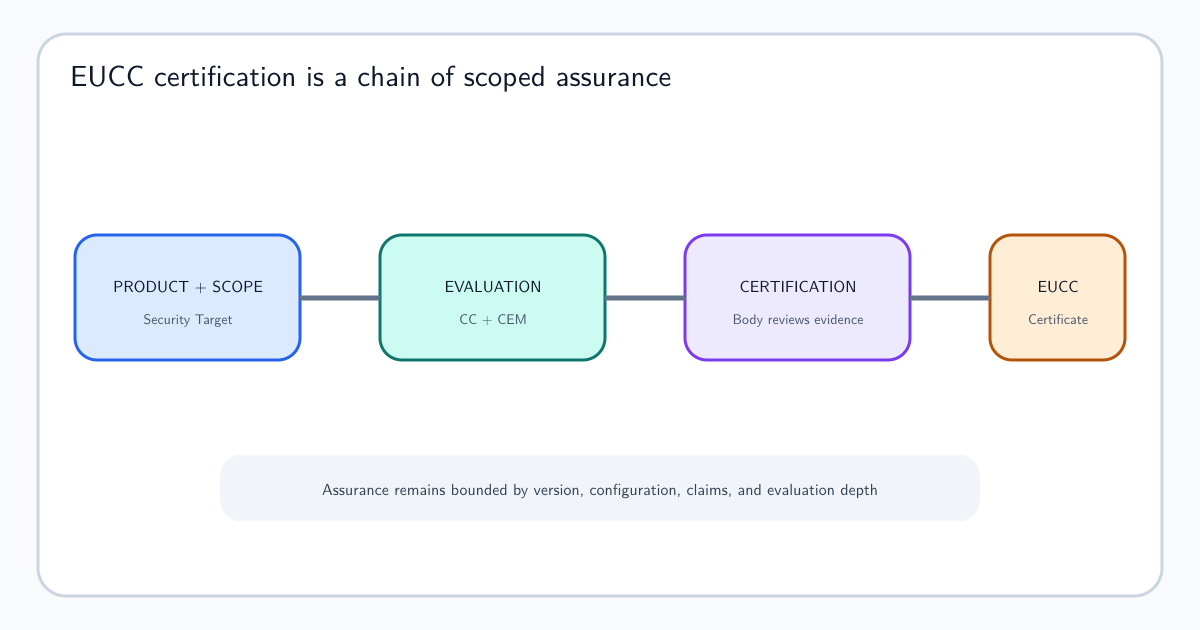
Ask suppliers for evidence tied to decisions: secure-development practices, vulnerability handling, component transparency, build provenance, signing and key protection, support periods, incident notification, and recovery capability. NIST’s SSDF gives producers and acquirers a common vocabulary; it should inform risk-based questions rather than become an undifferentiated questionnaire. For qualifying ICT products, EUCC certification can add independently evaluated evidence, but only for the product, version, configuration, claim, and assurance level named by the certificate.
Stage consequential updates, monitor behavior, preserve rollback, restrict software privileges and egress, segment high-impact systems, and maintain alternative operations for critical services. Automatic updates reduce exposure to ordinary vulnerabilities but also concentrate trust in the update channel; choose controls that preserve timely patching while limiting blast radius.
Detect Changes in the Chain and Effects in the Environment
Monitor source and branch-policy changes, new maintainers, token creation, unusual package publication, workflow modification, build-worker drift, unexpected network access, artifact hash changes, signing events, repository permission changes, and provenance verification failures. Baseline who normally releases what, from which workflow, and at what cadence.
Consumer detection should not depend solely on upstream admission. Monitor new services, scheduled tasks, identity use, process trees, outbound connections, altered security tools, and cross-system activity after software installation or update. Preserve installer, artifact, version, signature, provenance, deployment, and execution evidence so response can connect runtime behavior to the supply chain event.
A clean malware scan does not prove an artifact is authorized, and an authorized signature does not prove its behavior is benign. Combine integrity, identity, policy, and runtime evidence.
Respond When the Trusted Path Becomes Untrusted
Establish the affected products, versions, hashes, build runs, signing identities, repositories, deployment groups, and time window. Validate the supplier notice through a trusted channel. Pause suspect releases or constrain execution without destroying evidence, then determine whether the incident is upstream tampering, a vulnerable component, stolen credentials, or a false alarm.
Hunt for both installation and post-installation behavior. Rotate secrets the compromised software or pipeline could access, not every credential indiscriminately. Block confirmed malicious infrastructure, revoke affected identities, isolate build systems when necessary, and verify clean replacement artifacts through an independent recovery path.
Customers need a decision log: where affected software exists, what it could reach, which evidence was checked, what compensating controls apply, who accepts residual risk, and when the decision will be reviewed. Producers need a transparent, version-specific notice and a way for customers to validate remediation.
Practical Software Supply Chain Security Checklist
Map the end-to-end chain and its owners. Protect human and machine identities. Review sensitive source changes. Declare and verify inputs. Harden and isolate builds. Separate signing authority. Generate provenance. Secure artifact storage and distribution. Verify before deployment. Inventory components and installations. Monitor release and runtime behavior. Practice compromise recovery.
Measure coverage instead of counting tools: percentage of releases from approved workflows, artifacts with verified provenance, critical dependencies with owners, build identities using short-lived credentials, production deployments tied to reviewed artifacts, and time required to identify every installation of a suspect version.
The goal is not a chain with no dependencies or automation. It is a chain in which unauthorized change is difficult, evidence of each transition survives, customers can verify what they receive, and both producer and consumer can contain failure without guessing.
Frequently asked questions
What is a software supply chain attack?
A software supply chain attack compromises or abuses a step used to create, transform, depend on, build, sign, distribute, update, or operate software so the attacker can reach downstream users or systems through trusted delivery paths.
Is a vulnerable open-source dependency a supply chain attack?
Not by itself. An unintentionally vulnerable component creates supply chain risk, but an attack involves adversarial action such as publishing a malicious package, compromising a maintainer, tampering with source or builds, substituting an artifact, or exploiting the vulnerable dependency through the delivery chain.
Does an SBOM prevent software supply chain attacks?
No. An SBOM improves component transparency and incident scoping, but it does not prove that source was trustworthy, a build was isolated, dependencies were resolved safely, an artifact was untampered, or deployment was authorized. It is one control and evidence source.
Does code signing prove software is safe?
No. A valid signature can establish which identity signed particular bytes and whether they changed afterward. It cannot prove that the source, build process, signer, or signing decision was trustworthy. Compromised signing credentials can authorize malicious artifacts.
What is SLSA?
Supply-chain Levels for Software Artifacts is an incrementally adoptable specification for improving artifact integrity. Its build track uses provenance and increasingly hardened build controls to provide stronger assurance about how an artifact was produced.
What should customers do after a supplier reports a supply chain compromise?
Identify affected products and versions, verify the supplier notice, preserve relevant evidence, stop or constrain risky deployment and update paths, look for exposure and compromise, apply the vendor or incident guidance, rotate affected secrets, validate clean replacements, and track business dependencies until risk is resolved.