Detection Validation With Simulations and Known-Good Data
Test telemetry, logic, enrichment, alert delivery, and analyst outcomes with safe, repeatable malicious and benign scenarios.
Define what success means before executing
A rule compiling or an alert appearing once is not sufficient validation. Write a test contract that states the behavior, prerequisites, authorized scope, expected raw events, fields and timestamps, analytic result, alert routing, enrichment, severity, and analyst disposition. Include a cleanup and rollback plan. This connects the test to the detection engineering lifecycle rather than treating simulation as a separate performance.
Decide whether the objective is sensor visibility, query correctness, end-to-end alerting, prevention, correlation, or response automation. These are different experiments. A blocked action may prove prevention while hiding downstream detection coverage; disabling protection may expose telemetry but increase test risk. Record the configuration so the result can be interpreted and repeated.
Use the smallest safe simulation that answers the question
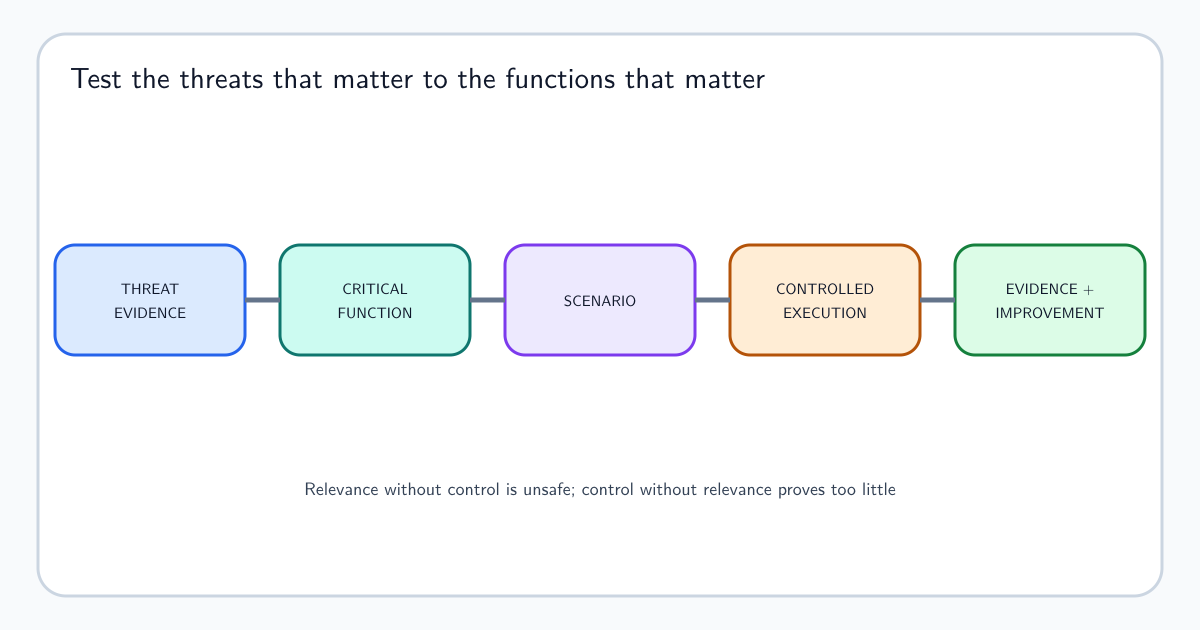
Start with synthetic events or query fixtures for logic, then controlled technique tests for collection and correlation, and only then broader adversary emulation for sequences and analyst workflow. Run under written authorization, named ownership, bounded targets, agreed timing, safe payloads, resource limits, and an emergency stop. Production testing can reveal real integration problems but requires proportionate change control and business awareness. For end-to-end exercises shaped by current threat evidence, use the broader intelligence-led security testing workflow.
Model behavior rather than copying dangerous tooling unnecessarily. An emulation should create the observable action required by the hypothesis without introducing persistence, uncontrolled propagation, real data theft, or destructive impact. Ransomware response exercises should test decisions with safe artifacts rather than real destructive code. Label test accounts and infrastructure in a way defenders can reconstruct afterward without making the detection depend on the label. Preserve commands, parameters, execution times, host state, and operator notes.
Test benign behavior as deliberately as malicious behavior
Positive tests show that expected hostile behavior can be found. Negative tests show whether legitimate administration, software deployment, troubleshooting, or user activity triggers the same logic. Build known-good examples near the decision boundary, not only obviously unrelated traffic. Include variants across operating systems, command forms, accounts, regions, and expected volumes when those dimensions affect the analytic.
Measure which evidence supported the outcome. A low alert count can reflect precise logic, missing data, broken routing, or an inactive environment. Validate telemetry quality and blind spots before interpreting silence as success. When a benign test alerts, decide whether context can safely distinguish it, whether an allowlist has a narrow owner and expiry, or whether analysts need the alert despite expected noise.
Diagnose the failed stage instead of tuning blindly
If the alert is absent, trace the expected path: did the action occur, did the sensor record it, did transport deliver it, did parsing preserve the fields, did the query evaluate the right window, did suppression remove it, and did the case reach the analyst? If the alert is present but unusable, inspect enrichment, entity resolution, severity, runbook, and available pivots. Each failure belongs to an owner.
Save the raw and normalized evidence with the test result. This prevents a later configuration change from rewriting history and lets engineers compare environments. Alert triage should receive enough context to form and test a hypothesis, not merely a technique label. Correct the narrowest failed stage, rerun the same test, and add it to regression coverage.
Turn validation into continuous assurance
Maintain versioned tests alongside detection logic. Run safe fixtures on every logic change, schedule bounded integration tests, and repeat higher-impact scenarios after meaningful telemetry, platform, or threat changes. Track last successful validation, environment, test version, evidence produced, benign cases, known gaps, and owner. An old green result does not prove current coverage after agents, schemas, routes, or permissions change.
Report outcomes as coverage and evidence, not a single percentage detached from scope. Document techniques that were not attempted, actions blocked before later stages, visibility without an alert, and alerts without sufficient context. Share results across detection, intelligence, engineering, and response teams. The goal is a reliable path from adversary behavior to a defensible decision—not an impressive demonstration that cannot be reproduced.