Signal, Analytic, Alert, Incident, and Response Are Not Synonyms
Keep signal, analytic, alert, incident, and response distinct so evidence can move through the detection service without conclusions becoming stronger by accident.
A signal is an observation before a security conclusion
A signal is an observable fact or derived feature that may bear on a security question. A login record, a process relationship, an unusual token audience, or a change in connection timing can be a signal. It is not automatically malicious and need not become an alert.
Signals have provenance, scope, and measurement limits. A missing record can reflect absence, collection failure, filtering, or delay. A derived score is still a signal, but its derivation must remain visible.
Calling every signal a detection collapses evidence and interpretation. Preserve the source fact first, because later reviewers need to distinguish what the environment recorded from what the detection service concluded.
An analytic turns evidence into a bounded judgment
An analytic is logic that evaluates one or more signals against a stated security hypothesis. It may filter, aggregate, correlate, score, or compare behavior with a baseline. Its result can include a match, confidence, supporting evidence, and reason.
The analytic does not discover truth in the abstract. It implements assumptions about field meaning, time, entities, thresholds, and missing data. Those assumptions define where its judgment is valid.
Keep the analytic result even when no alert follows. Suppression, risk accumulation, or routing policy may act later. Separating evaluation from notification allows you to inspect whether the logic worked without confusing that question with whether someone was interrupted.
An alert is a request for attention
An alert is a notification that an analytic result, accumulated risk, or policy condition deserves consumer attention. It is a workflow object, not proof of compromise. Its threshold reflects scarce analyst time and the cost of delay as well as technical suspicion.
An alert should explain what changed, which evidence supports it, who or what is affected, why the condition matters, and what remains uncertain. Routing, severity, deduplication, and suppression belong to alert policy.
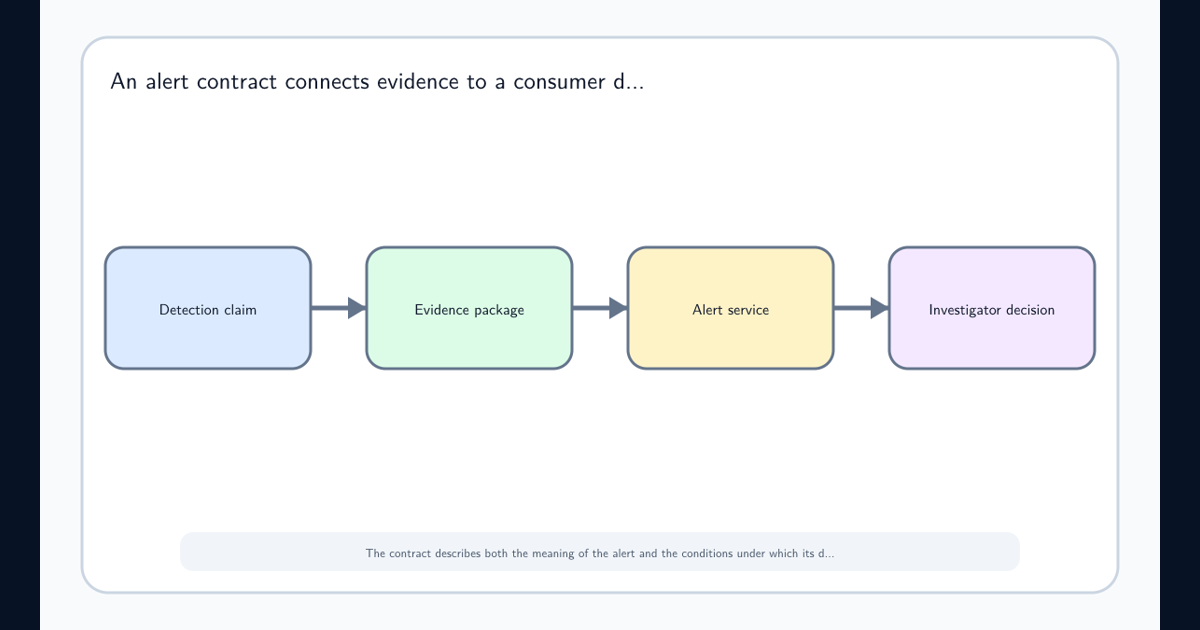
The alert contract makes this handoff explicit. Without it, analysts must reconstruct the analytic’s reasoning before they can evaluate the event.
An incident groups evidence around a managed security problem
An incident is a managed representation of a security problem that may contain several alerts, observations, entities, hypotheses, and investigative decisions. Grouping should follow a defensible relationship such as shared identity, campaign, asset, causal sequence, or response scope.
An incident can begin from an alert, threat intelligence, a user report, or proactive analysis. That is why alert and incident are not interchangeable. Several alerts may describe one incident, and one alert may be closed without an incident.
Record why items were joined and permit the grouping to change as evidence develops. Early association is an assessment. Treating it as immutable fact can make unrelated activity appear coordinated.
A response is an authorized change to risk or state
A response is an authorized action intended to reduce risk, preserve evidence, contain activity, recover service, or communicate a decision. Disabling an account, isolating a host, preserving logs, and notifying an owner are different responses with different consequences.
Automation does not erase the distinction. An alert may trigger a preauthorized response, but the action still needs scope, conditions, rollback, ownership, and auditability. The analytic supplies evidence; policy supplies authority.
Keep the chain legible: observed facts became an analytic result, policy requested attention, investigation formed an incident assessment, and authorized people or systems acted. That vocabulary prevents a technical match from silently becoming a claim of compromise or permission to disrupt a user.
Frequently asked questions
Why does detection engineering need separate names for signal, analytic, alert, incident, and response?
Each term marks a different transformation and decision. Keeping them separate shows what was observed, what logic inferred, what crossed a notification threshold, what was grouped as an incident, and what action was authorized.