Safe Validation and Response in Cyber-Physical Systems
Build confidence in OT detections through progressively stronger, process-approved evidence while keeping validation and response from creating the physical harm they are meant to prevent.
Validation tests a claim, not courage
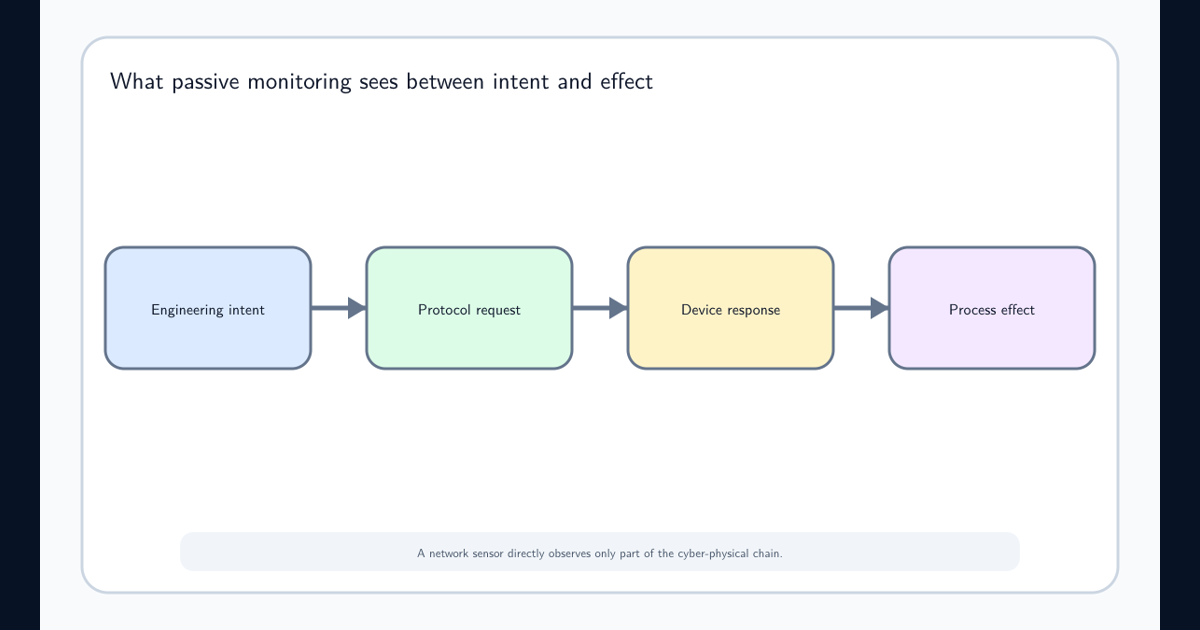
An analytic can match a prepared protocol record while the production sensor misses the traffic. A live controller action can produce telemetry while alert delivery fails. Validation should identify which link is being tested instead of treating realism as a single scale.
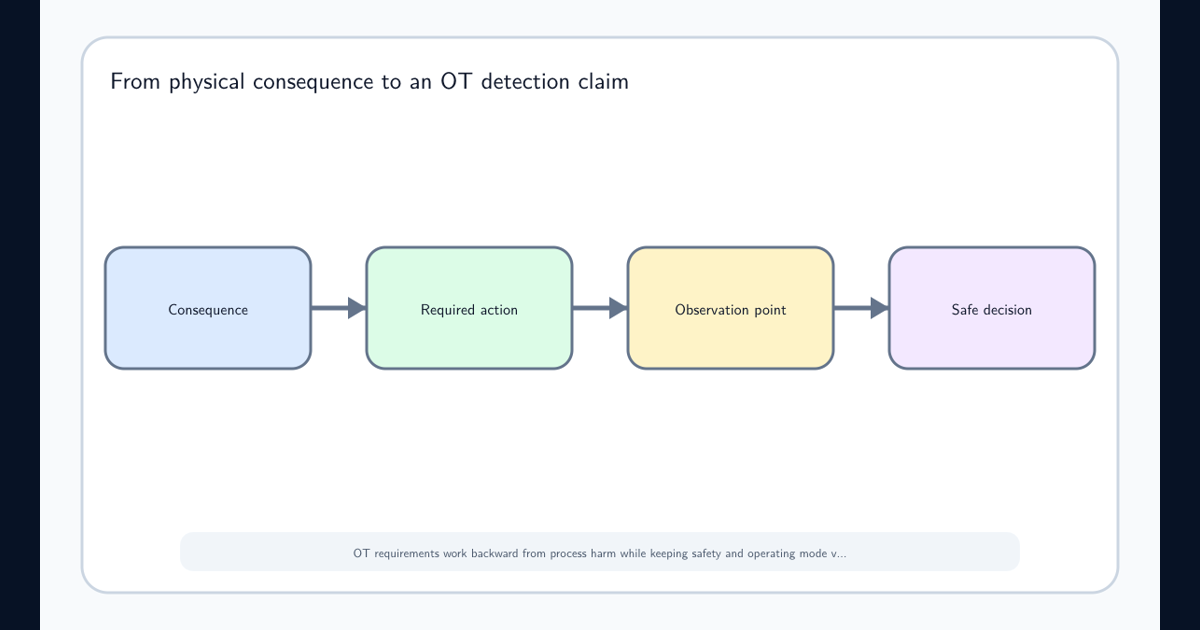
Decompose the OT detection requirements: behavior and process condition, observation point, protocol interpretation, asset and mode context, pipeline, analytic, delivery, consumer evidence, and safe response. Each part can fail independently.
The process owner determines which behavior is permissible. Detection engineers do not gain authority to manipulate equipment merely because an end-to-end test would be informative. The objective is justified confidence with controlled risk.
Match the method to the assumption
A schema fixture tests field expectations and logic edges. Replay tests parsing, normalization, backend behavior, and perhaps alert routing, but it can bypass the sensor. Synthetic telemetry tests controlled pipeline inputs. A simulator can exercise protocol and process relationships within the limits of its fidelity.
An approved maintenance activity can provide production observation without inventing a dangerous operation. Historical incident or change evidence can support retrospective validation if its completeness and versions are known. No method proves assumptions it bypasses.
Record what was introduced, which real components participated, what was simulated, expected and actual observations, equipment and software versions, process mode, approvals, and cleanup. “End-to-end” should name its endpoints.
Use progression and stop conditions
Begin with the least consequential method that can answer the question. Advance only when the remaining uncertainty justifies additional process exposure and the responsible owner approves it. A failed lower-layer test is a reason to stop, not to proceed to a more realistic scenario.
Define abort conditions before any operational observation: unexpected device state, alarm, communication loss, safety-system involvement, unplanned target, telemetry overload, or loss of an authorized supervisor. Define who can stop and how the process returns to a known condition.
Cleanup is evidence. Confirm temporary accounts, routes, projects, test markers, and alerts are removed or dispositioned. An unfinished validation artifact can become a later hazard or false signal.
Interpret passing and failing results narrowly
A successful replay establishes that known records exercised selected pipeline and logic. It does not establish live capture. An observed maintenance write establishes that one approved operation was visible under those conditions. It does not establish every device, mode, protocol path, or adversary variation.
A failure should locate the first divergence between expected and actual evidence. Do not lower a threshold or widen a window until you know whether observation, clock, parsing, identity, context, or delivery failed. Changing logic to make a test pass can quietly change the threat claim.
Preserve residual uncertainty with the result. Bounded confidence is useful; vague confidence is dangerous in a system where both missed attacks and unnecessary intervention carry consequence.
Validate the response path without surrendering safety
Response assurance can begin with notification, evidence preservation, owner contact, account restriction in a non-operational context, or a decision rehearsal. You can verify that the right people receive enough information without automatically issuing commands to equipment.
For each proposed action, consider process state, fail-safe behavior, dependencies, recovery, human authority, and the consequence of an incorrect assessment. A reversible account action can still cause irreversible physical effects if it interrupts the only engineer correcting a fault.
The final validation record should say what the alert can support: operator verification, engineering comparison, remote-access containment, or another bounded decision. Safe validation and safe response share the same rule—security evidence informs qualified operational judgment; it does not replace it.
Frequently asked questions
Must an OT detection be tested against live production equipment?
No. Different methods test different parts of the claim. Representative records, pipeline tests, simulations, approved maintenance observations, and carefully governed production evidence can build layered confidence without unsafe actions.