Alert Contracts and Investigation-Ready Evidence
Define the evidence, reasoning, context, ownership, and service behavior an alert must provide before asking an investigator to make a decision.
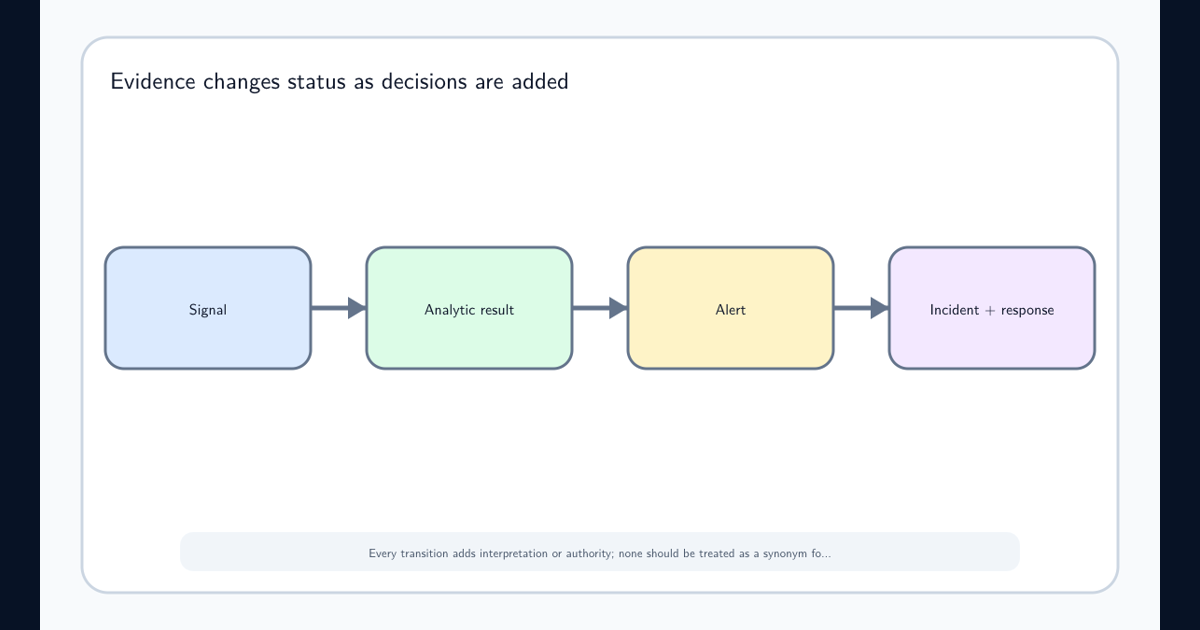
An alert is a handoff between two kinds of work
Detection engineering evaluates evidence at machine speed. Investigation interprets that result in organizational context. An alert contract states what the producer promises to provide and what the consumer can reasonably infer from it.
Begin with the decision the alert is meant to support. A credential-abuse alert may ask whether access should be contained, while a policy-drift alert may ask whether a change was authorized. The same event data can be insufficient for one decision and adequate for another.
Without a contract, the query becomes the de facto specification. Its hidden assumptions then reach the analyst as unexplained severity, opaque labels, and links that do not answer the actual question.
The evidence package should reconstruct the reason
The alert should identify the behavior observed, affected entities and their roles, source and event time, relevant sequence, matched analytic version, and the conditions that caused notification. Include the smallest useful raw evidence or stable references to it.
Context should reduce ambiguity rather than decorate the alert. Asset criticality, identity privilege, expected administration, and related observations matter only when their origin and freshness are known. An enrichment without provenance can be more misleading than no enrichment.
State missing or degraded dependencies. If entity resolution failed or a provider field was absent, expose that limit instead of silently substituting certainty.
Severity and confidence answer different questions
Severity expresses the potential consequence or response urgency if the assessment is correct. Confidence expresses how strongly the available evidence supports the assessment. A high-impact administrative change can have high severity and low confidence when authorization context is missing.
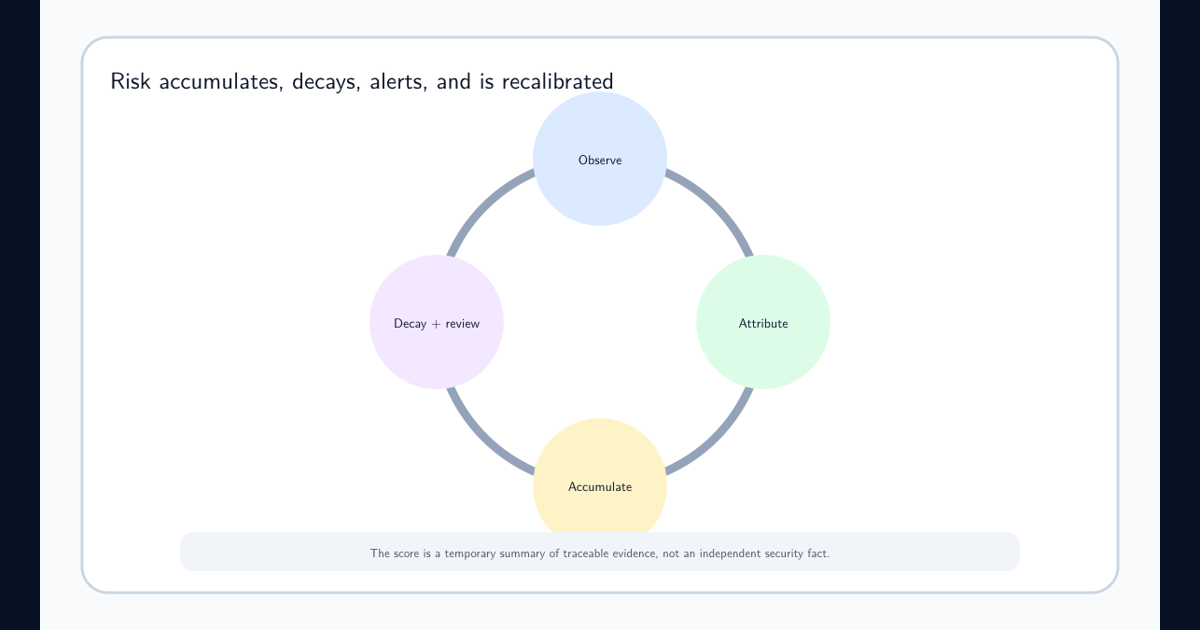
Define the scales and show their inputs. Do not let a single risk number conceal whether it rose because evidence became stronger, the asset became more critical, or policy became more urgent.
Use calibrated language. “Observed” should refer to recorded facts. “Likely” should mark an assessment supported by stated reasons. Alternative explanations and missing evidence belong beside the conclusion, not buried in implementation notes.
The contract also describes service behavior
Investigation readiness includes timing, grouping, update, and delivery semantics. State how often the analytic evaluates, how late evidence is handled, which fields define deduplication, whether an alert can be revised, and where acknowledgements are recorded.
Name the owner for analytic meaning and the owner for platform delivery. Define what happens when a required source, enrichment, or route is degraded. A stale but polished alert can be less useful than a prompt alert with explicit uncertainty.
Version the contract with the content. A change to grouping or severity can alter analyst workload and incident boundaries even when the underlying query stays the same.
Consumer feedback tests whether the contract works
Review dispositions, missing-context requests, duplicate handling, time to a defensible decision, escalations, and cases where the alert’s conclusion was misunderstood. These observations reveal whether the contract reduces uncertainty for its intended consumer.
Do not treat closure labels as ground truth without examining how they are defined and used. “Benign” may mean authorized, irrelevant, insufficient evidence, or simply not pursued. Feed precise failure reasons back into evidence, wording, grouping, and routing decisions.
Keep the vocabulary aligned with the signal and incident distinctions. The alert asks for attention; it does not, by itself, establish an incident or authorize a response.
Frequently asked questions
What is an alert contract?
It is an explicit agreement between detection producers and consumers describing why an alert exists, which evidence and context it carries, how it behaves operationally, who owns it, and what uncertainty the investigator should expect.