Command and Control in Cybersecurity: Detect and Respond
Learn how command-and-control channels work, which evidence reveals C2 activity, how to investigate it, and how to contain access without losing scope.
A compromised system becomes much more useful to an adversary when it can receive instructions and return results. That communication function is command and control, usually abbreviated C2 or C&C. A C2 channel can task discovery, credential theft, lateral movement, collection, tool transfer, sabotage, or exfiltration. It can also report that a host is alive without receiving an immediate command.
The visible network destination is not always the real controller. It may be a redirector, proxy, compromised device, cloud service, content platform, peer, or dead-drop location that tells malware where to connect next. Conversely, an unusual external connection is not automatically C2. Updaters, monitoring agents, backup clients, and business applications can produce the same superficial patterns.
This guide explains command-and-control servers, channels, infrastructure, encryption, telemetry, detection hypotheses, triage, containment, recovery, and measurement. The aim is to identify a supported control path and remove the adversary’s access—not to label traffic from one weak signal.
Separate the Controller, Infrastructure, Channel, and Session
Use precise terms because they lead to different defensive actions:
- A controller is the operator or system that originates tasks or receives results.
- C2 infrastructure is the set of domains, addresses, servers, redirectors, proxies, accounts, and services that support communication.
- A channel is the communication path and method, such as HTTPS, DNS, email, a cloud API, a custom protocol, or removable media.
- A beacon is a recurring check-in or status message; it may be regular, jittered, event-driven, or dormant for long periods.
- A session is a particular period of interactive or automated control.
- A command is an instruction; output, acknowledgements, task results, and transferred files are separate message functions.
The MITRE ATT&CK Command and Control tactic defines the adversary goal as communicating with systems under adversary control. ATT&CK organizes observed behaviors; it does not declare that any destination, product, or traffic pattern is inherently malicious.
Model the Full C2 Architecture
Start at the controlled entity and follow the path outward. Record the initiating process or account, local resolver, proxy, gateway, NAT mapping, tunnel, service, visible destination, redirector, and any next-stage infrastructure. Include internal C2 between a controller or pivot host and systems that cannot reach the internet directly.
Channels may be bidirectional, one-way, store-and-forward, peer-to-peer, or human-operated. An implant may poll for tasks, receive a push notification, read instructions from a public post, or watch a file share. Output can return through the same route, a separate route, or not at all. Fallback channels may activate only after the primary route fails.
Do not equate the first IP address with the adversary. Shared hosting, content delivery, VPNs, residential proxies, compromised routers, and legitimate platforms can separate the victim from the operator. Preserve every observed hop and state which relationship is direct, inferred, historical, or supplied by external intelligence.
Understand Common C2 Channels Without Building a Checklist
C2 can use ordinary application protocols, non-application protocols, removable media, or platform APIs. ATT&CK’s Application Layer Protocol technique includes web, file-transfer, mail, DNS, and publish/subscribe protocols. The defensive lesson is not to block every protocol; it is to ask whether the process, identity, destination, direction, content shape, and timing fit an approved use.
Web traffic provides broad egress and familiar request-response behavior. DNS can carry small queries and answers or help locate changing infrastructure. Email, messaging, repositories, document services, and other web services can carry instructions in legitimate platforms. SSH, RDP, SMB, tunnels, VPN protocols, raw sockets, and custom protocols can provide interactive or proxied control. In disconnected environments, files and removable media can create delayed tasking and result transfer.
Ports do not identify applications reliably. HTTPS can run outside 443, a custom encrypted protocol can run on 443, and DNS-like bytes can cross a nonstandard path. Prefer protocol validation, process association, destination policy, and behavioral context over port-only classification.
Expect Proxies, Web Services, and Dynamic Infrastructure
Adversaries can separate controlled systems from core infrastructure through redirectors, proxies, tunnels, compromised edge devices, anonymization networks, and multi-stage channels. They may use legitimate cloud or web services to blend with expected traffic or publish a dead-drop value that points to another destination.
Infrastructure can also change. ATT&CK’s Dynamic Resolution technique covers fast-flux DNS, domain-generation algorithms, and calculated DNS approaches. A channel may rotate domains or addresses, use dynamic DNS, or activate a fallback only when the primary route is unavailable.
This makes atomic blocking perishable. Retain domain, resolved address, resolver, TTL, certificate, hosting, account, service, and first/last-seen context. Identify the stable behavior that survives rotation: which process asks, how it resolves, how often it connects, which path it uses, what it sends, and what happens next.
Treat Encryption and Obfuscation as Conditions, Not Verdicts
Encryption can protect ordinary business traffic and adversary traffic alike. ATT&CK’s Encrypted Channel technique describes adversary use of cryptography to conceal C2 content, including channels that add their own encryption instead of relying only on the protocol. Obfuscation can add junk data, encoding, steganography, or protocol impersonation without providing cryptographic secrecy.
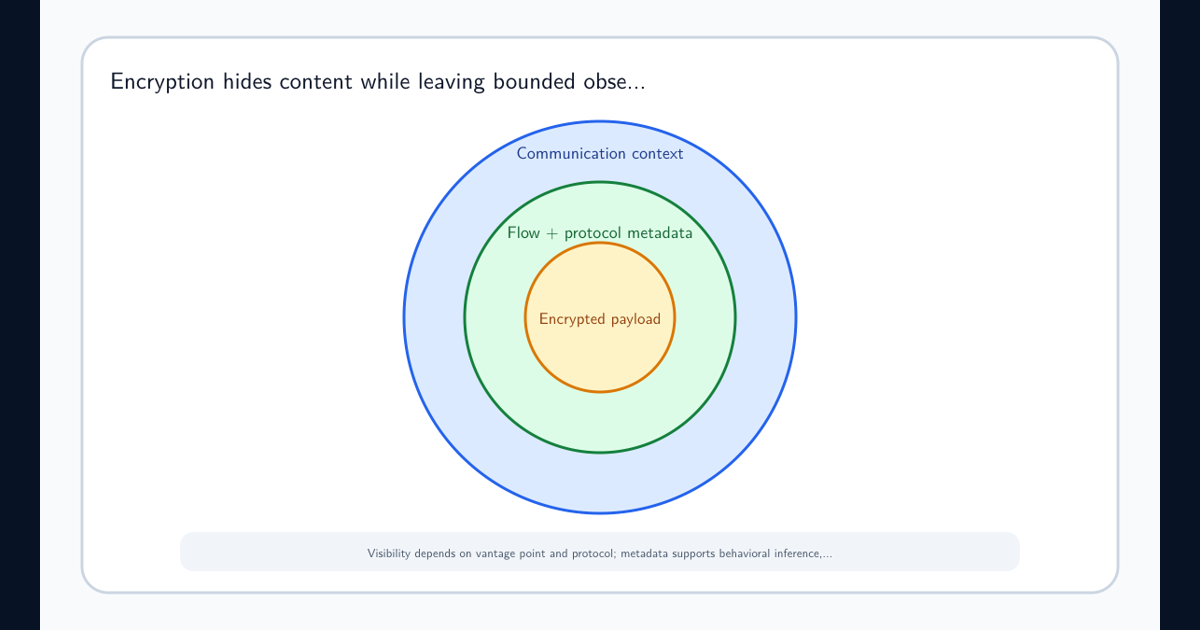
Even when content is unavailable, defenders may retain process identity, user, destination, DNS history, certificate properties, TLS handshake metadata, connection duration, direction, byte counts, intervals, routing, proxy decision, and endpoint effects. No single metadata field proves intent. Correlation can show that an unusual unsigned process created a persistent encrypted connection to a rare destination immediately after a suspicious file executed.
TLS inspection can expose content in some managed environments, but it has privacy, legal, performance, key-protection, protocol, and architectural limits. Define where inspection is authorized and useful. Do not present uninspected traffic as a blind void or inspected traffic as complete visibility.
Collect Evidence Across Endpoint, Identity, DNS, and Network Layers
A useful C2 evidence model joins:
- Endpoint: process GUID or stable identifier, lineage, executable, signer, hashes, command line, user, loaded modules, sockets, files, persistence, and sensor health.
- Identity: account, session, token, device, authentication context, privilege, and revocation state.
- DNS: query, type, response, TTL, resolver, client, time, and failure behavior.
- Network: source and destination, translated addresses, ports, protocol, direction, bytes, packets, duration, timing, sensor location, and sampling.
- Proxy and HTTP: method, host, path where permitted, status, user agent, authenticated user, category, and policy action.
- TLS: server name where visible, certificate and issuer, negotiated version, fingerprints where governed, and inspection status.
- Cloud and service: tenant, account, API operation, object or message, application identity, source, and audit outcome.
Preserve original timestamps and source identifiers. Track collection gaps, parser changes, retention, and clock error. The same connection can appear differently at an endpoint, proxy, firewall, and cloud service; entity resolution and time bounds are required before joining them.
Build C2 Detections as Testable Hypotheses
Begin with a claim and the evidence required to distinguish it from normal activity. Examples include:
- a process that does not normally use the network repeatedly contacts a rare external destination;
- an application uses DNS, HTTPS, or a publish/subscribe service in a way inconsistent with its role;
- a new unsigned binary creates a long-lived encrypted session after execution from a user-writable path;
- a server initiates outbound traffic outside its approved dependencies;
- connection intervals, message sizes, and direction remain unusually consistent for the relevant peer group;
- a domain, certificate, and destination rotate while process behavior and communication shape remain stable;
- a legitimate remote-administration tool appears under an unapproved identity or from an unexpected system.
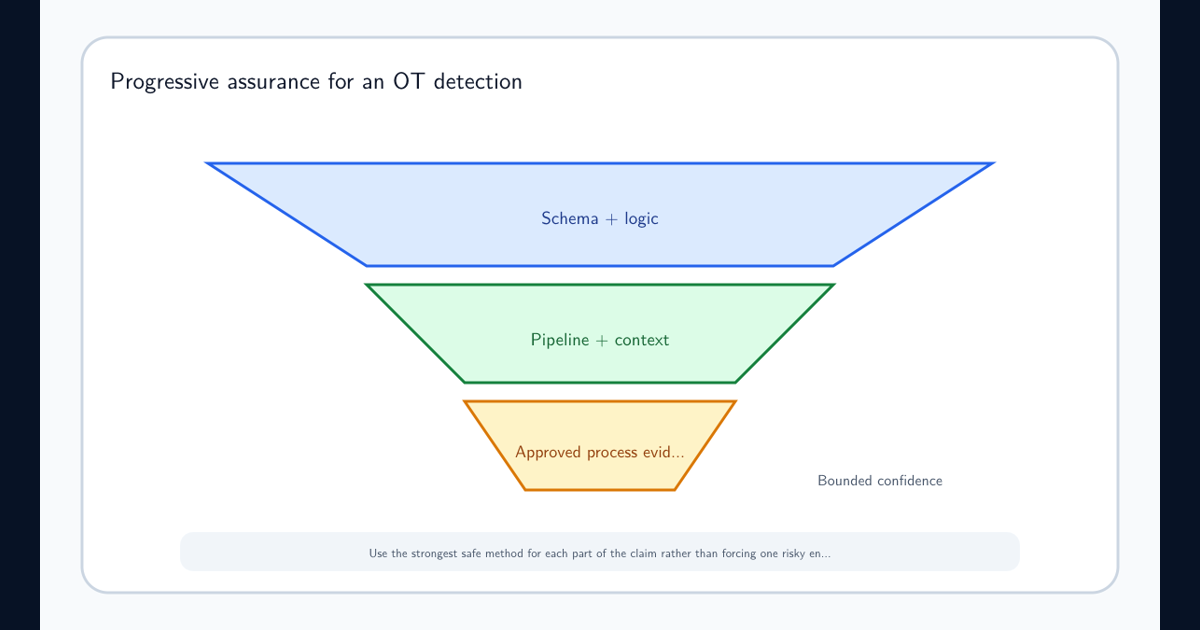
Define the entity, population, time window, required data, exclusions, threshold, severity, triage fields, and expected response. Rarity, periodicity, encryption, new domains, high entropy, or a nonstandard port can prioritize review; none proves C2 by itself.
Baseline the Right Peers and Account for Jitter
Compare like with like: the same process version on the same host role, service, environment, and change window. A management agent can be globally rare but normal on a specialized server. A browser can contact thousands of domains, making raw destination rarity less useful than an extension, child process, profile, or sequence that departs from its peers.
Beacon analysis should tolerate timing jitter, sleep changes, missed observations, batching, and user activity. Examine interval distributions, run length, active hours, direction, byte ratios, destination changes, and process association. Sampling and flow timeouts can distort periodicity; proxies can merge clients; NAT can obscure sources; content delivery can rotate addresses.
Use threat intelligence to add context, not to replace local evidence. A known malicious destination is strong relevant evidence for the observation window. An unknown destination is not benign, and a formerly malicious shared address may no longer support the same conclusion.
Validate Coverage and Logic With Safe Known-Good Tests
Validate each stage of the evidence path without deploying real malware or exposing an uncontrolled listener. Use synthetic events for query logic, benign scheduled requests to approved infrastructure for timing and correlation, and authorized simulations that produce the required endpoint and network observations. Label tests, bound targets and egress, use inert payloads, define an emergency stop, and clean up afterward.
Confirm that DNS, endpoint, proxy, flow, TLS, and alert times can be joined; that process and asset identifiers survive normalization; and that late or missing data changes the result visibly. Test common benign peers such as update agents, monitoring, software deployment, and backup traffic. A detection that succeeds only against a fixed interval or one test domain is not robust coverage.
Track data prerequisites separately from analytic correctness. If endpoint-network correlation disappears on unmanaged hosts or through a cloud path, publish the blind spot instead of silently treating the population as protected.
Triage From the Controlled System Outward
Preserve the alert, query, raw events, packet data where available, DNS answers, proxy records, endpoint timeline, process tree, file, memory evidence where proportionate, persistence, identity activity, and sensor health. Record all times in a common reference while keeping original timestamps.
Ask: Which process or account initiated communication? How was it created? When did contact begin? Was the destination resolved or hard-coded? Did it change? Was communication one-way or interactive? Which commands, files, or effects are supported? Did the same identity, binary, certificate, domain, or behavior appear elsewhere? What happened before and after each session?
Separate observations from conclusions. “Process X connected every 63–78 seconds to domain Y” is an observation. “This is C2” is an assessment requiring context. State alternative explanations, confidence, evidence gaps, and the immediate risk of leaving the path active.
Contain the Access Path Without Destroying Scope
Choose containment according to consequence, active risk, evidence needs, and operational safety. Options include isolating a host, blocking a domain or address, disabling an account, revoking sessions and tokens, removing a route, restricting egress, suspending a service integration, or sinkholing under appropriate authority. Coordinate changes so the adversary cannot simply switch to an unmonitored fallback while responders believe access ended.
A block is an interruption, not eradication. Identify persistence, additional payloads, compromised credentials, scheduled access, remote-management tools, peer systems, and upstream entry points. Rotate secrets from a trusted system. Rebuild where integrity cannot be established. Verify that approved business traffic will not be harmed by broad blocking of shared services or infrastructure.
NIST SP 800-61 Rev. 3 integrates incident response across cybersecurity risk management. Apply that broader preparation, detection, response, recovery, and improvement frame rather than treating a C2 alert as an isolated firewall task.
Operationalize C2 Defense and Measure Outcomes
Reduce opportunity before detection: enforce role-based egress, require managed DNS and proxies where appropriate, segment critical systems, restrict remote administration, protect service identities, inventory approved external dependencies, retain proportionate telemetry, and make exceptions visible. Controls should reflect business requirements; a universal deny rule without ownership becomes an outage or an undocumented bypass.
Maintain a playbook with evidence owners, query references, enrichment, escalation, containment authorities, legal and privacy boundaries, preservation steps, and recovery validation. Track time from first supported observation to alert, triage, containment, credential revocation, eradication, and verified recovery. Measure data-source coverage, join success, false-positive causes, recurring uncontrolled egress, fallback discovery, and affected assets found after the first alert.
Review every case for missed opportunity. Could endpoint and network records be joined? Did blocking erase evidence? Did the adversary use an approved service, an unmanaged asset, an internal pivot, or a dormant fallback? Feed those findings into telemetry, architecture, identity, detection, and exercises.
The defensible conclusion is not “this traffic looked like a beacon.” It is: this process or identity used this evidenced path to perform these supported control functions; these assets and credentials were in scope; these actions removed the path; and these tests show it has not returned.
Frequently asked questions
What is command and control in cybersecurity?
Command and control, commonly shortened to C2 or C&C, is adversary communication with compromised systems or accounts so the adversary can issue instructions, maintain access, change behavior, move tools, and receive status or results. It is a function, not one protocol or product.
What is a command-and-control server?
A command-and-control server is infrastructure that helps an operator exchange instructions or data with compromised systems. The visible destination may instead be a redirector, proxy, compromised website, cloud service, dead-drop location, or peer, so one observed address does not necessarily identify the ultimate controller.
Is periodic network traffic always a C2 beacon?
No. Updates, monitoring, authentication, backups, advertising, and other legitimate software can communicate periodically. Periodicity becomes useful when combined with an unexpected process, rare destination, unusual DNS or TLS behavior, consistent message sizes, persistence, or other independent evidence.
Can defenders detect encrypted command and control?
Often, but not from encryption alone. Defenders can correlate the initiating process and identity with DNS, destination, TLS metadata, timing, direction, byte patterns, policy, and endpoint effects. Decryption may help where lawful and proportionate, but metadata and host evidence remain important.
Is blocking a C2 IP address enough to contain an incident?
Usually not. Infrastructure can rotate, use proxies or legitimate services, and fall back to another channel. Blocking can interrupt access, but responders must also isolate affected systems, revoke compromised credentials and sessions, remove persistence, identify related assets, and verify recovery.
What is the difference between C2 and exfiltration?
C2 is communication used to control compromised systems; exfiltration is unauthorized removal of data. The same channel can carry commands, task results, tools, and stolen data, so defenders should classify observed functions separately instead of assuming every outbound connection proves exfiltration.