YARA Rules for Malware Analysis: Writing, Testing, Tuning
Learn how YARA rules work, select durable malware features, write precise conditions, test samples, tune performance, and maintain production rules.
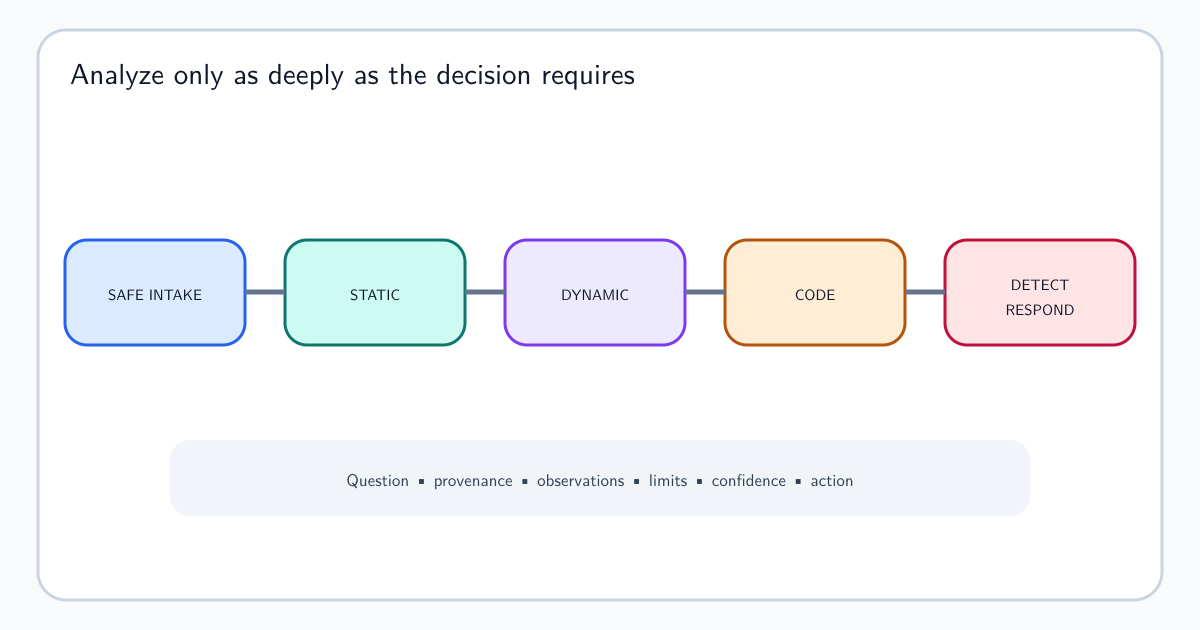
YARA lets analysts describe content using patterns and logic. A rule can identify a malware family, a tooling feature, an embedded configuration, a document lure, or another property visible in a file, process memory, or data buffer. The engine reports that the declared condition matched; the analyst decides what that match means. Use the broader malware analysis workflow to preserve samples, compare static and runtime evidence, and decide which features a rule can defensibly represent.
Good YARA rules are not collections of memorable strings copied from one sample. They encode features that are distinctive enough to separate the target from unrelated content, stable enough to survive minor changes, inexpensive enough to scan at the intended scale, and documented well enough for someone else to maintain.
This guide covers the full search intent behind “what is YARA” and “YARA malware rules”: rule anatomy, feature selection, text and hex patterns, conditions, modules, testing, performance, deployment, YARA versus YARA-X, VirusTotal use, metadata, versioning, and retirement.
Understand What a YARA Match Actually Proves
A match proves that the scanned input satisfied a compiled rule under a particular engine, version, configuration, module context, and scan boundary. It does not independently prove malicious intent, attribution, infection, execution, or compromise.
Define the conclusion before writing. A high-confidence family classifier may require several implementation-specific features. A broad hunting rule may intentionally trade precision for discovery and route matches to analyst review. A configuration extractor may use a private helper rule and a separate parser. Give each use case its own threshold and response.
Connect YARA output to the wider distinction between observables, indicators, and behavior in Indicators of Compromise vs TTPs. The rule should state which layer it supports.
Anatomy of a YARA Rule
A rule has an identifier and a required condition. Most production rules also contain meta and strings sections. Metadata records ownership and intent. Strings declare text, hexadecimal, or regular-expression patterns. The condition combines patterns, counts, locations, file properties, module values, and Boolean logic.
The official YARA-X rule anatomy documents the same core model. A minimal defensive example is:
rule Suspicious_Embedded_Config_Example {
  meta:
    description = "Training example; not a malware verdict"
    owner = "detection-engineering"
  strings:
    $marker = "client_identifier=" ascii
    $path = "\\AppData\\Local\\Temp\\" wide ascii
  condition:
    filesize < 2MB and all of them
}
This merely shows syntax. Its strings are not demonstrated to be unique, so it must not be deployed as a family classifier without representative evidence and negative testing.
Choose Features That Are Distinctive and Durable
Start with several related positive samples and, where possible, nearby non-target samples. Extract candidate text, byte sequences, structural properties, imports, resources, configuration markers, compiler artifacts, or format-specific values. Trace each feature to the code or data that creates it.
Reject incidental features: temporary paths, analyst labels, packer defaults, generic API names, standard library code, timestamps, common error messages, and values added by collection tooling. A feature repeated across related samples is not automatically distinctive; it may also occur across thousands of benign programs.
Prefer combinations of partly independent evidence. One format constraint, one implementation-specific byte pattern, and one configuration relationship often describe a target better than a long list of weak strings joined with any of them.
Use Text, Hex, and Regular Expressions for the Right Problem
Text patterns are readable and can use modifiers such as nocase, wide, ascii, or fullword. Every modifier broadens or changes what is searched; add it only when supported by sample encoding and expected variation.
Hex patterns express bytes and can include wildcards, alternatives, jumps, and other constructions. Wildcard relocation bytes or genuinely variable operands, not large portions of a function merely to force a match. Very short or highly wildcarded patterns can match broadly and cost more to scan.
Regular expressions are powerful but easy to make broad or expensive. Anchor structure where possible, constrain repetition, and prefer simpler text or hex patterns when they express the same evidence. Consult the exact engine documentation because regex syntax and warnings can differ between YARA and YARA-X.
Make the Condition Express the Detection Hypothesis
Conditions can require all, any, a threshold, counts, offsets, file-size limits, entry-point relationships, module values, or other rules. Write logic that explains why the feature combination represents the target.
Avoid any of them over many weak strings: it converts the least distinctive string into the effective threshold. Avoid exact hashes as the principal detection because they recognize only known bytes. Avoid a negative list that grows after every false positive; it often hides a weak positive model.
Use private rules for reusable components and global rules sparingly. A global restriction affects every rule in its compilation unit and can suppress valid matches unexpectedly. Keep dependencies visible and test the complete compiled rule set, not isolated fragments only.
Add Structural Context With Modules
Modules can parse formats or expose properties such as PE, ELF, .NET, Mach-O, hash, math, or other engine-supported data. They let conditions test structure instead of searching raw bytes for fields that already have defined semantics.
Module availability and behavior depend on the engine, build, and scan target. Undefined values require deliberate handling. A rule that works on files may not behave the same in process memory, and a module that parses one executable format should not be assumed to parse malformed content safely or identically across versions.
Record required modules and engine versions in the rule repository and deployment manifest. Compile in CI against every supported runtime.
Test Positive Coverage, Negative Safety, and Performance
Split samples into development and holdout sets. Positive tests should cover known variants, packing or format differences within scope, and damaged or partial inputs if the deployment scans them. Negative tests should include operating-system files, common applications, developer tools, installers, archives, documents, and content similar to the target.
Investigate every unexpected match. Determine which pattern and condition caused it, whether the rule scope is wrong, or whether the supposedly benign file deserves separate analysis. Do not tune solely against a small convenience corpus.
Measure compilation time, scan time, memory, match volume, and the effect of large files or adversarial input. Set scan timeouts and file-size policies in the surrounding platform as appropriate. Version the corpus sufficiently to reproduce decisions without distributing sensitive or malicious samples improperly.
Deploy According to the Scan Surface and Response
YARA can scan files at rest, submitted samples, extracted objects, process memory, or other buffers through command-line tools, libraries, and security products. Each surface has different permissions, content, cost, and response consequences.
Decide whether a match blocks, quarantines, tags, enriches, alerts, or enters an analyst queue. High-consequence automation needs high-confidence rules, safe rollback, and enough output to reproduce the match. Broad hunting rules belong in investigative workflows rather than silent prevention.
Preserve rule identifier, version, namespace, engine version, scan target, hashes, matching pattern identifiers and offsets where available, time, host or source, and action. Without that record, a later analyst cannot distinguish an old rule from a changed one.
Use VirusTotal and Shared Rules With Clear Boundaries
VirusTotal can support sample research and YARA-based hunting, but public or external services may disclose hashes, files, rule logic, search intent, or organizational interest according to the service and account. Follow authorization and data-handling policy before uploading anything.
Treat community rules as leads. Review syntax, metadata, license, scope, evidence, performance, dependencies, and test results before deployment. A rule name that mentions a family does not validate the classification.
YARA-X is a separate, newer implementation from VirusTotal. Its official documentation describes compatibility differences and its check, formatting, warning, API, and language-server capabilities. Migration requires compilation and corpus testing, not only a syntax glance.
Maintain Rules Like Production Code
Require an owner, description, scope, evidence reference, author, creation and modification dates, engine compatibility, confidence or deployment tier, review date, and change history. Use source control, peer review, automated compilation, corpus tests, formatting, and release artifacts.
Monitor match volume, prevalence, false-positive investigations, scan cost, rule errors, engine changes, and overlap with other rules. Revise when the target changes, the benign ecosystem adopts a feature, or a better structural constraint becomes available.
Retire rules explicitly. A stale rule can keep consuming scan time, trigger on unrelated software years later, or preserve an attribution claim no longer supported. Maintain malware intelligence separately from the detection so family naming and confidence can evolve without obscuring match behavior.
YARA Rule Review Checklist
Confirm the rule has a bounded purpose, representative positive samples, diverse negative samples, distinctive features, justified modifiers, understandable logic, required metadata, supported modules, engine compatibility, and measured performance.
Confirm the deployment specifies scan surface, maximum input and timeout behavior, response, logging, ownership, release version, monitoring, and rollback. Reproduce at least one match and one non-match from the production package rather than the editor alone.
The durable standard is: a reviewer can explain every feature, reproduce every claim, predict what a match means, and identify who will maintain the rule when the evidence changes.
Frequently asked questions
What is YARA?
YARA is a pattern-matching tool designed with malware research in mind. Analysts write rules containing textual, hexadecimal, or regular-expression patterns and a Boolean condition that determines whether scanned data matches.
What does YARA stand for?
The project commonly expands YARA as “YARA is Another Recursive Acronym.” The name matters less operationally than understanding that a YARA match is the result of declared patterns and logic, not an automatic malware verdict.
Is YARA an antivirus product?
No. YARA is a matching engine and rule language. Products can embed it for hunting, triage, classification, or scanning, but response, trust, updating, quarantine, and investigation workflows must be supplied by the surrounding system.
Should a YARA rule use malware-family names or hashes as strings?
Usually not as its main logic. Names and hashes are brittle or overly specific. Prefer distinctive implementation artifacts supported by several representative samples, then combine them with file structure, size, format, or other constraints.
How do you reduce YARA false positives?
Remove common strings, require combinations of independent features, add justified structural constraints, test diverse benign corpora, inspect every unexpected match, and measure performance. Do not simply add the first exclusion that makes a test pass.
What is the difference between YARA and YARA-X?
YARA-X is a newer implementation and toolchain from VirusTotal intended to become a faster, safer, and more user-friendly successor. It preserves the core rule model but has documented compatibility differences, so compile and test rules against the exact engine and version used in production.