Honeytokens, Decoy Credentials, and Canary Resources
Design honeytokens and decoy resources as controlled security claims whose placement, capability, trigger, and legitimate exposure determine what an interaction can actually prove.
A decoy begins with an expectation you can defend
Imagine a credential stored in a restricted archive that no production process should read. The credential cannot open a real system, but an attempt to use it creates a record. That record may be highly relevant because you deliberately narrowed the ordinary explanations before any interaction occurred.
A decoy is an artificial asset, service, identity, document, or data object presented so that unauthorized interaction becomes observable. A honeytoken is a decoy value such as a credential, link, record, API key, or identifier. Neither is high confidence by definition. The confidence comes from a controlled expectation about who can encounter it and which legitimate activity should use it.
Write that expectation plainly: where the object is placed, who can reach it, which automated systems may copy or inspect it, what action creates a trigger, and why ordinary work should not perform that action. Without this statement, the decoy is merely unusual data whose later meaning will be improvised.
Choose the smallest capability that still creates evidence
Believability helps a decoy attract meaningful interaction, but realism can create risk. A credential with broad production access may tempt an intruder, yet it also becomes a usable attack path. A fake customer record may appear convincing while collecting personal information that the detection never needed.
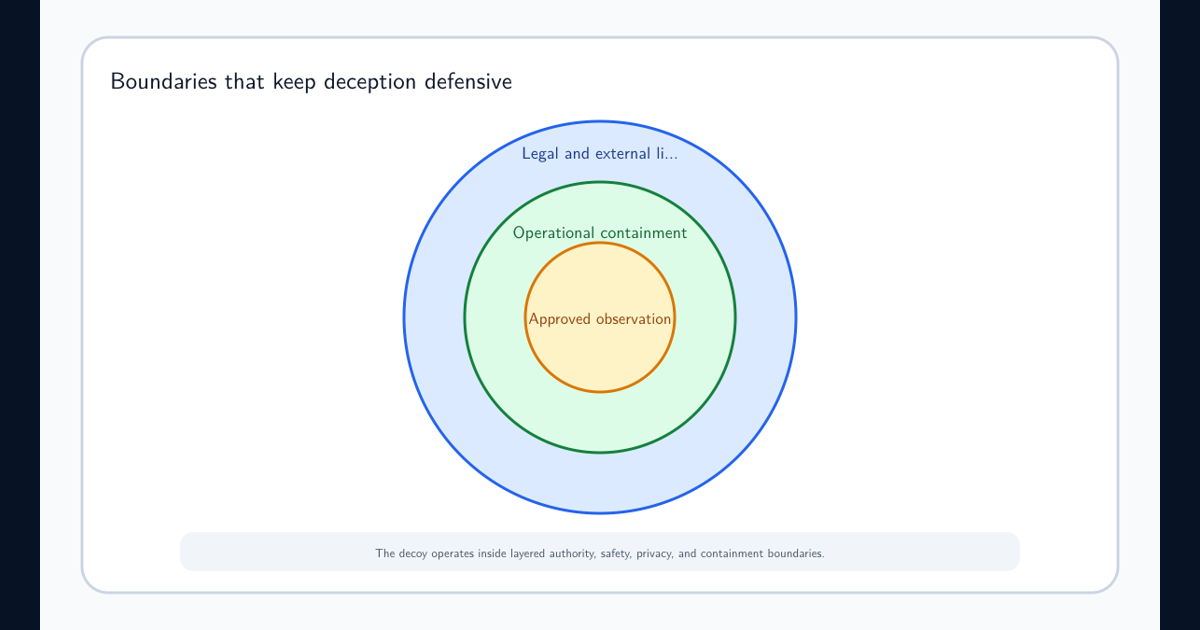
Minimize authority. A token can be recognizable to the monitoring service without granting access to a production resource. A canary document can report opening without containing real secrets. A decoy service can expose enough protocol behavior to support the intelligence question while remaining isolated from operational systems.
The capability should match the question. If you want to know whether secrets are being collected from a developer environment, a monitored value placed in that path may be sufficient. If you want to observe later lateral movement, a contained service may be appropriate. Adding capability that does not improve the question only expands exposure.
A trigger has semantics, just like any other sensor
Define exactly what causes the record. A DNS lookup, HTTP request, authentication attempt, document open, database query, or cloud API call establishes different facts. A secret scanner may resolve a domain without trying the credential. A preview service may fetch a link on behalf of a user. A backup system may copy a file without a person reading it.
Preserve the decoy identifier and version, trigger operation, source identity and network context, target, outcome, event time, ingest time, and sensor state. If the trigger depends on an external service, record what that service can and cannot observe.
Do not title every result “attacker used honeytoken.” State the fact first: the authentication service recorded an attempt involving a controlled credential. Then assess why the action conflicts with the placement expectation and which alternatives remain.
Placement drift can destroy the original claim
A credential may begin in a restricted archive and later be copied into a test fixture, training dataset, backup, or public repository. The token has not changed, but its legitimate exposure has. A future trigger can no longer be interpreted under the original assumption.
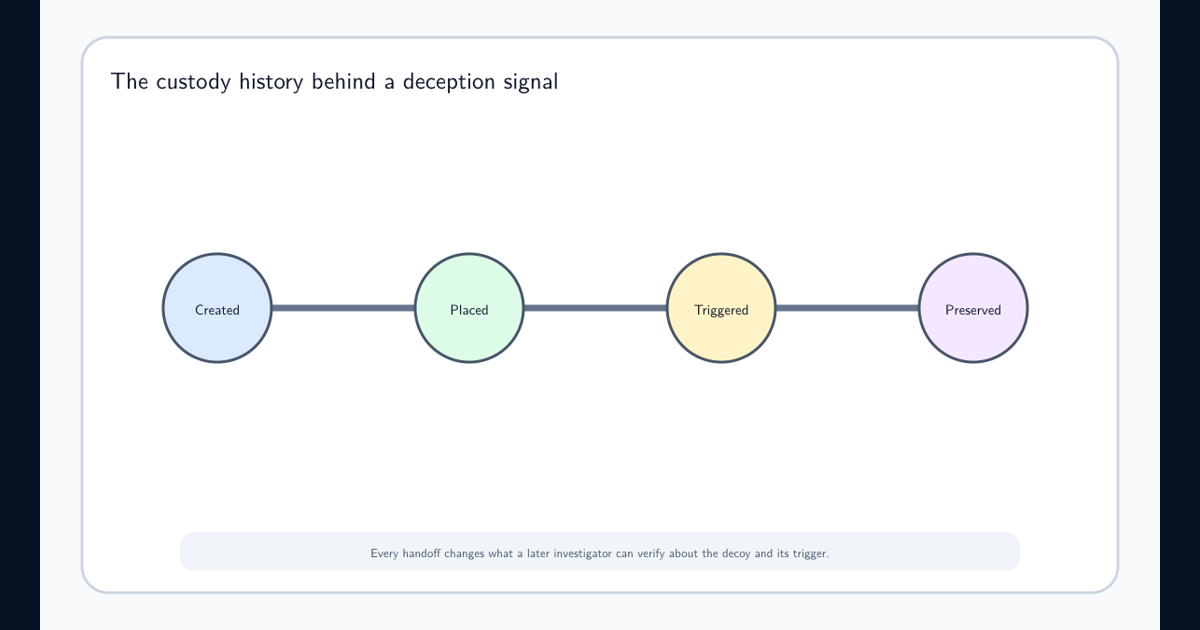
Track creation, placement, approved viewers, replication paths, activation, checks, movement, and retirement. The deception telemetry chain of custody lets an analyst verify whether the object remained controlled when it fired. Periodic exposure review should test the actual path, not merely confirm that the alert endpoint is alive.
If control is lost, change the signal state. The token may still provide investigative value, but it should not retain a high-confidence label that depended on exclusive placement.
Let the intelligence question determine the response
A trigger can support several decisions. A decoy in a protected administrator vault may justify urgent investigation of access paths. A public-repository token may support collection research rather than incident handling. A canary record in a customer database may help identify unauthorized bulk access but require careful privacy review.
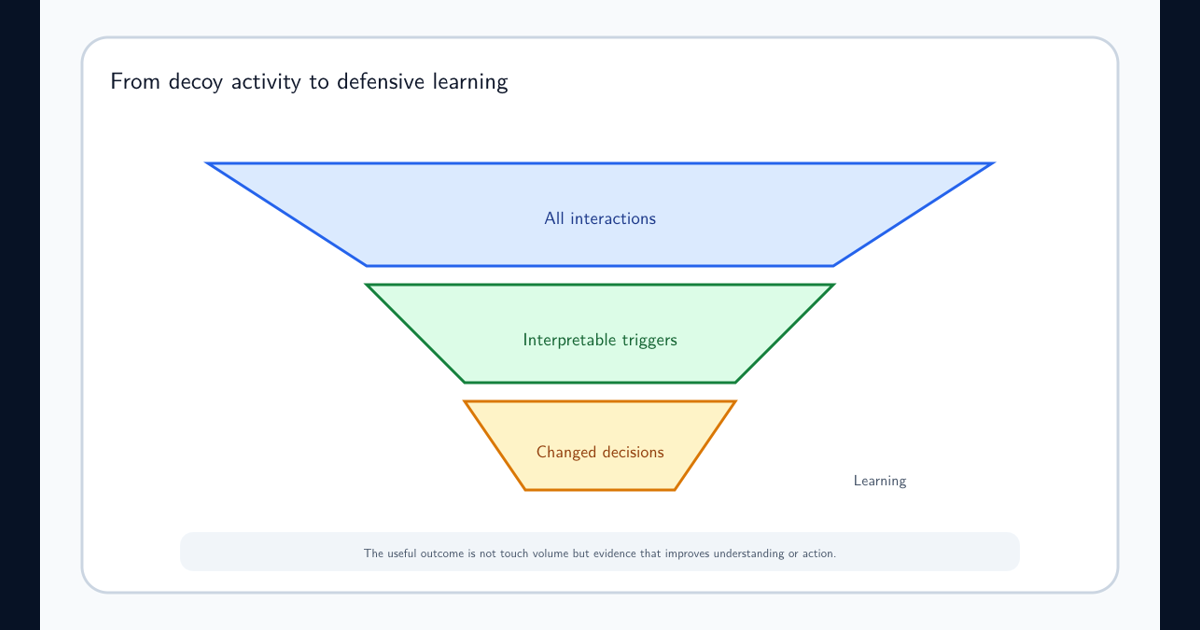
The alert should include the original intelligence question, placement expectation, trigger semantics, exposure history, independent context, and an authorized first action. Automated containment should depend on the consequence and confidence, not on the excitement associated with deception.
A well-designed decoy does not claim to know the intruder. It makes one normally ambiguous action easier to interpret by controlling part of the environment in advance. That is its analytical value.
Frequently asked questions
Does every honeytoken interaction prove malicious activity?
No. It proves that the monitored value or resource was used or touched. Attribution and intent still depend on placement history, legitimate exposure, trigger semantics, and independent evidence.