Measuring Deception Without Counting Touches
Measure whether deception answers an intelligence question and improves a decision, rather than rewarding trigger volume, deployed-decoy counts, or dramatic stories.
A large trigger count can mean the decoy is badly designed
A dashboard shows ten thousand interactions with deception assets. The number appears impressive until you learn that an approved scanner produced nearly all of them. The dashboard measures activity, not security value.
A vanity metric is easy to celebrate but weakly connected to the decision or outcome you care about. Trigger count, deployed-decoy count, and geographic map points can all become vanity metrics. More may mean wider exposure, duplicate instrumentation, or noise rather than better detection.
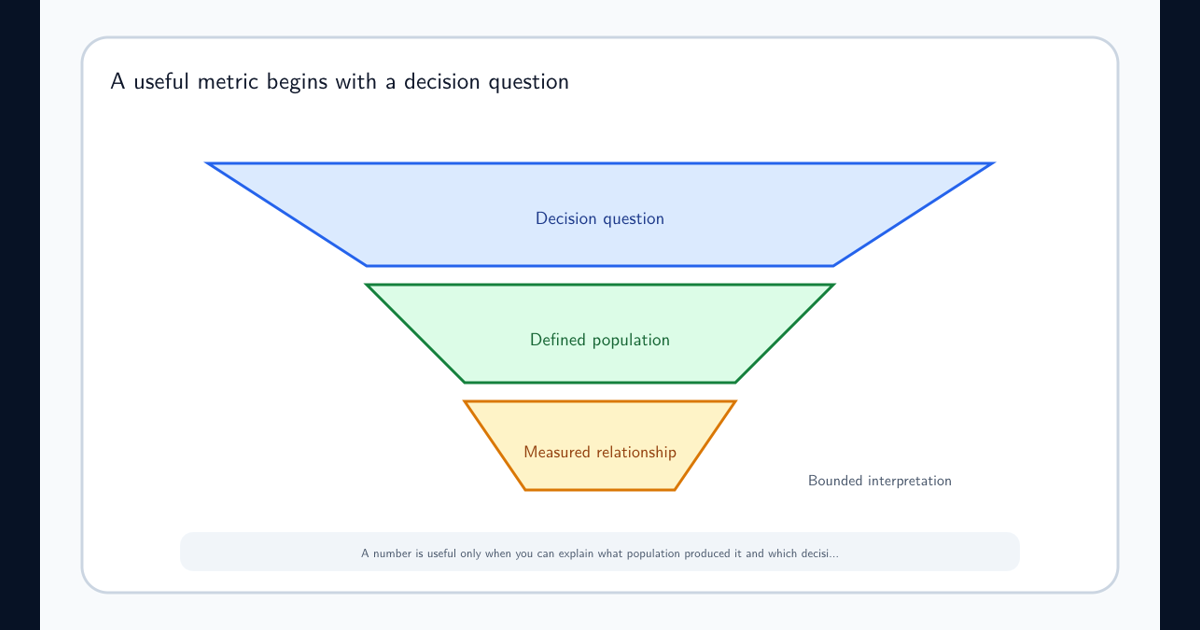
Begin with the intelligence question for each instrument. A credential placed in a developer archive may ask whether secrets from that path are being collected and used. A decoy share may ask whether an unauthorized identity is exploring protected storage. The question gives measurement a purpose.
Measure whether the controlled expectation still holds
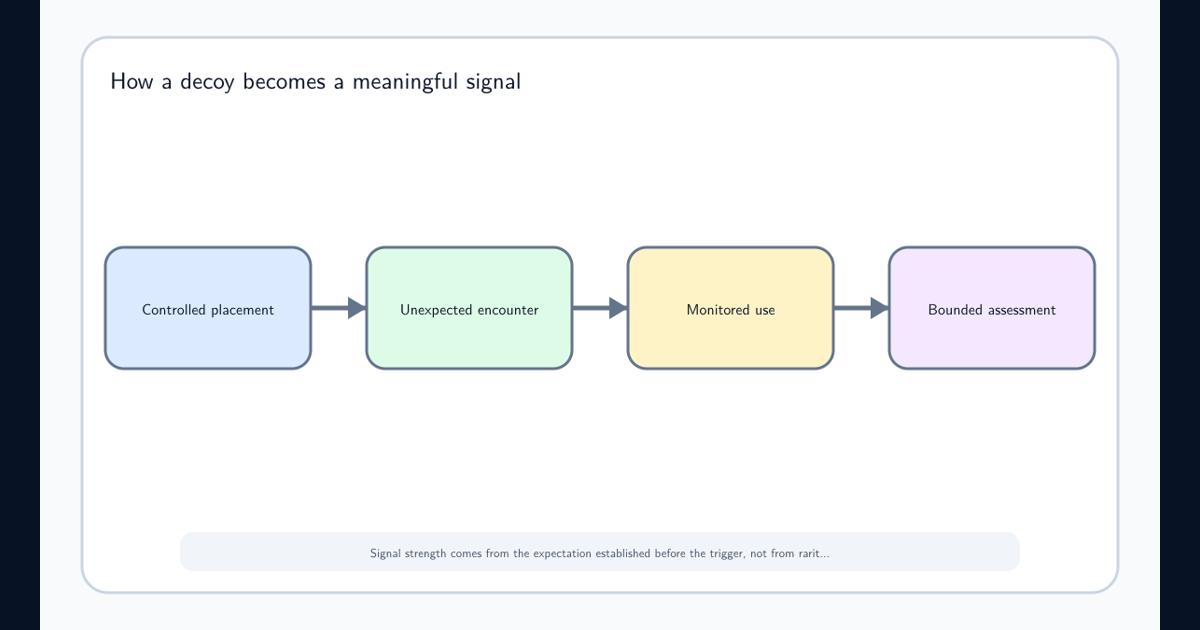
Before judging triggers, measure instrument integrity. Is the decoy still in its approved placement? Has legitimate exposure expanded? Does the token retain the intended minimum capability? Does the trigger path reach the consumer with the required fields and latency?
These are readiness measures. They do not show that an adversary has been detected, but they establish whether future silence or activity can be interpreted. A decoy that has drifted into backup and test systems no longer supports the original claim, even if its alert endpoint remains healthy.
Report healthy, degraded, and invalid states by instrument and question. A portfolio count that includes invalid instruments is not coverage.
Connect triggers to investigation and decision outcomes
When an instrument fires, record whether the result reached the right consumer, whether the evidence was sufficient to verify the expectation, how long interpretation took, and which decision changed. The result may raise an investigation’s priority, identify an access path, narrow affected systems, or reveal an ordinary process that invalidates the design.
Do not credit deception with the entire incident outcome. Other telemetry, analyst judgment, and controls may provide most of the evidence. Instead, ask what uncertainty the decoy reduced that would otherwise have remained.
Measure repeated triggers as related observations when they arise from one cause. Counting each retry as a separate success rewards unstable or easily repeated behavior.
Treat design failures as learning, not embarrassment
A legitimate backup touching a canary may reveal that the placement model was wrong. A health check may show a broken webhook. An investigation may reveal that a preview service, not a user, fetched a link. None proves hostile activity, but each improves understanding of the environment.
Record the changed assumption, affected instruments, corrective action, and new validation evidence. If the finding reduces confidence, update portfolio state immediately rather than protecting a success metric.
This is where detection metrics without vanity numbers applies directly: define the population, denominator, time period, interpretation, and decision. “Three of twelve restricted-path instruments lost exclusive placement this quarter” can drive action; “deception engagement increased” cannot.
Retire instruments whose learning no longer justifies their burden
Review infrastructure cost, evidence handling, analyst time, privacy exposure, accidental interaction, maintenance, and residual risk. A frequently triggered instrument whose results are ignored is not successful. A quiet instrument can remain justified if the path matters, its assumptions remain valid, and its delivery is tested.
Retirement is an outcome, not a failure, when the question is answered, the architecture changes, another control provides better evidence, or the burden exceeds expected value. Revoke capability, remove placements, preserve enough history, and transfer any remaining gap to the portfolio.
The best deception metric is learning attached to a decision: what became more certain, which action improved, and which assumption should change next.
Frequently asked questions
Why is trigger count a weak deception metric?
Because volume can come from scanners, automation, poor placement, or one repeated source. It does not show whether the instrument answered its question, produced usable evidence, or improved a defensive decision.