Deception Safety, Containment, and Legal Boundaries
Set technical, legal, privacy, and operational boundaries for defensive deception before deployment so observation never becomes uncontrolled access, collection, or engagement.
Ownership of the decoy is not authority over the visitor
A team may own a canary document, credential, domain, or service. That ownership lets the team configure and monitor its own instrument. It does not automatically authorize collection from unrelated systems, access to an external host, retaliation, or prolonged interaction with a person who encounters it.
Define the defensive purpose first. Are you detecting access to a protected store, measuring collection from a developer environment, or observing attempts against an isolated service? The purpose determines which data is necessary and which interaction is proportionate.
Record the approving owner, legal and privacy review, covered systems and populations, jurisdictional assumptions, collection fields, retention, access, escalation, and forbidden actions. A boundary that exists only in team memory will disappear during an urgent trigger.
Contain capability before making the decoy believable
A realistic credential can become a liability if it grants production access. A convincing service can become a pivot if it reaches internal networks. A decoy document can expose real employee or customer information if realism is achieved by copying sensitive content.
Containment should be architectural. Use non-production authority, narrow network paths, isolated storage, rate and resource limits, monitored egress, separate administration, and explicit shutdown. Assume the decoy itself can be studied or compromised.
Test failure states on paper and through authorized assurance: monitoring unavailable, a token copied elsewhere, a service exploited, an external scanner generating volume, or the owner unreachable. The safe state should not depend on the detection firing correctly.
Minimize data without destroying evidential value
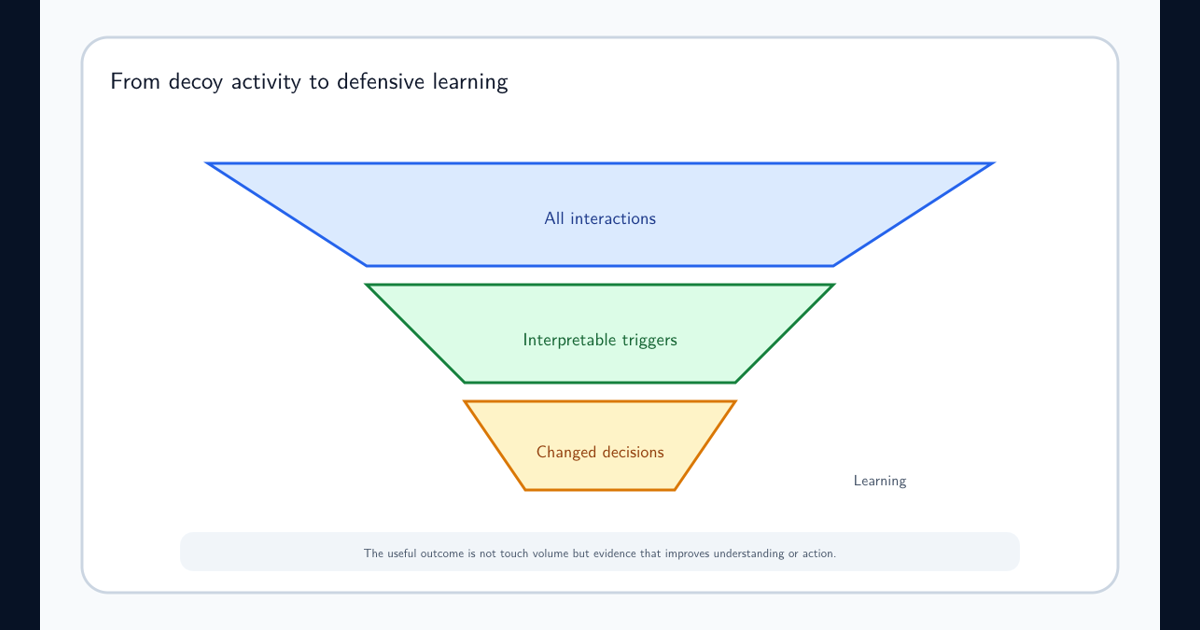
A trigger may expose network addresses, account identifiers, message content, document metadata, or tool behavior. Collecting everything can feel safer for investigation, but it creates a sensitive dataset whose harm may exceed its detection value.
Choose fields from the decision backward. To verify use of a canary credential, you may need credential identity, operation, target, time, outcome, and protected source context—not a complete payload from the connecting system. Hashing can support exact comparison, but it does not anonymize a value that can be guessed from a small set.
Define role-based access, review logging, retention, redaction, export rules, and deletion. If the intelligence question changes, obtain new authority rather than silently expanding the collection.
Prepare for employees, researchers, and mistakes
Not every interaction comes from an intruder. An employee may discover the object while troubleshooting. A researcher may scan a public service. A security product may inspect a credential. An administrator may copy a decoy during migration.
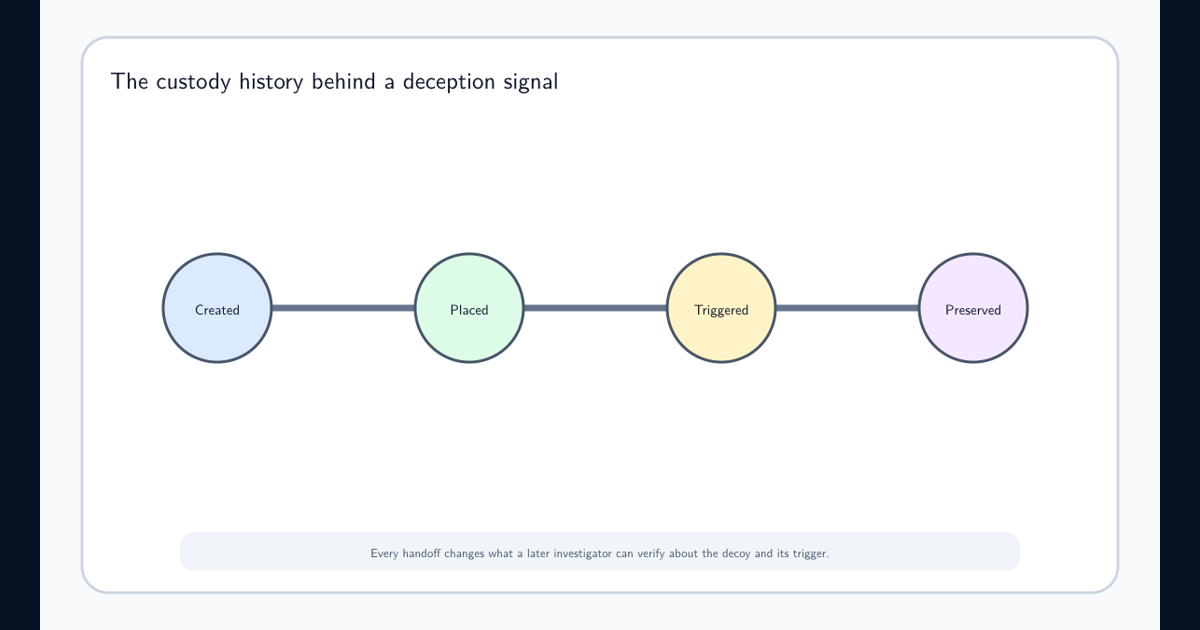
The response plan should distinguish observation from accusation. Preserve the event, verify the instrument’s deception telemetry chain of custody, check authorized exposure, and involve the appropriate privacy, legal, human-resources, or external-contact process before escalating identity claims.
Notification and handling may depend on location and relationship. Define those paths before a trigger so urgency does not turn a bounded defensive signal into disproportionate surveillance or public attribution.
Give every deployment a stop condition
A decoy should have an owner, review date, health evidence, and conditions for suspension or retirement. Stop when containment fails, legal assumptions change, monitoring becomes unreliable, legitimate exposure expands beyond the original claim, or the intelligence question no longer justifies the cost and collection.
The shutdown plan revokes capability, removes placements, preserves necessary records, notifies consumers, and changes any coverage statement that depended on the instrument. An abandoned decoy can become an unmanaged asset or continue producing alerts nobody can interpret.
Safe deception is not timid deception. It is disciplined observation whose authority, capability, data, and response remain aligned with a defensible purpose from creation through retirement.
Frequently asked questions
Can a defensive decoy actively engage anyone who touches it?
Not automatically. Authority, jurisdiction, privacy, safety, proportionality, and operational risk constrain collection and interaction. Defensive ownership of a decoy does not grant unlimited authority over another system or person.