Encrypted Network Traffic: What Metadata Can and Cannot Tell You
Use metadata from encrypted traffic to assess communication behavior while keeping payload content, application identity, user intent, and attribution outside claims the evidence cannot support.
Encryption changes the evidence, not the existence of traffic
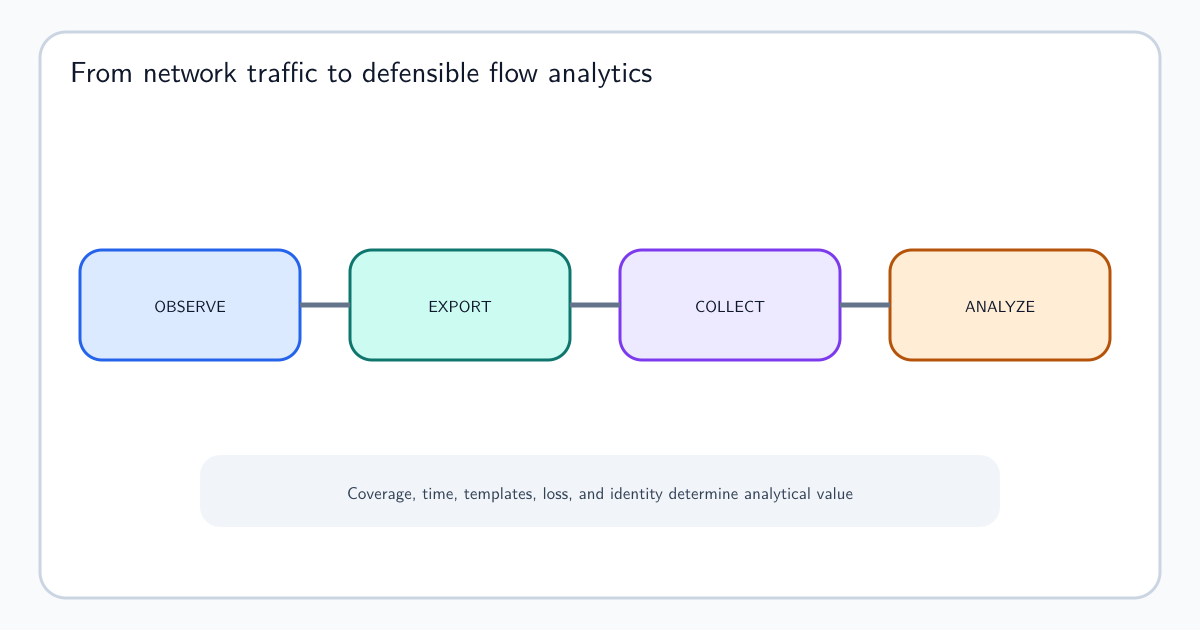
Encryption protects application content from observers that lack the keys. Network sensors may still observe endpoints, ports, timing, direction, volume, packet sizes, connection state, and some protocol negotiation. DNS, proxy, certificate, or endpoint records may add context. The NetFlow monitoring guide explains how flow exporters and collectors preserve a scalable subset of that metadata.
Call these observations metadata because they describe communication rather than its protected message. Metadata can reveal stable patterns, rare destinations, periodicity, volume changes, or protocol anomalies.
It cannot, by itself, tell you which commands or files passed through the channel. A detection claim should name the behavior inferred from the observable pattern and preserve that limit.
Vantage point determines which metadata survives
A sensor before network address translation sees different identity from one at an internet edge. A host sensor can know process and user context that a network device cannot. A proxy may terminate one encrypted connection and create another.
Document where the observation occurs, which direction is known, how addresses map to entities, and whether traffic can bypass that point. Cloud load balancers, service meshes, VPNs, and content delivery networks reshape flows.
Two records for the same communication are not necessarily duplicates; they may describe different legs. Correlate them only when time, identifiers, and topology support the relationship.
Protocol evolution can remove familiar fields
TLS and QUIC versions expose different handshake and transport properties. Encrypted ClientHello can conceal server-name information from some passive observers, while shared hosting makes one address represent many services. Resumption and connection reuse alter expected handshake frequency.
Fingerprinting summarizes observable client or server behavior, but software updates, libraries, middleboxes, and impersonation can change or copy a fingerprint. Treat it as supporting evidence, not identity proof.
Version the parser and protocol assumptions. An increase in unknown handshakes can reflect new software or a visibility change rather than hostile evasion.
Behavioral analytics need careful baselines
Useful patterns include rare destinations for a defined population, periodic low-volume connections, sudden outbound transfer, unusual protocol use, and communication inconsistent with a process or workload role. Each depends on a reference population.
Shared services, software updates, backups, remote work, and content delivery can resemble command-and-control or exfiltration patterns. Segment by entity type, network role, application, and time rather than applying one global threshold.
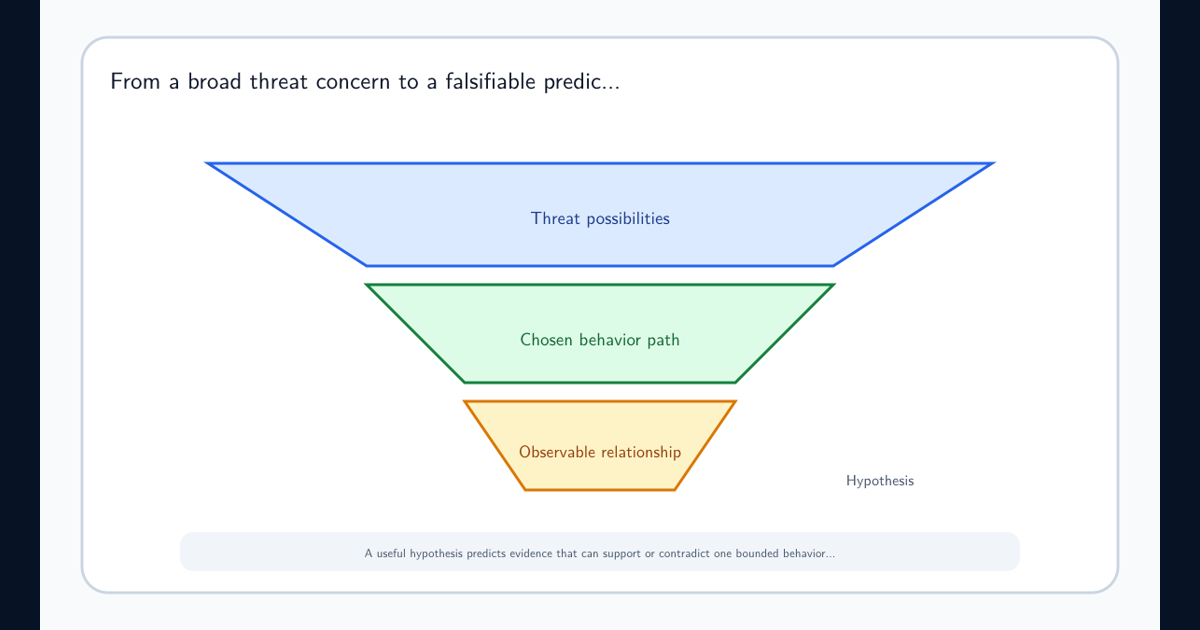
Corroborate with endpoint, identity, DNS, proxy, or cloud records when possible. The detection hypothesis should state which alternative explanations the additional evidence can actually reduce.
Privacy and uncertainty belong in the design
Metadata can still reveal relationships, habits, locations, and organizational activity. Collect only fields justified by the security purpose, restrict access, define retention, and evaluate whether joining sources creates a more sensitive dataset.
Health indicators should track sensor coverage, dropped flows, clock quality, parser versions, unknown protocols, directionality, and entity mapping. Missing payload is an intentional boundary; missing flow records are a health failure.
State the conclusion in layers. Facts describe observed endpoints, timing, volume, and protocol properties. Assessment explains why the pattern may represent a threat behavior. Uncertainty covers shared infrastructure, hidden protocol fields, unresolved entities, and the content that encryption correctly prevents you from seeing.
Retention should follow the decision horizon rather than an assumption that more history is always better. Long baselines can help expose slow change, but they also increase privacy impact and may preserve obsolete topology. Define which features need history, how identities are minimized, and when aggregated patterns can replace event-level records.
Frequently asked questions
Can encrypted traffic be detected without decrypting it?
Communication patterns and protocol metadata can support bounded detections, but they usually cannot reveal payload content or intent. Accuracy depends on vantage point, protocol version, client behavior, shared infrastructure, and corroborating endpoint or identity evidence.