Cyber Deterrence: Denial, Costs, Norms, and Collective Response
Design cyber deterrence as a behavior-specific portfolio of denial, resilience, exposure, law enforcement, diplomacy, costs, partnerships, and communication.
Define the behavior before choosing the response
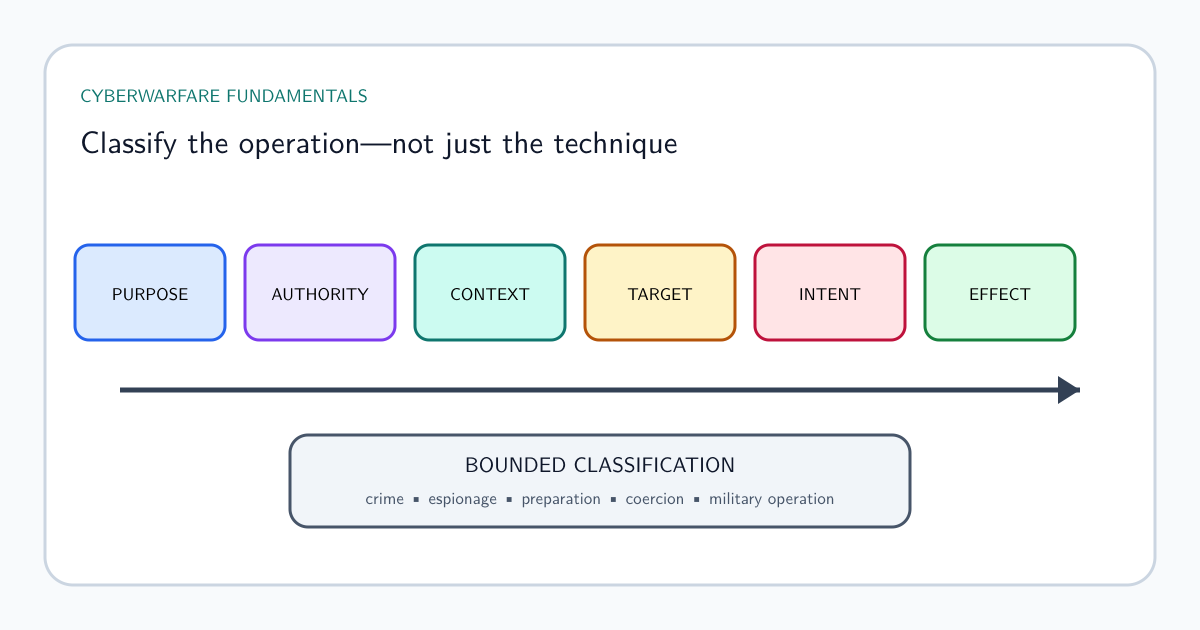
Deterrence aims to influence a choice. Begin with actor, prohibited or discouraged behavior, protected interest, threshold, time horizon, and desired restraint. “Deter cyberattacks” is too broad. A useful formulation might seek to reduce destructive operations against regional electricity restoration during an identified crisis while preserving legitimate communication and avoiding escalation.
Model what the actor values and believes: mission success, time, access, secrecy, revenue, legitimacy, domestic control, proxy relationships, economic benefit, or freedom of action. Assess capability, intent, opportunity, risk tolerance, previous adaptation, and decision structure. Do not assume every actor values reputation or cost in the same way.
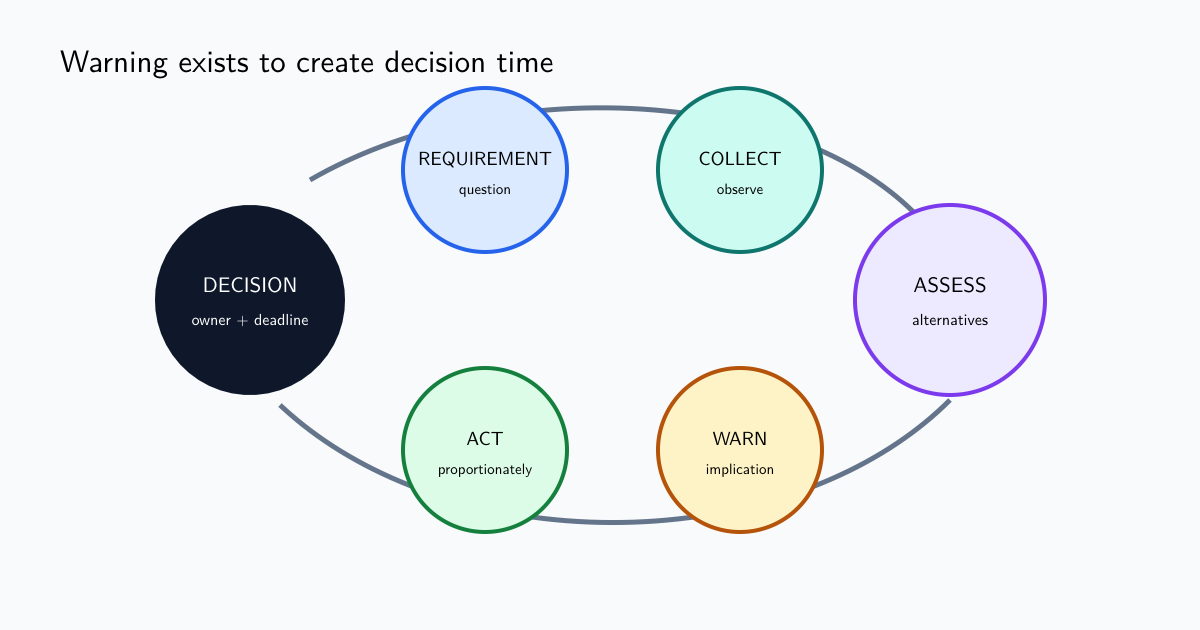
Establish a baseline and competing explanations. Behavior may be absent because the actor lacks access, has different priorities, is waiting, was disrupted, or was deterred by another party. Strategic warning supplies indicators of changing intent and opportunity. Deterrence claims should remain probabilistic and update when actor behavior contradicts the theory.
Build a portfolio across denial, resilience, and costs
Denial reduces expected benefit by closing paths, protecting cyber key terrain, detecting access, and making effects unreliable. Resilience reduces duration and strategic value through continuity, trusted communication, restoration, and partner support. Exposure, prosecution, sanctions, diplomatic action, market intervention, disruption, and other lawful measures can raise cost or constrain the ecosystem.
Combine instruments around the actor’s actual dependencies. Public attribution may threaten secrecy or legitimacy but can also reveal evidence, intelligence sources, and political thresholds. Law-enforcement action may remove infrastructure or create durable evidence. Defensive assistance can deny benefit without direct confrontation. Cyber action may constrain opportunity but can expose capability or invite adaptation. Every option requires its own authority and consequence review.
The 2023 DoD Cyber Strategy summary places cyber capabilities within integrated deterrence and emphasizes allies, partners, resilience, and integration with other instruments. Treat such doctrine as one state’s public approach, not a universal model. Tailor the portfolio to the responsible actor, protected community, legal framework, and political objective.
Use norms, alliances, and communication as infrastructure
International law, voluntary norms, confidence-building, capacity-building, points of contact, and institutional dialogue create reference points for state behavior. They do not end competition. They help states communicate expectations, organize assistance, expose violations, reduce misunderstanding, and build common response. The UN Global Mechanism began meeting in 2026 after the General Assembly endorsed the OEWG final framework.
Alliances add intelligence, resilience, interoperability, diplomatic weight, national capabilities, and political commitment. NATO’s current collective-defence guidance states that significant cyber and hybrid attacks may be considered armed attacks, while Article 5 determinations remain case-specific. Assistance is not limited to one instrument and is determined by Allies.
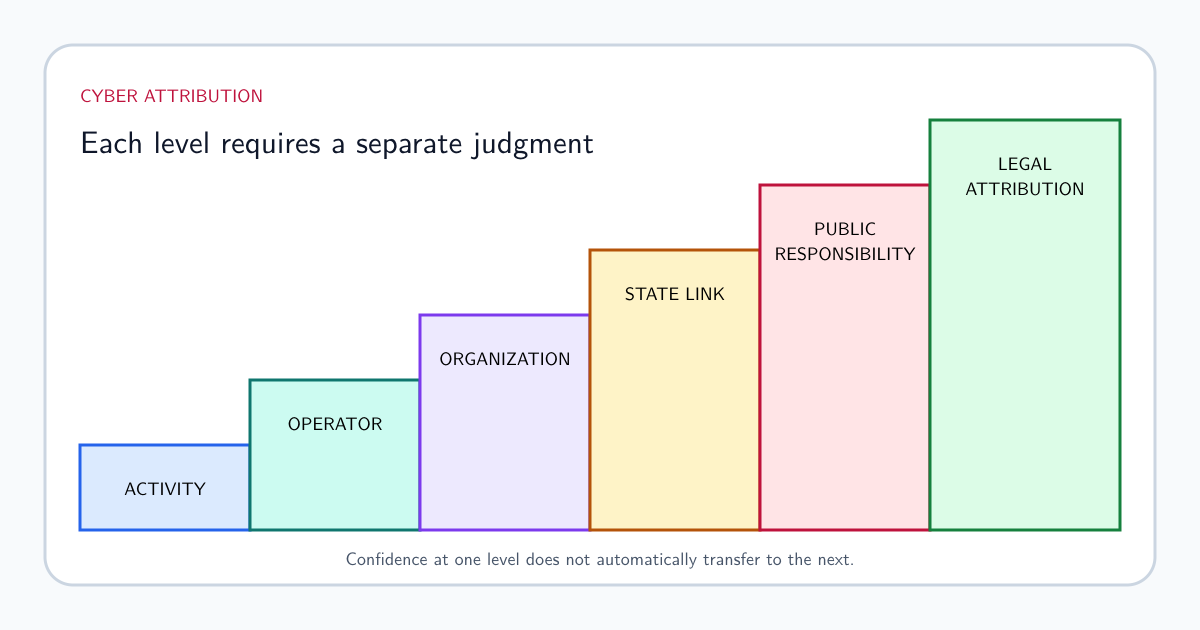
Communication must be credible, understandable to the intended actor, and consistent with actual capacity and resolve. Ambiguity can preserve options but also cause miscalculation. Excessive specificity can reveal thresholds or bind leaders. Coordinate private warning, public statement, partner messaging, technical advisory, and action. Ensure cyber attribution confidence and legal characterization are not silently exaggerated for rhetorical effect.
Control escalation and displacement
Responses alter an adversary’s incentives and information. Exposure may embarrass one actor but encourage a proxy. Sanctions may raise cost while shifting infrastructure or payments. Defensive improvement may move targeting toward weaker partners. Cyber disruption may reduce immediate capability while revealing access and prompting retaliation. Model branches before selecting the portfolio.
Use an escalation assessment with actor perception, stakes, thresholds, attribution confidence, reversibility, visibility, civilian exposure, partner position, cross-domain options, and communication. Compare action with restraint, delay, private warning, public exposure, law enforcement, and defensive assistance. Define stopping rules and authorities. Escalation control is not passivity; it is disciplined management of interaction under uncertainty.
Track displacement across targets, techniques, proxies, geography, and intensity. A reduction in one indicator may conceal strategic substitution. Share indicators and defensive gains with partners so success does not merely export risk. Reassess the portfolio when adversary value, leadership, conflict context, or access changes. Deterrence is continuously maintained, not declared once.
Assess deterrence without claiming credit for silence
Measure attempted and achieved behavior over time: frequency, severity, target set, operational quality, dwell time, proxy involvement, ecosystem cost, displacement, and recovery burden. Track the adversary’s statements, resource changes, tasking, infrastructure, and adaptation while treating public rhetoric cautiously. Compare with baseline and plausible counterfactuals.
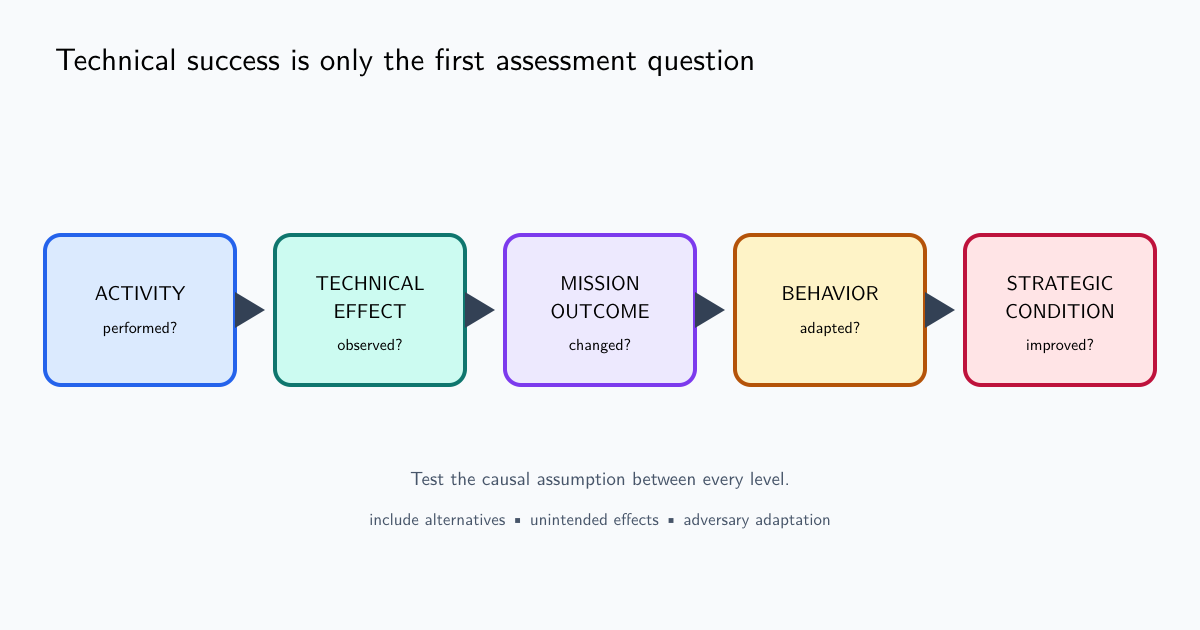
Use cyber-effects assessment to test whether the portfolio contributed to denial, delay, restraint, adaptation, or unintended escalation. Absence of attack is not direct evidence of deterrence. The actor may lack intent, capability, access, or opportunity. Conversely, attempted operations that repeatedly fail may show denial even when intrusion volume remains high. State confidence and alternative explanations.
Review credibility: were threatened or promised actions carried out, were partners protected, did communication reach the intended actor, and did legal and political authority endure? Record failure modes and update the theory. A mature deterrence assessment helps leaders choose the next mix of resilience, exposure, cooperation, cost, communication, and restraint without pretending to read an adversary’s mind.
Frequently asked questions
What is cyber deterrence?
Cyber deterrence is the effort to influence an actor not to undertake or continue a defined behavior by changing expected benefit, cost, risk, legitimacy, or feasibility. It is a relationship and portfolio, not synonymous with retaliation.
What is deterrence by denial?
Deterrence by denial reduces an actor’s expectation that the operation will achieve useful effects. Security, resilience, continuity, rapid recovery, trusted communication, and partner capacity can reduce the benefit of attempted disruption.
Can NATO Article 5 apply to a cyberattack?
NATO states that significant cyber and hybrid attacks may be considered armed attacks and that Article 5 decisions are made case by case. Article 5 is a political and legal collective-defence mechanism, not an automatic technical severity threshold.
How is cyber deterrence measured?
Measure the defined adversary behavior over time, including frequency, severity, target selection, displacement, proxy use, adaptation, and attempted versus achieved effects. Non-events cannot be attributed to deterrence without examining capability, intent, opportunity, and alternative causes.