Cyber Attribution: From Technical Evidence to State Responsibility
Build bounded cyber attribution judgments by separating activity clusters, operators, organizations, state relationships, public responsibility, and legal attribution.
Define the attribution question before collecting evidence
Cyber attribution is not one question. A defender may need to know whether two incidents share an operator. An intelligence team may need an organizational identity and objective. Law enforcement may need admissible evidence connecting named people to acts. A government may decide whether to publicly assign responsibility. Legal advisers may assess whether conduct is attributable to a state under applicable international law. Each decision has a different deadline, evidence threshold, source constraint, and consequence of error.
Write the proposition precisely: “Activity observed between these dates was conducted by operators associated with organization X with state direction,” rather than “Who hacked us?” Bound the victim set, time period, activity, relationship, and level of attribution. Define who owns the decision and what action the judgment will support. A containment decision often can proceed on behavior and scope without waiting for nationality.
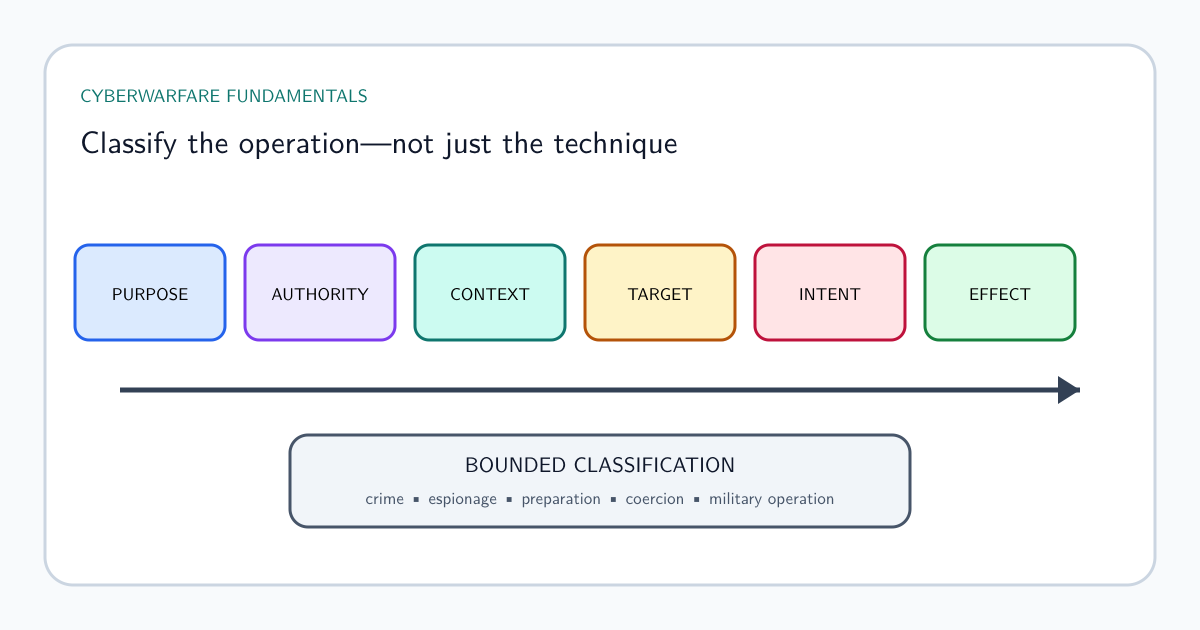
Keep six levels separate: activity cluster, operator, organization, sponsor or state relationship, public responsibility, and legal attribution. The practical definition of cyberwarfare adds conflict and purpose; it should not be smuggled into a technical cluster label. An APT name is a vendor’s analytic container, not proof of a legal entity or government command relationship.
Build the technical case from chronology and provenance
Start with a normalized chronology. Preserve original timestamps, time zones, clock quality, collection point, and transformations. Record first and last observed activity, registration and certificate events, infrastructure changes, authentication, execution, lateral movement, collection, command traffic, effects, cleanup, and defender action. Sequence can distinguish shared tooling from shared operation and reveal infrastructure prepared before a public lure or crisis.
Establish provenance for each artifact. A hash identifies bytes, not an author. An IP address identifies infrastructure involved in one observation, not necessarily its controller. A domain may be registered, stolen, sinkholed, delegated, or hosted through a reseller. Compile code can be altered. Language artifacts can reflect libraries, developers, victims, or deception. Tool overlap matters most when combined with uncommon implementation choices, infrastructure administration, repeated operational procedure, and independent evidence.
Protect the chain from collection to judgment. Retain raw evidence, hashing and acquisition records, query logic, exclusions, analyst notes, and source limitations. Separate what the sensor observed from what a product inferred. Responsible OSINT collection can enrich ownership, chronology, public personas, companies, procurement, leaks, and infrastructure, but public data must be obtained lawfully and assessed for authenticity, manipulation, and safety.
Move from behavior to operator and organization carefully
Behavioral analysis examines how access is obtained, tasks are sequenced, infrastructure is administered, targets are selected, work is scheduled, data is handled, effects are controlled, and mistakes recur. Stable combinations can connect incidents even when individual indicators change. Victimology and strategic timing add context, but national interest is rarely unique enough to prove identity by itself.
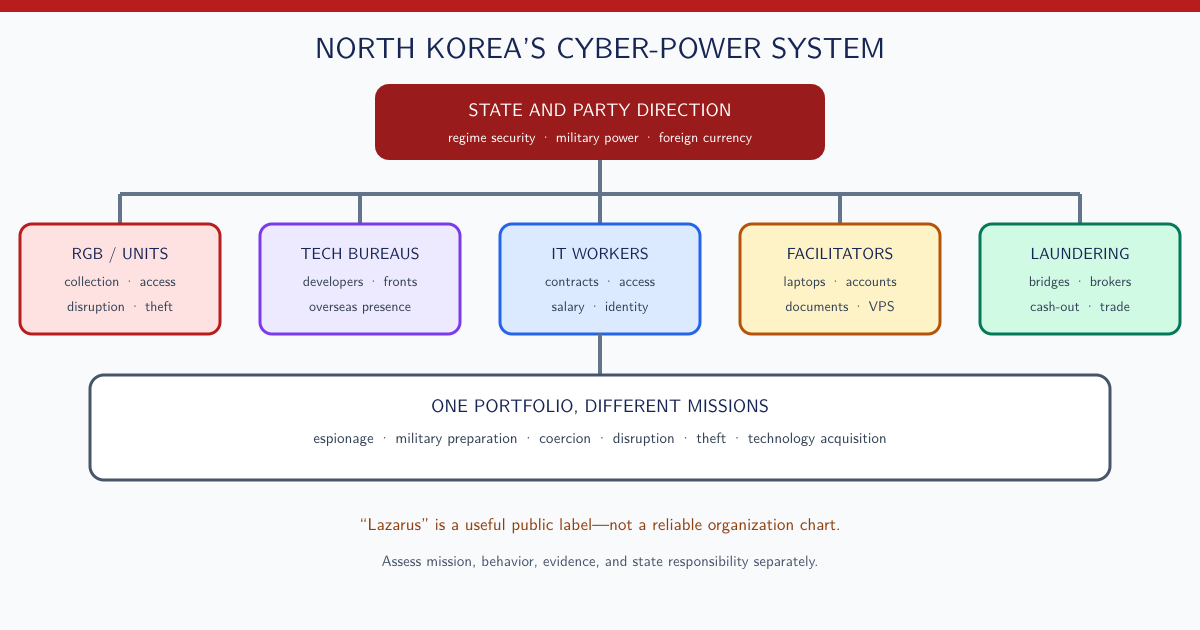
Build relationship hypotheses rather than one actor box. Separate the hands-on operator, malware or access supplier, infrastructure provider, contractor, criminal market, intelligence service, military unit, amplifier, and beneficiary. Ask whether the evidence supports common tooling, coordination, direction, control, financing, tolerance, purchase, or merely shared interest. Confidence at a lower rung does not automatically transfer upward.
Organizational attribution benefits from sources beyond network telemetry: human reporting, legal process, payment and procurement records, seized infrastructure, provider records, travel or employment history, partner intelligence, and operational security failures. Many will be unavailable to a private defender. State the boundary rather than compensating with stronger language. Share useful behavior with defenders even when organizational identity remains unresolved.
Test deception, copied tradecraft, and proxy explanations
False flags exploit analysts who overvalue recognizable artifacts. An operator can copy strings, reuse public code, route through another region, select a misleading working schedule, or imitate a known group’s destructive pattern. Shared malware can also arise without deception through leaks, commercial tools, access brokers, common libraries, training, or parallel development.
Test the evidence against competing explanations. Could the artifact have been planted after compromise? Does chronology show when it entered the environment? Is the supposedly distinctive feature present in public repositories? Does infrastructure administration match the claimed actor over time? Do victim selection, access method, operational tempo, and effect control cohere? Which independent source would discriminate between imitation and continuity?
Use a deception check before high-consequence attribution. Identify who benefits from the expected conclusion, what the source wanted the analyst to see, which evidence is unusually convenient, what contradictory evidence is missing, and whether defender action changed the observable record. The 2018 Olympic Destroyer operation is valuable because public reporting and later legal allegations described deliberate imitation of another state-linked group. The lesson is not that attribution is futile; it is that provenance and multiple evidentiary lines matter.
Separate public attribution from legal state responsibility
Public attribution is a sovereign policy act. Governments may combine technical evidence, classified intelligence, partner assessments, diplomatic objectives, source-protection needs, law-enforcement action, and response strategy. They may publish detailed indicators, name an organization, condemn a state, issue an indictment, impose sanctions, or coordinate a joint statement. The amount disclosed does not reveal the complete evidence base.
Legal attribution asks a different question: under the applicable rules of state responsibility, is the conduct attributable to the state? The ICRC position paper summarizes recognized categories including conduct by state organs; entities empowered to exercise governmental authority; persons or groups acting on state instructions or under direction or control; and conduct a state acknowledges and adopts as its own. Sponsorship, tolerance, benefit, and legal attribution should not be treated as synonyms.
The 2020 US indictment of six GRU officers illustrates how a public record can join individuals, a military organization, infrastructure, malware development, victim events, destructive effects, and alleged false-flag activity. An indictment remains an allegation to be proved in court, not a conviction. It can nevertheless expose the kinds of evidentiary relationships that short vendor labels omit. Analysts should identify the institution making the claim, its standard and purpose, the disclosed evidence, and what remains unavailable.
Write an attribution judgment that survives challenge
Lead with one bounded assessment: actor level, relationship, activity, target set, and time horizon. Use calibrated probability language and state confidence separately. Summarize the strongest evidence by independent line—chronology, infrastructure control, behavior, victimology, human or legal evidence, and partner reporting. Then name the strongest alternative and the evidence that would raise or lower it.
Document source access, reliability, consistency, gaps, deception risk, and assumptions. Distinguish observed facts from publisher claims and your own assessment. Explain naming: which vendor clusters overlap, which do not, and why a government or organizational name is being used. Avoid laundering another source’s confidence through citation. If a state relationship is assessed, say whether the evidence supports direction, control, organizational membership, contracting, sponsorship, tolerance, or benefit.
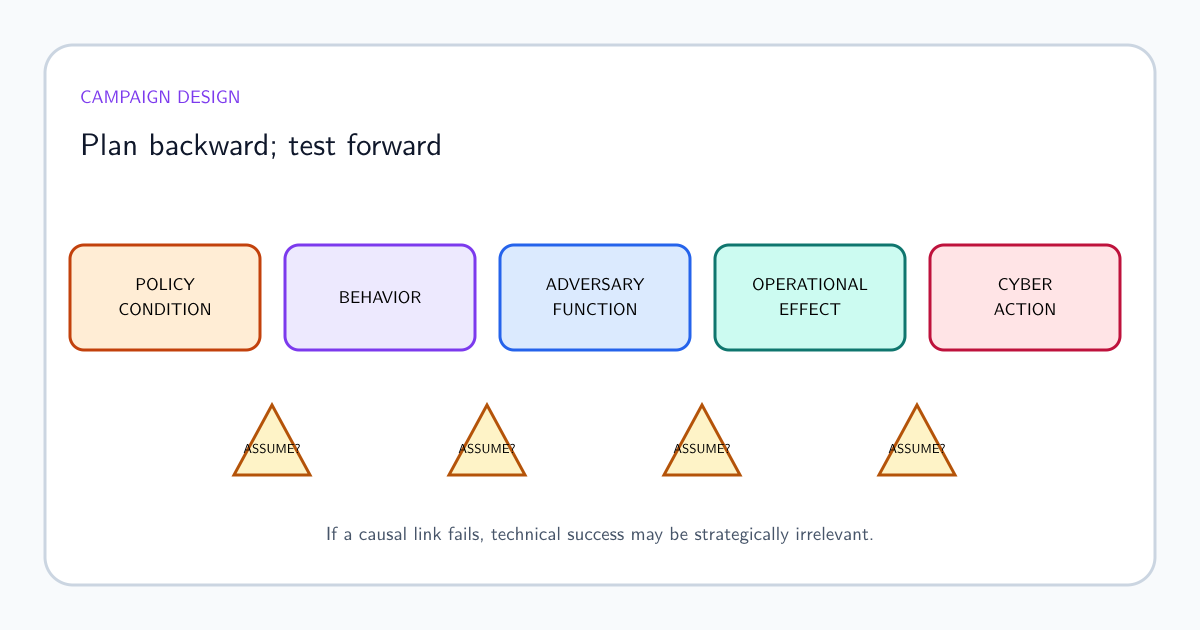
End with decision relevance. Defenders need behaviors, affected dependencies, hunting priorities, mitigations, and warning indicators. Policymakers need confidence, consequences of error, response options, partner positions, and escalation considerations. Campaign planners need adversary adaptation and feedback into cyber campaign design. Define the next collection requirement and update trigger. The best attribution product makes uncertainty inspectable while still enabling proportionate action.
Frequently asked questions
Can an IP address identify the attacker?
Usually it identifies infrastructure observed in a particular transaction. The address may belong to a victim, provider, relay, VPN, proxy, botnet node, or shared service. Attribution requires chronology, provenance, behavior, infrastructure control, victimology, independent sources, and organizational context.
What is the difference between technical and political attribution?
Technical attribution groups related activity and may connect it to an operator or organization. Political attribution is a state decision to publicly assign responsibility or condemn activity, often using intelligence and policy considerations that are not fully disclosed. Legal attribution to a state is another distinct judgment.
How should confidence be stated?
State the assessed proposition and time period, use calibrated likelihood language, then give confidence based on source access, quality, corroboration, consistency, and alternatives. Confidence and probability answer different questions and should not be collapsed into one label.
Do false flags make attribution impossible?
No. They make single-source and artifact-led attribution unreliable. Chronology, provenance, infrastructure administration, repeated behavior, operational mistakes, human relationships, legal evidence, and independent intelligence can expose copied or planted indicators.