What Is Cyberwarfare? A Practical Definition for Analysts and Operators
Distinguish cyberwarfare from cybercrime, espionage, influence, preparation, and ordinary military support by examining purpose, authority, context, target, and effect.
The direct answer: cyberwarfare is a relationship, not a toolset
Cyberwarfare is the organized use of cyber capabilities as part of military strategy, armed conflict, or a state campaign intended to create strategic or operational advantage. The term describes the relationship between digital action and political or military purpose. It does not identify a special family of malware, a level of technical sophistication, or every intrusion attributed to a government.
Start with six questions: who is acting; what objective they pursue; under whose authority; in what conflict context; against which system and mission; and with what intended and observed effects. Theft for revenue, intelligence collection, preparation of future access, coercive disruption, influence, battlefield support, and destructive attack may reuse the same infrastructure or access method. Their meaning changes with purpose and context.
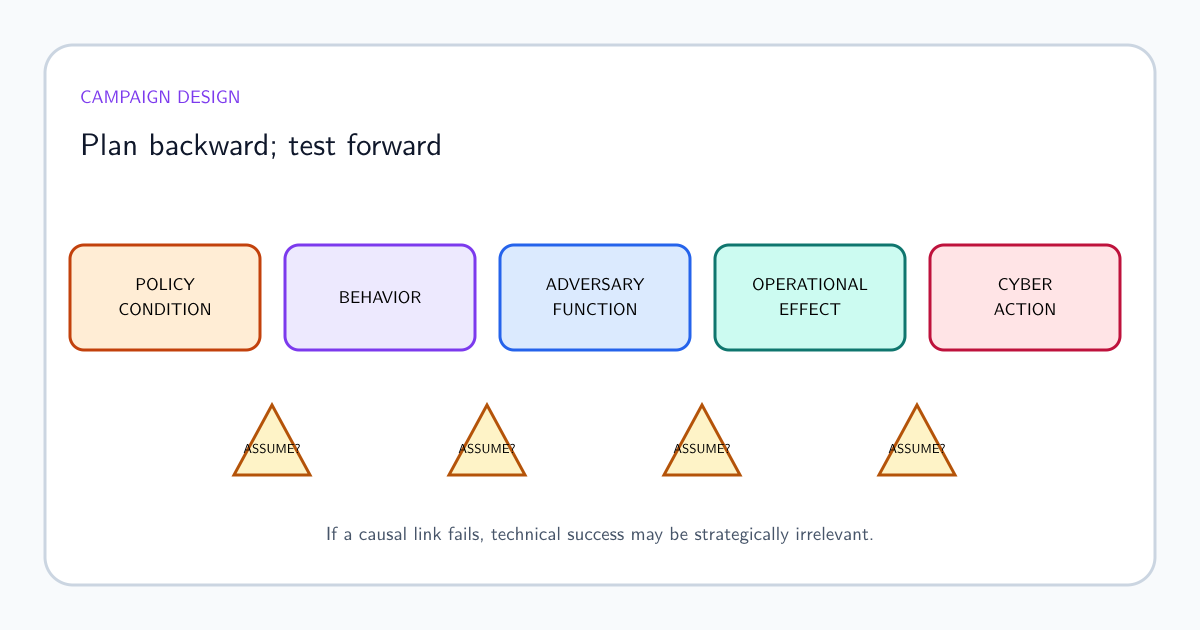
This is why professional analysis should resist headlines that call every severe incident “cyberwar.” A precise description might instead read: “a state-sponsored espionage campaign that also created plausible contingency access to telecommunications infrastructure.” That wording preserves what the evidence supports and exposes the unresolved question. Readers who need to turn that classification into an operational theory can continue with the linked guide to cyber campaign design.
Distinguish operation, attack, armed conflict, and warfare
A cyber operation is the broadest useful term: an activity conducted in or through cyberspace to achieve an objective. Cyber attack has different meanings across technical practice, military doctrine, policy, and international humanitarian law. In incident response it may mean any malicious intrusion. In legal analysis during armed conflict, the word “attack” can carry a narrower consequence-based meaning. Analysts should identify the framework before importing its threshold.
Armed conflict is not created merely by attaching a military unit to an incident report. Its existence and the nexus of a particular cyber operation to that conflict are legal and factual questions. Likewise, espionage can occur during tension or war without automatically becoming an attack. Preparation of the environment can create options for later action while its current purpose remains intelligence or positioning.
Use the narrowest accurate term, then add context. Describe the observed operation, assessed actor relationship, intended function, produced effects, and connection to wider events separately. This prevents a disputed headline label from carrying the entire argument and lets legal, intelligence, military, and defensive teams apply their own decision thresholds to the same factual record.
Trace technical action to strategic consequence
Classification improves when analysts trace an effects chain. A task changes a component, account, route, process, or information state. That technical effect changes a service or system function. The functional change affects an operational mission, institution, population, or decision. Political and military actors then react, producing strategic consequences that may differ from the attacker’s intention.
A ministry website outage illustrates the distinction. Traffic may exhaust capacity, producing a clear technical and service effect. If emergency information remains available elsewhere, the operational harm may be limited. If the outage is synchronized with forged announcements and visible military pressure, perceived institutional collapse may matter more than the lost web service. The same observable event can therefore be nuisance, coercive signal, deception support, or one element of an armed campaign.
Record direct, indirect, delayed, cumulative, and cross-border effects. Include recovery action and adversary adaptation, because the campaign continues after the first impact. Technical success does not prove strategic value: disruption can harden the target, expose capability, unify allies, trigger sanctions, or create civilian harm that defeats the sponsor’s political purpose.
Place the operation on the competition-to-conflict continuum
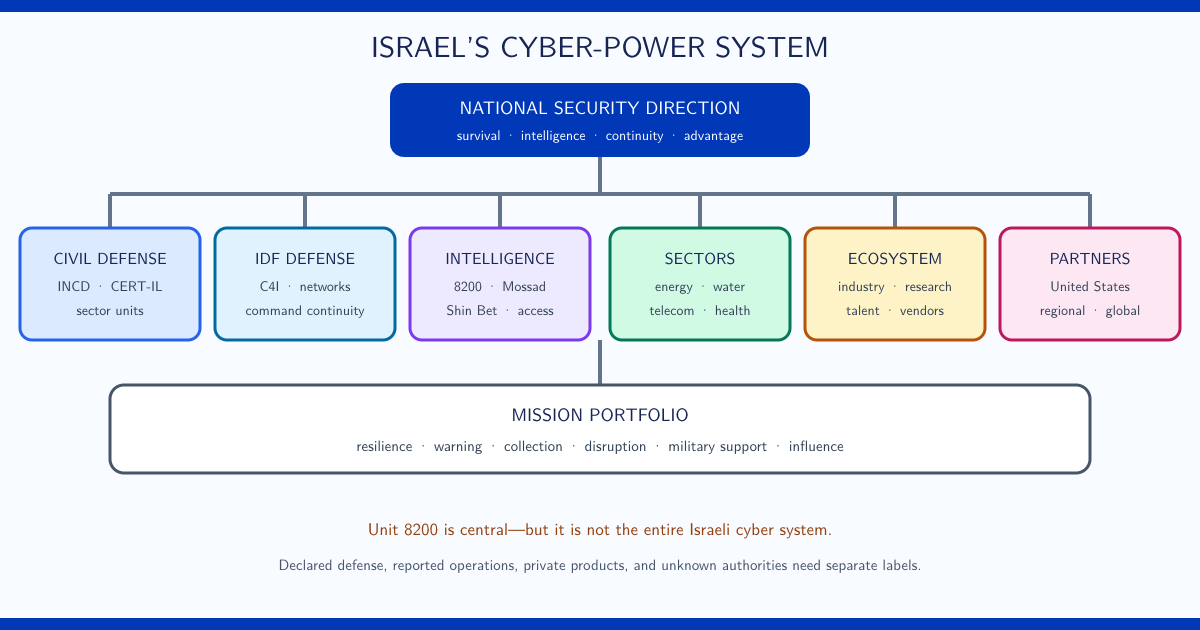
States use cyber capabilities during routine competition, acute crisis, and armed conflict. Persistent intelligence collection, access development, counter-crime disruption, influence, and defensive partnership can occur every day. Crisis compresses decision time and increases the risk that ambiguous activity is interpreted as preparation for attack. Armed conflict adds a legal and operational setting but does not make every connected intrusion a wartime attack.
NATO states that cyber defence is part of collective defence and that significant cyber activity can, case by case, lead to an Article 5 decision. That policy does not create an automatic technical threshold. Allies retain national attribution and response processes, and a response can combine defensive, diplomatic, economic, law-enforcement, intelligence, and military instruments.
The UN process also matters. The 2021–2025 Open-Ended Working Group concluded with a framework for the permanent Global Mechanism that began meeting in 2026. Its existence reflects sustained state concern with responsible behavior, international law, confidence building, capacity building, and prevention of conflict in the use of information and communications technologies. Analysts should distinguish those state-security processes from the narrower question of whether one incident is “war.”
Use real cases without turning them into myths
Estonia in 2007, Georgia in 2008, Stuxnet, the Ukrainian grid attacks, NotPetya, Olympic Destroyer, KA-SAT, and the wartime campaigns against Ukraine are often presented as milestones. They are useful only when compared with a consistent matrix: political setting, actor model, objective, target system, access path, timing, observed effect, attribution basis, civilian exposure, adaptation, and strategic result.
Estonia demonstrated how service disruption, social dependence, public communication, and international coordination interact during political crisis. Georgia showed parallel cyber and military activity, but public timing alone does not prove centralized tactical control. Stuxnet demonstrated the process knowledge and concealment required for a precise industrial effect. NotPetya showed how an operation aimed through a trusted update path could create global and civilian consequences far beyond its apparent strategic focus.
Mark every case claim as observed, officially asserted, analytically assessed, disputed, or unknown. Avoid the hero story in which one tool explains an entire campaign. Public evidence is incomplete by design; good education teaches what cannot be concluded as carefully as what can.
A classification checklist for daily practice
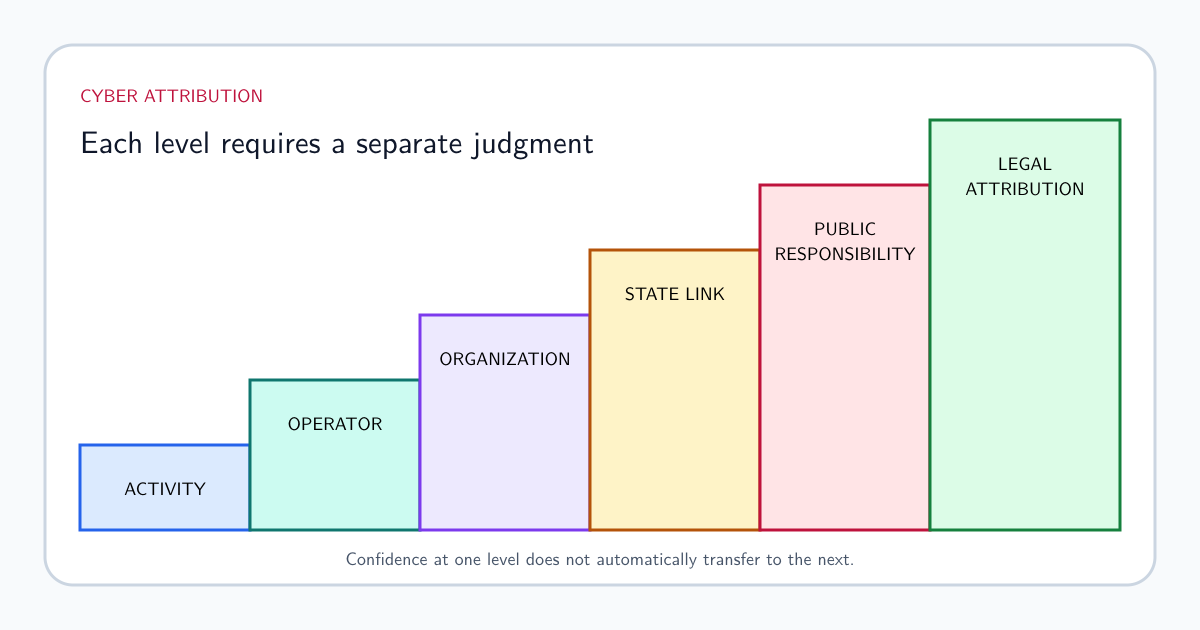
Begin a case note with the event and time window, not the actor nickname. Identify affected services and mission owners. Separate operator cluster, organizational identity, state sponsorship, and legal responsibility. State the assessed objective and the strongest alternative. Trace task, technical effect, operational effect, and strategic consequence. Describe the conflict context and applicable decision framework without making a legal conclusion outside your role.
Then test the language. Would the assessment remain accurate if attribution changed? Does “attack” mean the same thing to every intended reader? Are intent and effect being confused? Is absence of public evidence being treated as evidence of absence? Does the label help a defender, commander, policymaker, or partner choose an action? If not, replace it with a narrower factual description.
Finish with implications, collection gaps, confidence, and an update trigger. Link technical findings to cyber attribution only when the reader needs the structured evidentiary model. Link the incident response lifecycle when operational containment or recovery is the immediate need. Precision is not academic caution; it prevents the wrong authority, threshold, or response from being attached to an ambiguous event.
Frequently asked questions
Is every state-sponsored intrusion cyberwarfare?
No. State sponsorship identifies a relationship, not the operation’s legal or strategic character. Espionage, preparation, coercion, military support, and wartime attack can use similar techniques. Classification requires purpose, authority, conflict context, target, intended effect, and observed consequence.
Does cyberwarfare require physical destruction?
Not as a general descriptive matter. Cyber operations can support military action, deny functions, manipulate information, collect intelligence, or influence decisions without physical damage. Whether a particular operation qualifies as an attack or use of force is a separate legal question that depends on facts and the applicable legal framework.
Can cybercrime become part of a state campaign?
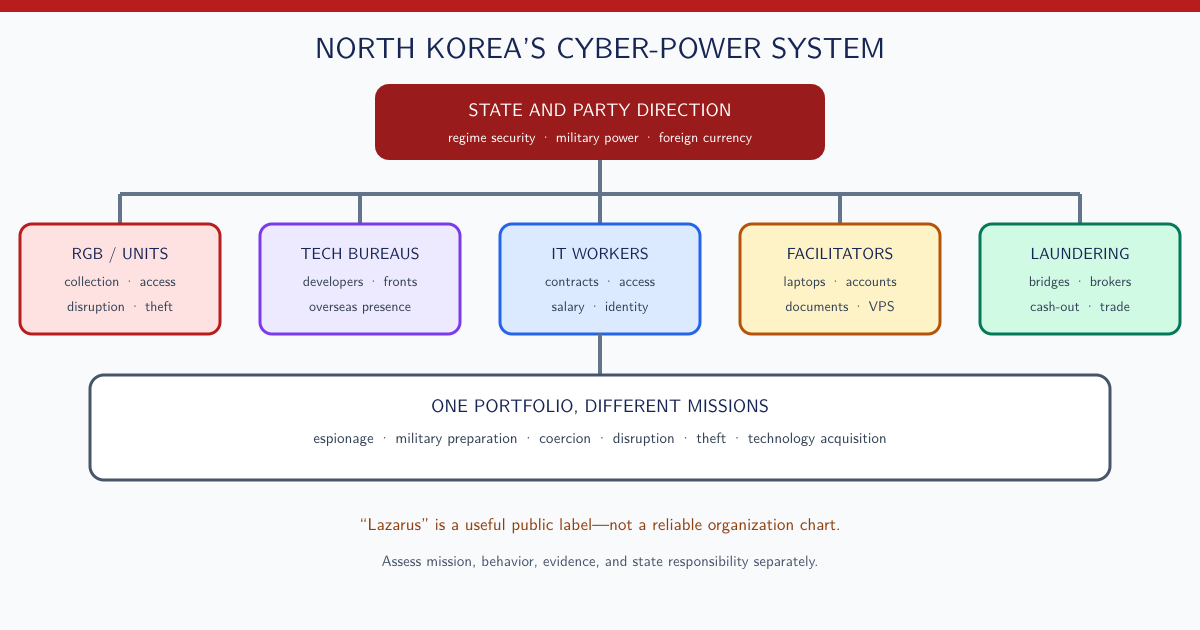
Yes. States may direct, recruit, purchase from, tolerate, or benefit from criminal ecosystems. Analysts should distinguish the operator, sponsor, control relationship, beneficiary, and objective instead of treating “criminal” and “state” as mutually exclusive labels.
What is the safest working definition?
Use cyberwarfare for cyber operations that are integrated with armed conflict or organized military strategy, and state the evidence for that connection. When evidence is incomplete, use a narrower description such as state-sponsored espionage, coercive disruption, preparation of the environment, or cyber-enabled military support.