Cyber Effects Assessment: Measures, Baselines, and Counterfactuals
Measure whether cyber activity changed systems, missions, behavior, and strategy using causal chains, baselines, counterfactuals, indicators, and independent challenge.
Separate performance from effectiveness
Measures of performance answer whether the team completed tasks to standard: access established, message delivered, command executed, target observed, partner notified, or restoration completed. Measures of effectiveness ask whether the operation changed the target function, mission, audience, behavior, or strategic condition in the intended direction. The two must not be substituted.
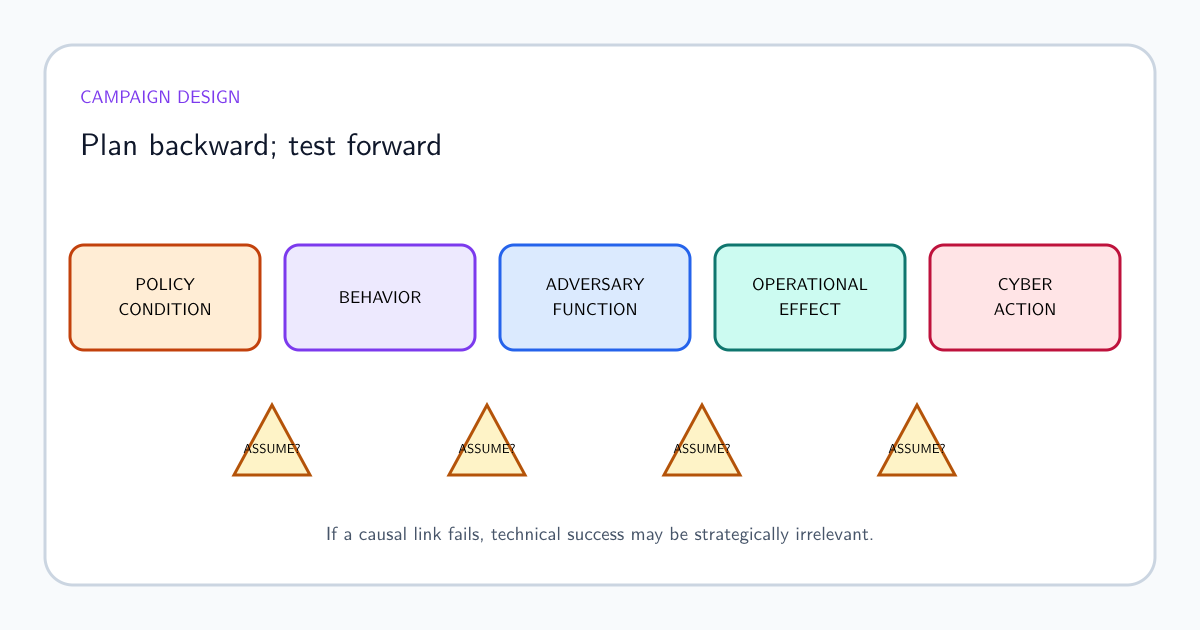
Build a causal chain during cyber campaign design. State the action, immediate technical effect, functional outcome, operational consequence, expected decision or behavior, and policy condition. Write the assumption between each link. An account lockout does not prove command disruption; command disruption does not prove delayed maneuver; delay does not prove strategic advantage. Each requires evidence.
Include failure and harm definitions before execution. Specify partial success, no material effect, effect outside the approved scope, civilian harm and reverberating effects, partner impact, capability exposure, and adversary benefit. Assessment is not advocacy for the operation. Its professional purpose is to discover what happened and improve the next decision.
Establish baselines and counterfactuals before action
A baseline records pre-action level, trend, variability, seasonality, known disruptions, collection quality, and adversary behavior. Collect it from technical telemetry, mission systems, operators, partners, public reporting, and independent sources. Protect baseline data and time synchronization because an adversary can manipulate what the assessor sees.
The counterfactual asks what likely would have occurred without the action. Use comparable systems or regions, historical episodes, planned exercises, process models, adversary doctrine, interrupted time series, or structured expert judgment. No method removes uncertainty. State alternative causes such as kinetic action, defensive change, weather, leadership decision, public exposure, or adversary deception.
Define evidence ownership and collection windows before action. Some strategic effects appear late; some technical effects disappear quickly. Preserve the ability to observe without unnecessarily exposing sensitive access. If no credible baseline or counterfactual can be built, narrow the claim. “Activity coincided with reduced output” is defensible where “operation caused strategic paralysis” is not.
Design indicators, sources, and thresholds at every level
For each causal link, specify indicator, expected direction, threshold, source, owner, cadence, latency, reliability, confounders, and expiry. Technical indicators may include availability, configuration, authentication, data integrity, or routing. Operational indicators measure mission tempo, accuracy, capacity, decision delay, workaround use, and restoration. Strategic indicators examine behavior, resource allocation, coalition action, legitimacy, or policy condition.
Use several independent sources. Target telemetry may be incomplete, manipulated, or lost during the effect. Combine system data with operator observation, external measurement, partner reporting, logistics, communications, and intelligence. Protect collection that can observe effect and record when an indicator is only a proxy. The GAO outcome-based metrics review highlights the difficulty and necessity of metrics tied to mission outcomes rather than program activity.
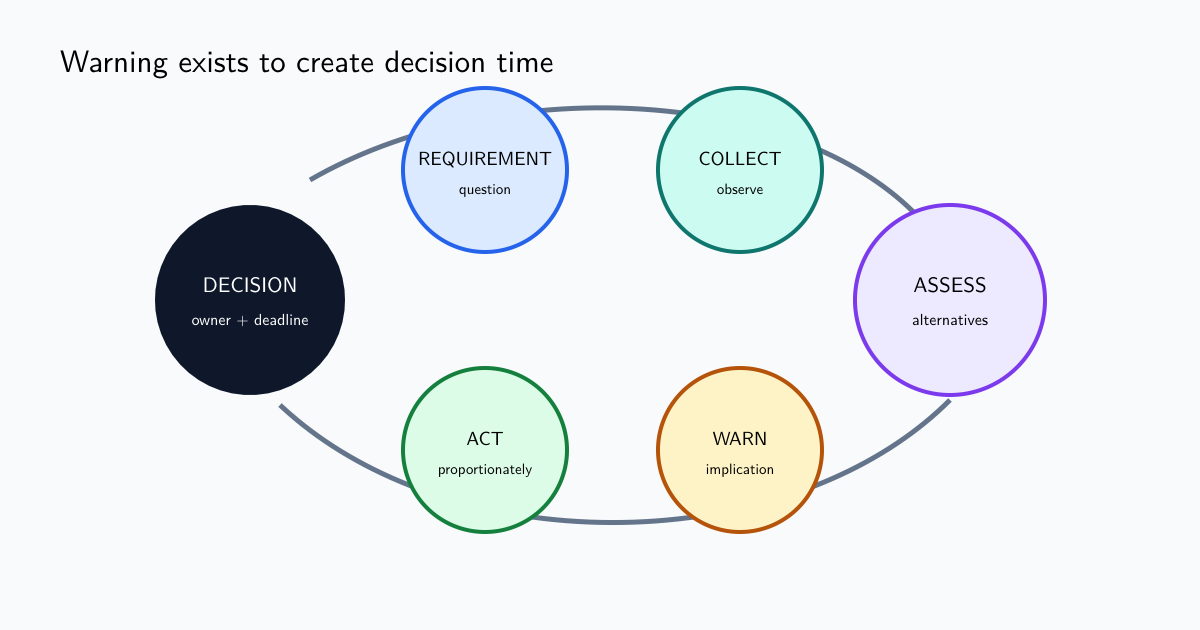
Connect thresholds to decisions. A metric without a decision owner becomes reporting overhead. Define when to reinforce, pause, terminate, warn, restore, disclose, or revise the campaign. Strategic warning should consume the same indicators when adversary adaptation creates a new risk or opportunity.
Assess adaptation, displacement, and unintended effects
Adversaries route around disruption, replace infrastructure, change tools, delegate to proxies, alter narratives, accelerate operations, or retaliate elsewhere. A local effect can therefore produce strategic displacement rather than restraint. Track the affected function across alternate systems, organizations, geographies, and time. Ask whether the campaign changed cost, tempo, quality, exposure, or merely visibility.
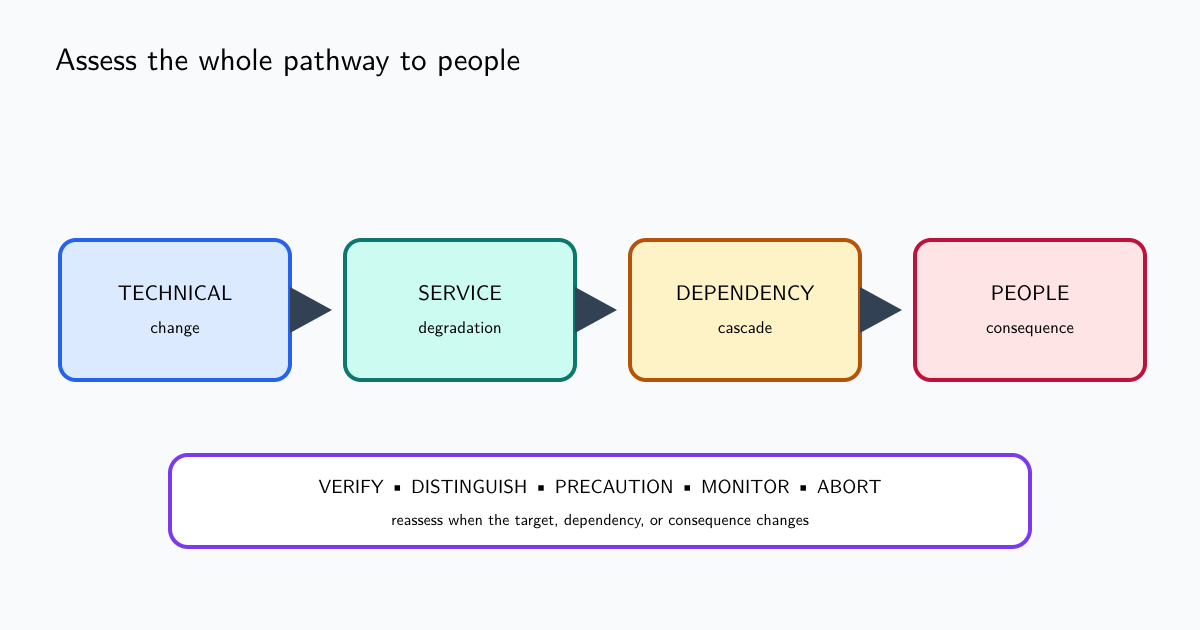
Monitor unintended effects with the same discipline as intended outcomes. Include civilian disruption, partner friction, intelligence loss, capability disclosure, defensive complacency, escalation, market consequence, and adversary recruitment or propaganda. Record positive externalities too, such as improved partner defence or exposure of a wider ecosystem. Do not erase harm by netting it against technical success.
Establish review cadences for immediate technical assessment, near-term mission assessment, and longer strategic assessment. Use independent challenge to test confirmation bias and institutional incentives. Preserve the possibility that observed change was temporary, caused by another actor, or produced no durable strategic value.
Write an assessment that changes the next decision
Lead with outcome, confidence, and implication. State performance separately. Walk the evidence through the causal chain, identify the baseline and counterfactual, explain alternatives and gaps, and describe intended, unintended, and adaptive effects. Distinguish observed fact, partner report, official claim, and analytic inference. Avoid numeric precision unsupported by collection.
Recommend whether to continue, reinforce, modify, pause, terminate, disclose, or shift instruments. Identify the decision owner and deadline. Preserve dissent and specify indicators that would change the judgment. A finding that the operation failed is valuable when it prevents repeated cost; a finding of success is incomplete until durability and strategic relevance are tested.
Maintain an assessment ledger linking objectives, assumptions, measures, sources, readings, decisions, and revisions. Feed lessons into campaign theory, target models, access stewardship, precautions, collection, and training. The best cyber-effects assessment does not decorate a completed operation. It makes the organization more honest about causality and more capable of adapting.
Frequently asked questions
What is cyber-effects assessment?
Cyber-effects assessment determines what changed because of an operation or campaign across technical, functional, operational, human, and strategic levels. It tests causal assumptions, unintended consequences, adversary adaptation, and whether the result served the objective.
What is the difference between performance and effectiveness?
Performance asks whether the activity was executed as intended. Effectiveness asks whether it produced the desired outcome. Successful access or task completion can coexist with no meaningful mission or strategic change.
Why is a baseline necessary?
A baseline describes conditions before action, normal variation, and expected trends. Without it, analysts can mistake routine fluctuation, unrelated events, or adversary deception for operational effect.
What is a counterfactual in campaign assessment?
A counterfactual is the best-supported estimate of what would likely have happened without the operation. It can use comparison systems, historical patterns, process knowledge, adversary behavior, or structured expert judgment and should state uncertainty.