Cyber Campaign Design: Connecting Ends, Ways, Means, and Effects
Build defensible cyber campaign concepts by connecting policy aims to behavior, operational functions, effects, authorities, intelligence, risk, assessment, and termination.
Begin with a policy condition and a decision deadline
Cyber campaign design starts with the condition a responsible authority wants to create, preserve, or prevent. “Disrupt the adversary” is not yet an end. A usable aim identifies the actor or system of concern, desired behavior or condition, protected interests, time horizon, acceptable cost, and the decision-maker who will judge progress. It should also describe what must remain true for civilians, partners, intelligence equities, and friendly missions.
Translate the aim into a theory of change. Ask which adversary decisions, capabilities, confidence, relationships, or operating conditions must change. Identify the functions that enable the unwanted behavior: command, identity, logistics, finance, communications, data, distribution, trust, or recovery. Only then consider whether a cyber effect can alter one of those functions at the required time and scale.
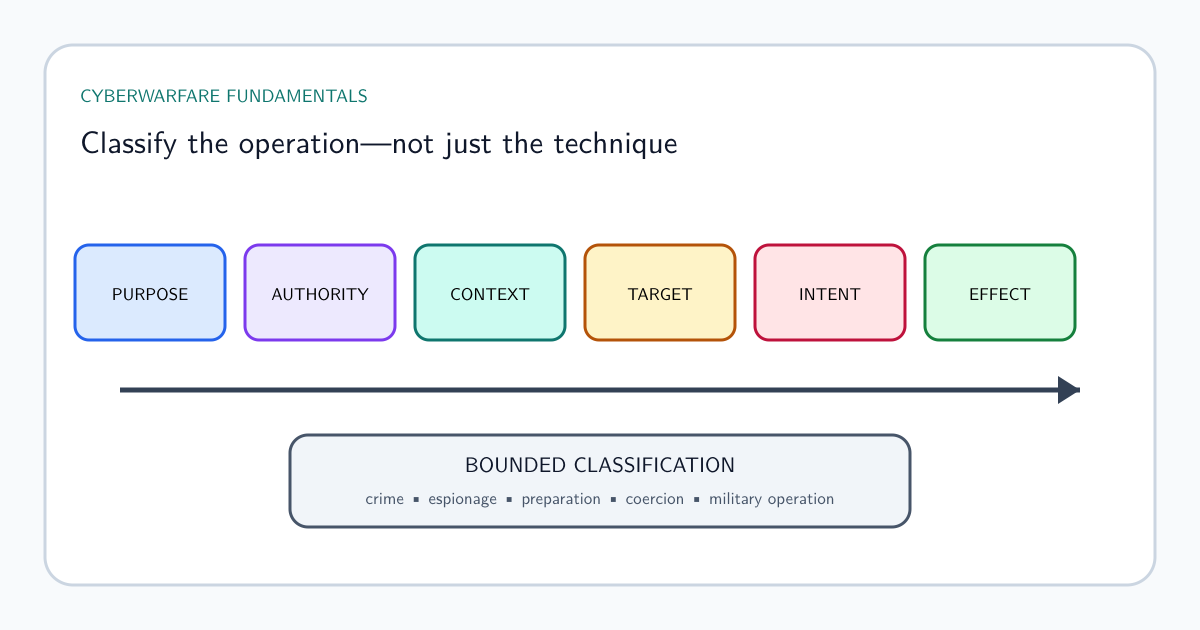
Work backward from policy condition to behavior, adversary function, operational effect, and possible action. At every link write the assumption and an observable test. Then test forward: if the action succeeds technically, is the operational function likely to change; if the function changes, how might the adversary adapt; and if behavior changes, does that create the intended policy condition? The practical definition of cyberwarfare helps keep this design tied to strategic context rather than tool selection.
Design options around effects, not capabilities
An effect specification describes what must change, where, for whom, when, for how long, with what visibility, and with what recovery or reversibility. Terms such as deny, degrade, disrupt, destroy, manipulate, expose, or influence are starting verbs, not complete requirements. Define the target function and state, acceptable precision, propagation boundary, confidence, monitoring, and condition for stopping.
Develop multiple ways to reach the objective. Cyber action may enable intelligence, temporary friction, data denial, confidence loss, exposure, or support to another instrument. Defensive hardening, partner assistance, diplomacy, sanctions, law enforcement, public attribution, physical action, or doing nothing may be better. Compare options on likely effect, time, authority, access cost, intelligence gain or loss, reversibility, civilian consequence, partner dependence, escalation, and adversary adaptation.
The UK’s Responsible Cyber Power in Practice describes operations as accountable, precise, and calibrated, and emphasizes cognitive as well as technical effect. That does not mean every campaign should pursue hidden influence. It means planners should consider how an adversary interprets degraded function, exposed activity, unreliable data, or repeated recovery cost—and how friendly and neutral audiences may interpret the same event.
Treat target development as a versioned argument
A target is the adversary function or behavior the campaign intends to affect. The visible host, account, application, supplier, or network is an object within a larger system. Map people and process, identity, applications, data, communications, suppliers, physical dependencies, recovery paths, and mission use. Draw dependencies in both directions so shared services and downstream civilian consequences remain visible.
Build a target folder as a versioned analytic argument. Separate observed facts, supported inferences, assumptions, gaps, sources, owners, timestamps, confidence, expiry, and abort triggers. Document current system state, expected changes, alternative routes, administrative control, monitoring, and what evidence would invalidate the design. A polished diagram without provenance can conceal more uncertainty than it resolves.
Target development joins intelligence, operations, technical specialists, legal advisers, civilian-protection expertise, mission owners, and partners. Each sees a different failure mode. Independent review should challenge whether the object is necessary, whether the effect remains bounded, whether shared dependencies are understood, and whether a safer or more reversible option can produce sufficient advantage.
Manage access, capability, and operational security as portfolios
Access is not a trophy. Record the requirement it supports, authority, owner, confidence, intelligence value, actions it could enable, dependencies, observation method, exposure, interference risk, and expiry. Additional persistence can create diminishing value by increasing counterintelligence, legal, collateral, and capability-loss risk. Retire access that no longer serves an authorized purpose.
Separate access from capability. A capability must fit the current target state, intended effect, delivery conditions, monitoring, reversibility, safety constraints, and release authority. Validate only in authorized replicas or ranges, under configuration control and independent review. Real systems contain undocumented dependencies, operator behavior, timing, and recovery actions that a test environment cannot reproduce completely.
Operational security covers the campaign’s people, procurement, development, testing, infrastructure, communications, execution, assessment, and cleanup. Correlation over time can expose a program even when individual actions appear anonymous. Define what the adversary, provider, partner, and public can observe at each phase. Deconflict collection and operational equities before they collide, and name the person who can pause or terminate the activity.
Integrate authority, partners, defence, and civilian protection
Campaign approval is conditional on a changing environment. Record domestic authority, international-law analysis, partner caveats, target status, civilian dependencies, intelligence equities, release conditions, escalation assumptions, and required precautions. Revalidate when the target moves, a supplier changes, armed conflict begins, civilian use appears, telemetry is lost, or the expected effect escapes its boundary.
Integration does not erase ownership. Intelligence can identify access and observe effect; operations can sequence action; defenders can harden friendly systems and detect retaliation; diplomats and law enforcement can provide other levers; communicators can prepare truthful public response; partners bring access, context, caveats, and consequences. A common campaign picture should show decisions, dependencies, and deadlines while preserving each authority.
Design civilian protection across the full chain: object, technical effect, service effect, and human consequence. Shared identity, cloud, telecom, energy, financial, health, and software services can transmit harm beyond the intended object. Include vulnerable populations, reverberating effects, recovery burden, and cumulative disruption. Precautions and reassessment are operational controls, not a legal paragraph added after the design is complete.
Assess, adapt, and terminate the campaign honestly
Establish baselines and collection before action. Measures of performance ask whether tasks occurred. Technical measures ask whether the system state changed. Measures of effectiveness ask whether the target function changed. Strategic assessment asks whether behavior or conditions moved toward the policy aim. Keep these levels separate so completed activity is not reported as achieved strategy.
For every indicator define source, owner, expected direction, threshold, latency, and alternative causes. Include negative effects: civilian disruption, faster adversary adaptation, partner distrust, capability disclosure, escalation, recruitment value, and friendly opportunity cost. Protect the sources that can observe the result and plan for deceptive or incomplete telemetry.
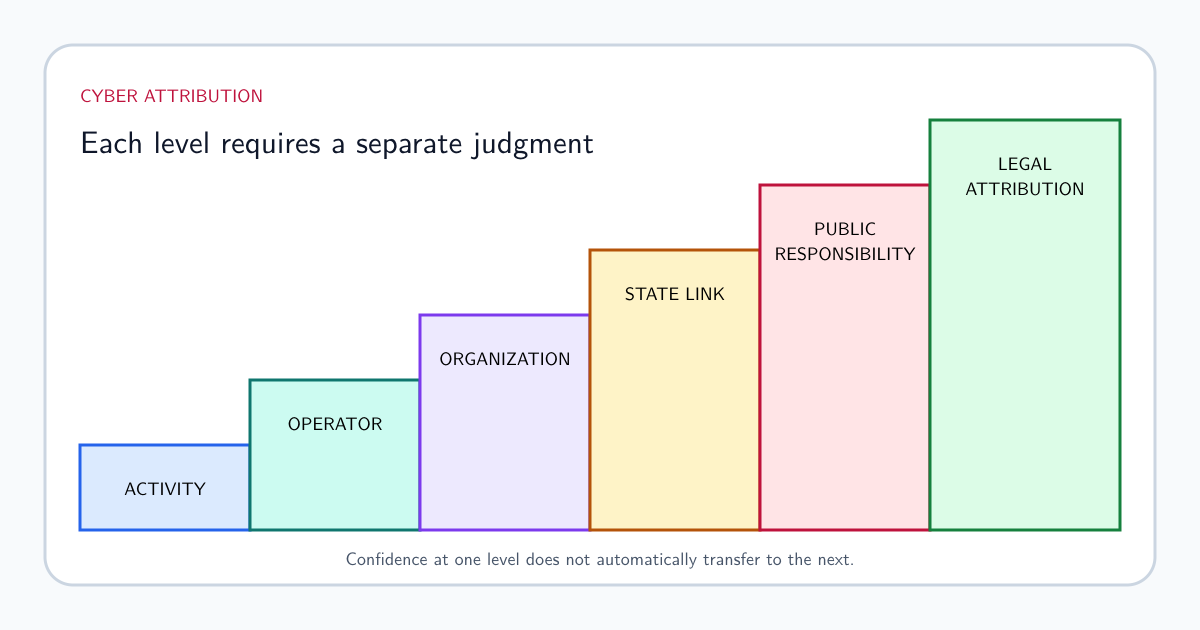
Assessment exists to drive decisions: reinforce, change method, shift instrument, pause, disclose, terminate, or move to defence. Define success, partial success, failure, and unacceptable harm in advance. Preserve the possibility that the operation produced no material strategic effect. Feed observed behavior into cyber attribution where responsibility affects the next decision and into the detection engineering lifecycle where friendly defence must adapt. A campaign ends responsibly when its authority, relevance, acceptable risk, or causal theory ends—not merely when technical access disappears.
Frequently asked questions
What is cyber campaign design?
Cyber campaign design is the reasoning process that links a policy condition to target behavior, operational functions, authorized effects, capabilities, sequencing, safeguards, assessment, and termination. It is broader than selecting a vulnerability or technical action.
Why plan backward from the policy aim?
A technical effect has value only if a credible causal path connects it to the desired operational or strategic change. Backward planning exposes assumptions before scarce access, capability, authority, and partner trust are committed.
Is persistent access always operationally valuable?
No. Access has purpose, cost, exposure, dependencies, intelligence value, authority, and shelf life. Unneeded persistence can create legal, counterintelligence, collateral, and capability-loss risk.
How should campaign success be measured?
Separate measures of performance, technical effect, operational effectiveness, and strategic outcome. Establish baselines, indicators, decision thresholds, observation owners, timing, alternative causes, and unacceptable-harm criteria before action.