Responsible OSINT Collection
Plan public-source research with clear authority, minimization, researcher safety, provenance, retention, and escalation boundaries.
Possible collection is not automatically responsible
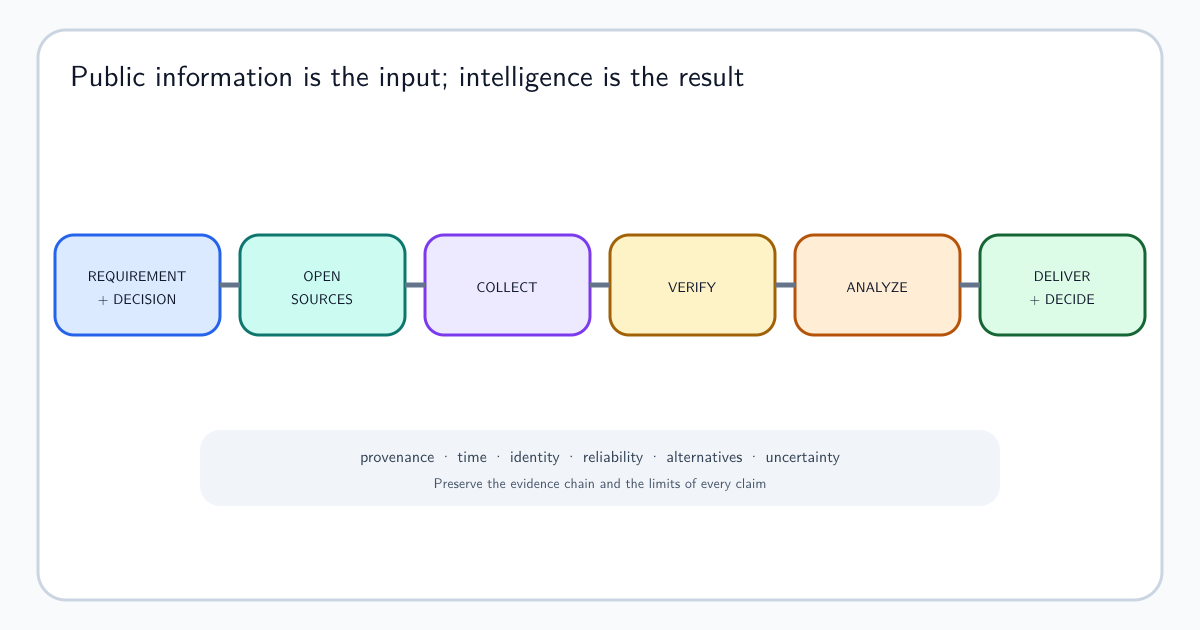
Public availability does not remove legal, contractual, ethical, privacy, or safety obligations. Begin with a legitimate requirement and collect only what is necessary to support an authorized decision. For the definition, source landscape, verification workflow, and cybersecurity applications that precede these safeguards, see What Is OSINT?.
A public profile, exposed database, discussion forum, breach post, or map can still contain sensitive personal data, unsafe material, copyrighted content, or information subject to platform terms and local law. Write the intelligence question, intended consumer, and action before searching. If the work has no defensible decision purpose, broader collection is unlikely to make it responsible. Seek organizational legal or privacy guidance when authority is unclear.
Define authority and necessity
Document purpose, scope, jurisdictions, platform terms, permitted methods, sensitive categories, retention, and approvers. Avoid authentication bypass, deceptive interaction, purchasing access, or collection that exceeds organizational authority.
Define whether analysts may create accounts, join groups, automate requests, interact with subjects, acquire datasets, or use leaked credentials. “It was technically possible” is not authorization. Use a collection plan that names sources, methods, rate and time limits, data fields, security controls, escalation points, and disposal. Reassess when the investigation crosses into a new country, platform, identity, protected group, or type of interaction.
Protect people and researcher identity
Separate personal and research accounts, control active content, avoid unnecessary contact, and consider how searches, downloads, and profiles expose the researcher. Escalate material involving vulnerable people, imminent harm, or illegal content through approved routes.
Use an approved research environment, managed identities, safe browsing and file-handling controls, and a communication plan. Searches, follows, profile views, purchases, and messages may notify a subject or shape the platform’s recommendations, changing both risk and evidence. Do not improvise contact with threat actors or potential victims. If collection reveals imminent danger, exploitation, or prohibited material, stop ordinary handling, preserve minimal necessary context, and use the designated safety or legal route.
Preserve provenance and minimize data
Record URLs, authorship claims, timestamps, captures, transformations, and collection conditions. Minimize unrelated personal data and protect raw material. Source evaluation and corroboration require the original context, not only an extracted claim.
Preserve the exact location, retrieval time, visible account or publisher claim, access conditions, and a controlled capture where permitted. Record translations, OCR, cropping, de-duplication, enrichment, and analyst notes separately from the original. Collect the smallest fields needed; redact unrelated people in distributable products while retaining authorized provenance. Public content can be false, recycled, manipulated, or removed, so evaluate source access, motivation, history, and independent corroboration.
Use stop and escalation conditions
Set limits for time, depth, interaction, cost, confidence, and risk before collection begins. Stop when the requirement is answered, evidence becomes too weak, risk increases, or new authority is required. Record gaps rather than crossing the boundary.
Practical stop conditions include encountering credentials, paywalls or access controls, requests for payment or contact, sensitive personal data outside scope, malware, illegal content, escalating researcher exposure, or inability to preserve provenance. Escalation can authorize a safer method, narrow the question, involve specialists, or end collection. A documented gap is an analytical result; concealing an unauthorized method or accumulating unnecessary data creates risk that no additional fact can justify. When a source changes from passive viewing to interaction, pause and reassess authorization because the legal, ethical, and operational risk may have changed materially.