Threat Intelligence Career Path: Analyst to CTI Leader
Explore the threat intelligence career path from junior analyst to senior specialist, principal, manager, and CTI leader, including promotion skills.
The Threat Intelligence Career Path Is Not a Single Ladder
Once you land a threat intelligence role, the next question changes. You are no longer asking, “How do I get into CTI?” You are asking, “What does good progression actually look like?”
The answer is not simply junior analyst, analyst, senior analyst, manager.
A threat intelligence career path is rarely one fixed ladder. Mature CTI teams support several overlapping routes: some analysts become deep technical specialists, some become strategic intelligence experts, some move toward principal or staff-level individual-contributor roles, and others become team leads, managers, program owners, or heads of intelligence.
The important distinction is that career level and job title are not the same thing. Titles vary dramatically between companies. One organization may call someone a Senior Threat Intelligence Analyst after three years, while another reserves “senior” for analysts who own major intelligence programs and influence enterprise security strategy.
A better way to understand progression is to look at four dimensions:
Scope. How large and ambiguous are the problems you can own?
Judgment. How much trust does the organization place in your assessments and recommendations?
Influence. How many people, teams, and decisions are affected by your work?
Ownership. Do you complete assigned products, or do you identify what intelligence work needs to exist in the first place?
Early in your career, growth usually means becoming independently reliable. Later, it means making other analysts, security functions, and decision-makers more effective.
That is why the strongest promotion strategy is not “learn more tools.” It is to repeatedly increase the size of the problem you can solve without reducing the quality of your analysis.
Level 1: Junior CTI Analyst - Learn to Produce Reliable Work
The junior analyst stage is primarily about execution with guidance.
You may be assigned indicator enrichment, daily threat monitoring, actor updates, campaign summaries, intelligence collection, phishing analysis, vulnerability context, or recurring reporting. The individual tasks can look simple, but the real objective is to build disciplined habits.
At this level, your manager should not expect you to know everything. They should expect you to be teachable, traceable, and increasingly consistent.
The strongest junior analysts learn to:
Follow an intelligence requirement. They understand what question the product is supposed to answer instead of collecting interesting facts indefinitely.
Document sources and pivots. Someone else can reproduce the research path and understand why a source was trusted.
Separate fact from assessment. They do not present assumptions, vendor claims, or weak attribution as established truth.
Write clearly. Their work may still require editing, but the core judgment is visible and the evidence is organized.
Ask useful questions. They escalate uncertainty without handing the entire problem back to a senior analyst.
Incorporate feedback. The same editorial or analytical mistake should not appear ten times.
Promotion out of the junior stage usually happens when the team stops thinking, “Can this person complete the task?” and starts thinking, “I can give this person the problem and trust the result.”
That shift from supervised execution to independent reliability is the first major career milestone.
Level 2: CTI Analyst - Own Problems, Not Just Products
A fully independent CTI analyst is expected to do more than complete recurring deliverables. You begin to own analytical problems.
Instead of being told, “Write a report about this campaign,” you may be asked, “Are we exposed to this campaign, and what should we do about it?” That second question requires broader judgment.
At this stage, strong analysts can define the research approach, choose appropriate sources, coordinate with internal teams, identify collection gaps, and tailor the final product to the consumer.
Your work should also become more connected to operations.
If you identify new adversary behavior, can detection engineering use it?
If you assess a sector-specific threat, can vulnerability management change prioritization?
If a campaign is likely to target executives, can security awareness or identity teams take action?
If leadership asks whether a geopolitical event changes risk, can you explain the plausible pathways instead of repeating headlines?
The analyst level is where CTI starts becoming less about “threat research” and more about decision support.
To progress further, you need to demonstrate that your work improves outcomes outside the intelligence team. Seniority comes from creating leverage: better detections, faster investigations, clearer priorities, more focused collection, stronger executive decisions, or fewer wasted analyst hours.
A capable mid-level analyst makes their own work good. A future senior analyst starts making the surrounding system better.
Level 3: Senior CTI Analyst - Handle Ambiguity and Raise the Quality of the Team
Senior analysts are not simply faster analysts with more threat actor knowledge.
The defining change is ambiguity.
A senior analyst can take a poorly defined intelligence problem, clarify the requirement, identify the stakeholders, determine what evidence is available, establish what is missing, and produce an assessment that remains useful even when the data is incomplete.
Senior analysts are often trusted with high-impact work: strategic threat assessments, major incident support, attribution-sensitive analysis, executive briefings, intelligence planning, collection strategy, priority threat programs, and review of other analysts’ products.
But individual output is only part of the role.
A strong senior analyst also improves the team’s analytical standard. They review drafts without rewriting everything themselves. They explain why an assessment is weak. They notice recurring source-quality problems. They build templates, analytic standards, research methods, or review practices that make future work better.
This is also where stakeholder management becomes a core skill.
Senior analysts need to challenge requests that are interesting but irrelevant. They need to tell leaders when available evidence cannot support a confident answer. They need to translate technical findings for executives without distorting them. And they need to work across incident response, SOC, vulnerability management, detection engineering, fraud, physical security, legal, and risk functions.
The promotion signal at this level is no longer “produces excellent intelligence.”
It becomes: “When this person is involved, difficult intelligence problems become more structured, and everyone around them makes better decisions.”
The Expert Track: Principal, Staff, and Specialist CTI Roles
Management is not the only way to keep advancing.
Strong CTI organizations create senior individual-contributor paths for analysts whose greatest value comes from deep expertise, high-level analytical judgment, technical capability, or cross-organizational influence.
Titles vary, but you may encounter Principal Threat Intelligence Analyst, Staff Analyst, Principal Researcher, Senior Threat Researcher, Intelligence Architect, or similar roles.
These positions often combine several forms of leverage.
Deep domain expertise. You may become the organization’s authority on a threat ecosystem, region, intrusion set, malware family, cloud attack surface, criminal marketplace, or intelligence discipline.
Methodology ownership. Principal analysts often define how the organization performs attribution, source evaluation, intelligence requirements, actor tracking, collection management, analytic review, or intelligence production.
Cross-functional influence. You may work directly with senior security leaders, product teams, detection engineering, incident response, legal, trust and safety, fraud, corporate security, or external partners.
Complex-case leadership. During major incidents or ambiguous investigations, the principal analyst may coordinate the intelligence picture without becoming the people’s manager.
Mentorship without direct reports. You raise the capability of other analysts through reviews, coaching, research guidance, and analytical standards.
The expert track fits people who enjoy difficult intelligence problems and broad influence but do not want their calendar dominated by hiring, performance reviews, budgets, and organizational administration.
Reaching principal level generally requires something stronger than “I am the person who knows the most threat actors.” You need a record of solving high-value problems that few others can solve and of transferring that capability into the organization.
The Leadership Track: Team Lead, Manager, Director, and Head of CTI
Moving into CTI leadership changes the job more dramatically than many analysts expect.
Your value is no longer measured mainly by the intelligence products you personally create. It is measured by the capability of the function you build.
A team lead may still perform substantial analysis while coordinating priorities, reviewing work, mentoring analysts, and representing the team in operational meetings.
A manager owns people and delivery. Hiring, performance management, workload balance, development plans, prioritization, stakeholder expectations, and quality control become central responsibilities.
A director or head of CTI operates at program level. They define what the intelligence function exists to accomplish, secure budget and tooling, establish collection priorities, manage vendors and partnerships, align intelligence with business risk, and explain the program’s value to senior leadership.
The skills that made you a great analyst are necessary but no longer sufficient.
CTI leaders need to become strong at:
Prioritization. There will always be more threats than analyst capacity.
Expectation management. Stakeholders need to understand what intelligence can answer, what it cannot answer, and how long different assessments require.
Talent development. A manager who produces great analysis but fails to grow analysts eventually becomes the team’s bottleneck.
Program design. Leadership requires deciding which products, workflows, sources, and partnerships deserve investment.
Measurement. You need credible ways to show whether intelligence changes decisions, improves defensive action, reduces uncertainty, or saves time.
Organizational communication. Senior leaders rarely care how many indicators were enriched. They care whether the program helps the organization understand and manage meaningful risk.
The best CTI leaders stop trying to be the smartest analyst in every room. They build an environment where good analysis happens consistently without depending on them.
Specialist Branches: Technical, Strategic, Research, and Intelligence Operations
Not every CTI career develops around the same type of intelligence.
As you gain experience, you may discover that one part of the discipline consistently holds your attention. Specialization can become a powerful career accelerator when it is built on solid general tradecraft.
Technical threat intelligence sits close to detection engineering, incident response, malware analysis, network analysis, and adversary infrastructure. Analysts in this branch may focus on TTPs, telemetry, detection opportunities, malware ecosystems, infrastructure clustering, or intrusion reconstruction.
Strategic threat intelligence sits closer to business risk and leadership decision-making. The work may involve geopolitical developments, sector targeting, supply-chain exposure, emerging adversary capabilities, executive risk, or long-range threat assessments.
Threat research often emphasizes discovering and tracking adversaries, campaigns, malware, vulnerabilities, infrastructure, and criminal ecosystems. In vendors and security companies, research may also support public reporting, product capabilities, detections, or customer-facing intelligence.
Intelligence operations and collection focuses on how intelligence is sourced, organized, enriched, prioritized, distributed, and measured. This can include intelligence platforms, collection requirements, source management, automation, data engineering, TIP administration, and workflow design.
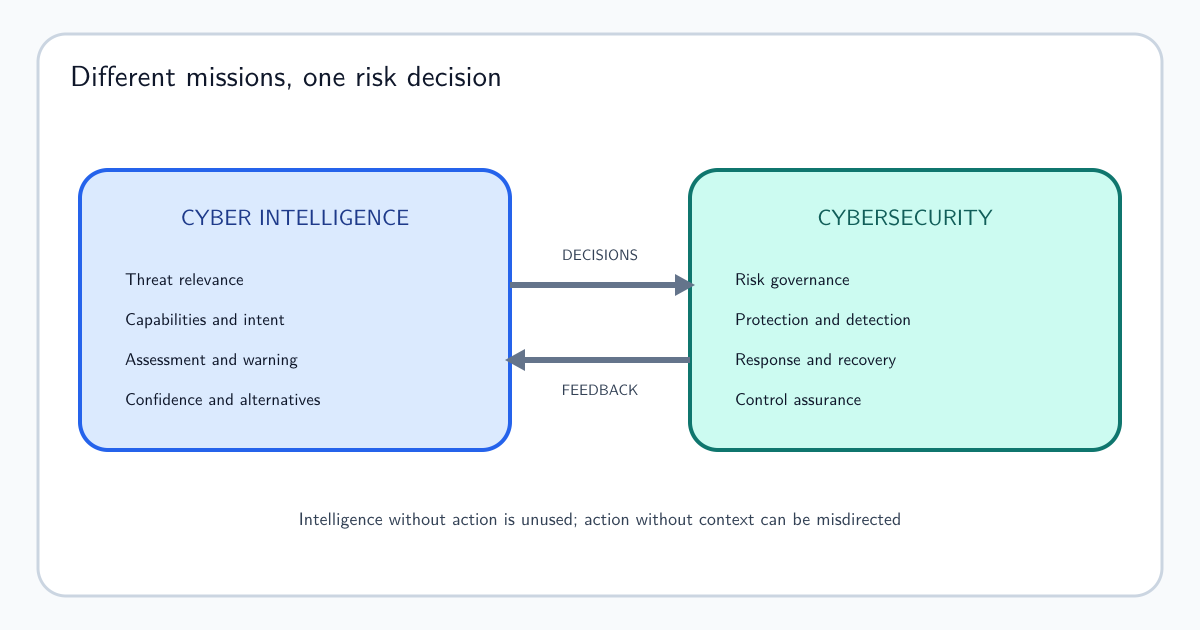
Threat hunting and detection-focused intelligence blends CTI with operational defense. Analysts translate adversary behavior into hypotheses, hunts, analytics, detection logic, and validation. If you are deciding between adjacent career families, Cyber Intelligence vs Cybersecurity compares their missions, workflows, outputs, tools, and skills.
Fraud, trust and safety, physical security, and corporate intelligence can also intersect with CTI when adversaries cross digital and non-digital boundaries.
Specialization should not mean tunnel vision. The best specialists understand adjacent disciplines well enough to connect their work to the wider security mission.
A technical expert who cannot explain business relevance will hit a ceiling. A strategic analyst who does not understand the technical evidence beneath an assessment will also hit a ceiling.
Depth creates differentiation. Breadth keeps the depth useful.
What Actually Gets You Promoted in Threat Intelligence
Promotions rarely come from doing the same work for another twelve months.
The clearest promotion cases show a pattern of expanded impact.
You require less direction. You can clarify an unclear request, plan the work, identify dependencies, and deliver without constant intervention.
Your assessments are trusted. Stakeholders know that your confidence language means something, your sourcing is defensible, and you will update an assessment when the evidence changes.
You connect intelligence to action. Your work affects detections, investigations, vulnerability priorities, security controls, executive decisions, planning, or resource allocation.
You improve recurring work. You automate a painful process, redesign an ineffective product, improve source management, create a repeatable methodology, or eliminate duplicated effort.
You make other analysts better. You review work constructively, share techniques, document methods, mentor newer analysts, and reduce dependence on tribal knowledge.
You operate well across boundaries. Senior work often requires coordination with people who do not report to you and may not understand intelligence terminology.
You demonstrate judgment about what not to do. Mature analysts know that another report, another feed, another dashboard, or another actor profile is not automatically valuable.
Keep a record of these outcomes throughout the year. Do not wait for performance-review season and try to remember everything from memory.
A useful promotion log includes the problem, your role, the decision or outcome, the stakeholders involved, measurable improvement where available, and what changed because of your work.
This creates a far stronger career narrative than a list of courses completed or tools learned.
Design Your Next Two Years: A CTI Career Progression Plan
Career progression becomes easier when you stop treating “senior” as an abstract destination.
Choose the kind of responsibility you want next and work backward.
If you want to become a senior analyst, seek ambiguous assessments, stakeholder-facing work, product review opportunities, and ownership of a recurring intelligence problem.
If you want to become a principal or specialist, build unusual depth in an area the organization genuinely needs. Publish internal methodology, solve hard cases, mentor analysts, and become known for transferable expertise rather than isolated knowledge.
If you want to become a manager, start practicing leadership before you have direct reports. Improve planning, run small projects, mentor peers, coordinate across teams, document expectations, and learn how to give useful feedback.
If you want to become a CTI leader, learn the business side of intelligence. Understand budgets, vendor decisions, hiring, program measurement, organizational risk, executive communication, and how security priorities are set.
Then identify the gap between your current evidence and the next role.
A simple two-year plan can contain four categories:
Capability: What must you become able to do?
Evidence: What project or outcome will prove it?
Exposure: Which stakeholders or problems do you need experience with?
Feedback: Who can tell you whether you are operating at the next level yet?
Review that plan every quarter. Replace vague goals such as “learn more threat intelligence” with observable ones such as “lead one cross-functional assessment from requirement to executive briefing” or “design and document the review standard for recurring actor reports.”
If you are still building toward your first role, start with our courses to develop structured capability and exams to validate key skills. Once you are inside a CTI team, however, the most valuable career evidence increasingly comes from the problems you own and the outcomes you create.
Your career advances when the organization can trust you with a larger piece of the intelligence mission. At first that may be a report. Then a problem. Then a program. Eventually, it may be the people and strategy behind the entire function.