CTI Sources: How to Evaluate and Corroborate Them
Evaluate CTI sources for reliability, provenance, bias, coverage, and claim credibility, then corroborate reporting without mistaking repetition for proof.
Cyber Threat Intelligence is only as defensible as its evidence. That does not mean analysts should search for one perfectly reliable source. No source sees the entire threat environment. Internal telemetry reveals what happened inside one organization; a vendor sees its customers; a sharing group sees participating members; a government sees what its authorities and partners provide; a criminal seller may know its own inventory but exaggerate to attract buyers.
The analyst’s task is to build a portfolio in which sources answer different parts of a requirement, preserve where every claim came from, evaluate access and motivation, and corroborate important judgments with genuinely independent evidence. More information is not automatically better. Collection that outruns processing, analysis, authority, or action creates noise and risk.
This guide explains the source landscape, collection planning, provenance, source and claim evaluation, corroboration, bias, portfolio measurement, and responsible collection. Readers who first need the definition, source families, process, risks, and cybersecurity applications can start with What Is OSINT?. It is designed to support the collection stages in the Cyber Threat Intelligence lifecycle. Analysts can practice the method with public, licensed, and synthetic data using a safe threat intelligence home lab, then apply the same provenance and corroboration discipline when designing intelligence-led security testing.
Source Selection Starts With the Intelligence Requirement
A source is valuable only relative to a question. A malware sandbox may provide excellent execution behavior and no useful visibility into actor intent. A geopolitical specialist may explain state objectives and have no access to the intrusion’s forensic evidence. A commercial feed may provide fast indicators while omitting provenance needed for attribution.
For each intelligence question, define:
- which facts or observations would support an answer;
- which evidence could disprove the leading explanation;
- required geography, language, sector, platform, and time range;
- how quickly the consumer needs the information;
- whether the decision requires broad trend coverage or case-level detail;
- acceptable handling, privacy, legal, and source-protection constraints;
- the cost of a false conclusion;
- internal sources that can validate external reporting.
Then map candidate sources to those needs. Do not begin with “Which feeds do we own?” Begin with “Which evidence would change the answer?”
A collection plan should also record coverage gaps. If no source has direct visibility into attacker tasking, state that motivation will be inferred from targeting and collection behavior. If endpoint telemetry covers only part of the fleet, a negative search cannot prove absence across the organization.
The CTI Source Landscape
A strong portfolio combines sources with different access and limitations.
Internal security telemetry: endpoint, network, DNS, proxy, email, identity, cloud, application, and control-plane events. It provides direct organizational relevance but only where collection and retention exist.
Incident and case records: timelines, forensic artifacts, responder notes, fraud cases, help-desk reports, and lessons learned. They reveal actual exposure and attacker behavior, though inconsistent documentation can limit comparison.
Business and asset context: inventory, vulnerabilities, identities, privileges, suppliers, applications, data flows, critical processes, geography, and planned changes. This is what turns external threat reporting into organizational intelligence.
Government and public-sector reporting: advisories, alerts, indictments, sanctions, vulnerability catalogs, and technical reports. These can carry authoritative access or policy significance, but public evidence and detail vary.
Commercial intelligence: feeds, portals, finished reports, malware analysis, infrastructure data, risk scores, and analyst access. Commercial does not automatically mean independent, complete, or high quality; evaluate the underlying collection.
Information-sharing communities: ISACs, ISAOs, sector groups, trusted circles, and bilateral partnerships. They can provide timely peer context, but membership, validation, and redistribution rules differ. In industrial environments, the OT CTI method shows how sector reporting, vendor evidence, engineering knowledge, and site telemetry must converge before a threat claim becomes an operational decision.
Technical and internet data: passive DNS, certificates, routing, registration, scanning, sandboxes, malware repositories, code repositories, package ecosystems, and vulnerability research. These are powerful for pivots and relationships when time, shared infrastructure, and collection method are understood.
Media, research, and academic sources: investigative reporting, conference papers, institutional research, and specialist publications. They offer context and synthesis but may repeat vendor or government claims.
Human and criminal-ecosystem sources: interviews, expert contacts, source reporting, forums, marketplaces, leak sites, negotiation logs, and actor communications. They can reveal intent and access but create substantial authenticity, deception, authorization, safety, privacy, and handling challenges.
Preserve Provenance Before Enrichment and Repetition Obscure It
Provenance is the history of where information came from and how it changed. Without it, analysts cannot evaluate independence, timing, credibility, handling, or error.
For every material claim or artifact, retain:
- original source and author or producer;
- source type and collection method when known;
- original publication, observation, collection, and receipt times;
- the exact claim or observation, not only a paraphrase;
- references to upstream sources;
- transformations such as translation, extraction, enrichment, or scoring;
- handling markings, licensing, privacy, and sharing restrictions;
- analyst notes, confidence, and link to the requirement;
- revisions, retractions, and later validation.
Trace reporting to the earliest accessible observation. A news story may cite a vendor blog, which cites an unnamed incident, which relies on telemetry not shown publicly. The story and blog are not independent confirmation of the incident. They are a chain leading to one underlying evidentiary stream.
Preserve the original alongside processed data. An automatically extracted IP can lose the sentence explaining that it belongs to a shared service, was observed only once, or is included as a benign comparison. Translation can change probability language. A screenshot can omit timestamp, account, or surrounding conversation.
Provenance also makes corrections possible. If an original source retracts a domain or changes an attribution, the team can identify every derived record, analytic product, detection, and consumer that may need review.
Evaluate the Source and the Specific Claim Separately
Source reliability and information credibility are related but different.
Source reliability asks whether the producer has appropriate access, expertise, methods, and a history of accurate reporting. Consider:
- direct versus indirect access;
- relevant technical, regional, linguistic, sector, or investigative expertise;
- transparency of collection and method;
- historical accuracy and correction behavior;
- incentives, conflicts, marketing pressure, political position, or adversary control;
- scope and recurring blind spots;
- identity and authenticity.
Information credibility asks whether this particular claim deserves belief. Consider:
- internal consistency and technical plausibility;
- specificity and falsifiability;
- timestamps and temporal fit;
- supporting evidence;
- independent corroboration;
- consistency with directly observed internal data;
- alternative explanations;
- contradictions or signs of manipulation.
A historically reliable vendor may publish a new attribution based on one uncorroborated overlap. The source can remain reliable while confidence in that claim stays limited. An unknown researcher may publish a packet capture and reproducible method that makes one technical finding highly credible even though the source lacks a track record.
Avoid compressing every dimension into one score. A source can be fast but shallow, technically precise but narrow, strategically insightful but late, or highly relevant but restricted from sharing. Preserve these dimensions so analysts can select the right source for the right question.
Corroboration Requires Independent Access, Not Repeated Wording
Corroboration strengthens a claim when another source with relevant and independent access provides compatible evidence.
Use this method:
1. Define the exact claim. “The actor uses Domain X,” “Domain X hosted malware on a date,” and “Domain X was controlled by the actor” are different claims.
2. Trace dependencies. Identify which sources cite, syndicate, license, or derive from others.
3. Compare access. Two endpoint vendors observing different victims may be independent. Two articles citing the same government advisory are not.
4. Compare evidence, not conclusions. Sources can agree on an actor name while using different cluster definitions. Determine which underlying incidents and artifacts overlap.
5. Check temporal compatibility. The same IP seen a year apart may represent reassignment, not corroboration.
6. Look for complementary evidence. Malware configuration, passive DNS, authentication events, victim reports, and source communications can independently support different parts of one assessment.
7. Preserve disagreement. Contradiction may reveal a false assumption, different scope, collection bias, or actor change.
Corroboration is not a voting system. Evidence strength depends on access, specificity, independence, and fit. One direct forensic observation can outweigh many derivative summaries. Conversely, one source’s privileged access can be valuable while remaining impossible to verify publicly, requiring an honest confidence limit.
Every Source Portfolio Has Visibility and Selection Bias
What a CTI team sees is shaped by where it looks.
An email-security provider sees phishing well. An endpoint vendor sees behavior on enrolled endpoints. A cloud provider sees its own control plane. A national incident-response body sees incidents reported within its remit. A leak-site collector sees victims actors choose to name. An English-language research program sees what is published in English or translated.
Common biases include:
- collection bias: available sensors overrepresent observable behaviors;
- victim bias: reporting covers customers, members, regions, or organizations willing to disclose;
- survivorship bias: detected and reported attacks appear more common than successful quiet ones;
- publication bias: novel, sophisticated, attributable, or marketable cases receive more attention;
- language and regional bias: source access and search terms exclude local reporting;
- platform bias: familiar operating systems and tools dominate analysis;
- adversary manipulation: criminals advertise, exaggerate, recycle, or plant information for their own objectives;
- internal retention bias: teams infer prevalence from the telemetry they retain longest.
State the effect of bias on the judgment. Do not merely add “data may be incomplete.” Explain, for example, that leak-site counts exclude unlisted victims and reflect changing actor posting practices, making them unsuitable as a complete measure of ransomware prevalence.
Reduce bias through diverse sources, explicit coverage mapping, local expertise, negative collection, periodic gap review, and comparison with internal exposure. Bias cannot be eliminated, but it can be made visible and prevented from masquerading as reality.
Collect Public and Sensitive Information Responsibly
“Publicly accessible” does not mean unrestricted, risk-free, or appropriate to collect indefinitely.
Before collecting, define:
- legitimate intelligence purpose and organizational authority;
- applicable law, contract, platform terms, copyright, and policy;
- the minimum information required;
- approved accounts, infrastructure, tools, and operational-security measures;
- whether interaction, registration, payment, access to restricted spaces, or downloading is permitted;
- treatment of personal, victim, credential, financial, health, or illicit data;
- access control, encryption, retention, deletion, and audit;
- escalation to legal, privacy, law enforcement, or safeguarding functions;
- source protection and analyst wellbeing.
Analysts should not probe systems, reuse exposed credentials, impersonate people, purchase criminal goods, transact with threat actors, access restricted services, or download unlawful content unless a specifically authorized specialist operation permits it. Curiosity is not authorization.
Minimize victim harm. Do not republish credentials, private records, sensitive screenshots, or identifying details when a sanitized description supports the intelligence purpose. Mark uncertainty so an unverified criminal claim does not become a permanent allegation.
Collection procedures should include stop conditions. If material suggests immediate risk to life, exploitation, prohibited content, or an active compromise beyond the team’s remit, analysts need a known escalation path rather than improvising.
Build and Measure a Source Portfolio
Treat sources as a portfolio, not a contest.
Maintain a source register with:
- owner, access method, contract, and cost;
- requirements and topics covered;
- geography, language, sector, platform, and threat scope;
- collection origin and upstream dependencies;
- timeliness, update pattern, and historical depth;
- reliability, claim-quality patterns, corrections, and limitations;
- uniqueness and overlap with other sources;
- handling, redistribution, retention, and licensing terms;
- technical integration and analyst processing cost;
- decisions, products, detections, or investigations supported;
- review date and retirement criteria.
Useful portfolio measures include requirement coverage, unique contribution, time advantage, validated leads, analytic use, decision impact, false-positive burden, processing time, integration health, and total cost. Record when a source confirms something already known versus when it changes the answer.
A high-volume feed may be low value if analysts cannot trace or action it. A low-volume expert source may be decisive for one priority region. A source used rarely may still provide necessary resilience if a primary provider fails.
Retire or renegotiate sources that duplicate others without adding timeliness, access, quality, or resilience. Add a source only when it addresses a documented gap and the team has capacity to process and use it.
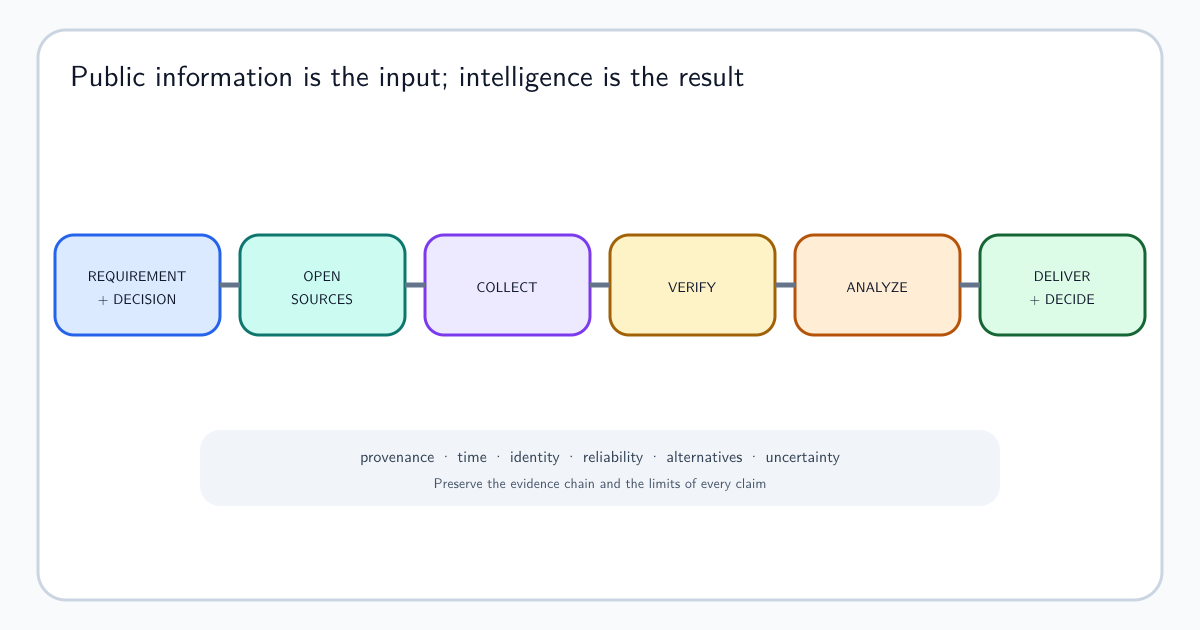
A Practical Source Evaluation and Corroboration Workflow
Use this sequence for any claim important enough to affect a decision:
1. Write the exact claim. Avoid evaluating a vague topic or entire report as one unit.
2. Capture the original. Preserve content, source, timestamps, references, and handling before enrichment.
3. Establish source access and motivation. Determine how the source could know and why it is reporting.
4. Evaluate this claim. Test plausibility, internal consistency, technical detail, timing, and supporting evidence.
5. Trace upstream dependencies. Find the earliest accessible observation and identify repetition.
6. Search for independent and complementary evidence. Include internal telemetry and business context where possible.
7. Record contradictions and alternatives. Do not discard evidence that weakens the preferred explanation.
8. Assess relevance. Connect the claim to organizational technologies, people, geography, suppliers, and decisions.
9. Express confidence and gaps. Explain why the evidence supports the judgment and what remains unobserved.
10. Define review triggers. New reporting, source correction, internal sighting, infrastructure change, or incident evidence may require reassessment.
Source evaluation does not aim to declare a provider permanently “good” or “bad.” It determines how much weight a specific item deserves for a specific claim. That distinction is especially important in cyber threat attribution, where repeated weak claims can otherwise harden into an actor identity.
A disciplined source portfolio gives analysts something more valuable than volume: evidence whose origin, limitations, relevance, and relationship to the decision remain visible from collection through final assessment.
Frequently asked questions
What is the best Cyber Threat Intelligence source?
There is no universally best source. The best source is one with suitable access, timeliness, quality, provenance, reliability, and handling terms for a specific intelligence requirement. A balanced portfolio usually combines internal telemetry with multiple external source types.
What is the difference between source reliability and information credibility?
Source reliability concerns the source's history, access, expertise, and consistency. Information credibility concerns whether a particular claim is plausible, internally consistent, timely, and corroborated. A reliable source can make a weak claim, and a new source can provide credible direct evidence.
How many sources are needed to corroborate a claim?
There is no fixed number. What matters is whether the sources are genuinely independent, have relevant access, and provide evidence that supports the same claim. Ten articles repeating one original report are one evidentiary stream, not ten confirmations.
Is open-source intelligence free information from the internet?
OSINT is intelligence derived from publicly or commercially available information collected and used lawfully for an intelligence purpose. It can require paid access, specialist expertise, validation, translation, and substantial processing. Public availability does not remove privacy, copyright, contractual, or ethical obligations.
Is a threat feed a source or intelligence?
It can be either, depending on its content and context. A feed of values with little provenance is primarily collected data. A feed that preserves source, time, relationships, confidence, role, and intended use can carry structured intelligence. Consumers still need to evaluate relevance.
Can social media posts be used as CTI sources?
Yes, as leads or evidence when their provenance, authenticity, timing, access, motivation, and content are evaluated. Screenshots and reposts should be traced to the original where possible, and important claims need independent support.
Should analysts access criminal forums or leaked data?
Only within explicit legal, ethical, security, and organizational authorization. Teams need approved identities and infrastructure, collection boundaries, minimization, retention, handling, and escalation procedures. Analysts should not interact, transact, download illicit material, or access restricted systems without specialist approval.
Should CTI teams assign one numerical score to every source?
A score can aid triage, but one number can hide important differences in access, reliability, timeliness, topic coverage, provenance, bias, and handling. Preserve the underlying dimensions and evaluate each claim separately.