How to Evaluate a Commercial Threat Intelligence Feed Before You Buy
Run a decision-based trial that tests unique coverage, relevance, timeliness, provenance, integration effort, and measurable operational value.
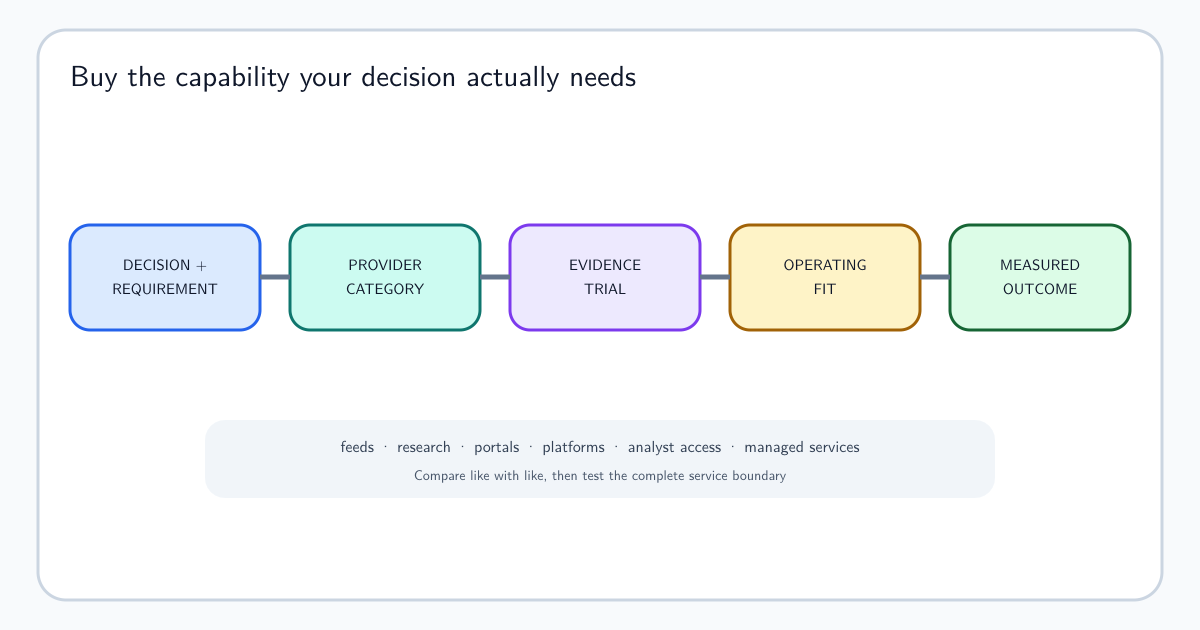
A feed should be purchased because it improves a defined decision, not because its demo contains a famous actor, a large indicator count, or an attractive portal. Before a trial, name the use cases, current baseline, consumers, and failure cost. If you have not yet decided whether the requirement needs data, software, analyst access, specialist work, or outsourced delivery, start with the CTI provider comparison guide.
Examples include earlier vulnerability warning, better incident enrichment, coverage of a region, or higher-quality detection context. If the team cannot describe how the source will be used, it cannot measure whether the source is valuable.
Set Mandatory Gates First
Check legal and privacy terms, permitted sharing, retention, data residency, authentication, export, support, continuity, and safe integration. Require provenance and update or revocation behavior appropriate to the use case. A trial that cannot pass a mandatory condition should stop before weighted scoring.
Ask what is collected directly, purchased, exchanged, inferred, or copied. Clarify how corrections reach customers.
Run the Feed Beside Your Baseline
Normalize data and compare it with existing sources. Measure unique relevant findings, lead time, context completeness, false positives, stale artifacts, corrections, source independence, and analyst time required. Sample both quiet periods and incidents.
Track outcomes: investigations opened, exposure confirmed, detections improved, decisions accelerated, or cases correctly closed. Avoid crediting the feed for an item the team already had earlier elsewhere.
Include the Full Operating Cost
Add license, ingestion, storage, engineering, tuning, analyst review, training, administration, and exit costs. Estimate which existing source or manual work it could replace. A lower-priced feed that creates daily triage can cost more than a focused service.
Present each use case separately; strengths in vulnerability intelligence do not compensate for failure in regional campaign reporting unless the buyer needs both. The TIP selection guide can help assess platform dependencies.
Make the Decision Auditable
Recommend buy, renegotiate, extend trial, or decline for each use case. Show evidence, uncertainty, total cost, mandatory conditions, and the review date. Define service levels and cancellation triggers in the agreement.
A fair trial may conclude that a good feed does not fit your organization. That is a useful result: it prevents ongoing expense and operational noise.
Frequently asked questions
Is a larger indicator feed better?
Not necessarily. Volume can increase duplicate, stale, irrelevant, and false-positive data. Measure unique decision value.
How long should a threat feed trial run?
Long enough to include normal operations and representative events; define the duration from your update cycles and decision needs rather than a universal number.
How should feed overlap be measured?
Compare normalized artifacts and reporting lineage, then examine whether overlapping items arrive earlier or carry better context rather than counting them as equal.
Should procurement use one weighted score?
A score can summarize results, but keep mandatory requirements, evidence, cost, and integration risks visible so trade-offs are not hidden.
What should trigger cancellation of a feed?
Repeated failure to support agreed use cases, poor provenance, unacceptable noise, missing service levels, or cost that exceeds demonstrated value should trigger review.