Vulnerability Intelligence: How to Prioritize What to Fix First
Turn vulnerability data into remediation decisions by combining technical severity, exploitation evidence, exposure, asset importance, likely impact, controls, and operational constraints—and learn how to handle urgent disclosures without treating every critical score as an emergency.
Vulnerability teams rarely have enough time to fix everything at once. The decision is not whether every weakness matters. It is which action will reduce the most relevant risk now, which work can wait, and what must be monitored while conditions change.
Technical severity is one input. A defensible priority also needs evidence of exploitation, organizational exposure, asset importance, likely consequence, current controls, remediation feasibility, and confidence. A critical score on a product you do not use is not an emergency. A moderately scored weakness being exploited against an exposed identity service that supports critical operations may be.
This guide provides a practical decision model for vulnerability intelligence. It explains how to use CVSS, CISA’s Known Exploited Vulnerabilities catalog, EPSS, proof-of-concept reporting, asset and business context, compensating controls, and remediation evidence without turning any single signal into a universal priority score.
Severity Describes the Vulnerability, Not Your Complete Risk
The Common Vulnerability Scoring System provides a transparent way to communicate technical characteristics and severity. In CVSS 4.0, Base metrics describe intrinsic vulnerability characteristics, Threat metrics add conditions that change over time, Environmental metrics tailor the assessment to a consumer’s environment, and Supplemental metrics communicate additional qualities without changing the score.
The Base score is useful for comparing technical severity under standardized assumptions. It does not know:
- whether your organization runs the affected product or version;
- whether the vulnerable feature is enabled;
- whether an attacker can reach it;
- whether exploitation is occurring;
- which identity or privilege is required;
- what data or business process depends on the asset;
- which mitigations or detections exist;
- whether a safe remediation is operationally possible.
Preserve the vector, not only the number. The vector shows which assumptions produced the score and helps teams identify where their deployment differs. When reliable local information exists, apply the Threat and Environmental metrics rather than informally changing a number with no audit trail.
Do not relabel CVSS as “risk.” Technical severity can inform risk, but risk is specific to exposure, likelihood, impact, and controls in a real environment.
Use Each Vulnerability Signal for the Question It Can Answer
| Signal | What it helps answer | What it does not answer alone |
|---|---|---|
| CVE identifier | Which publicly disclosed vulnerability are we discussing? | Severity, exposure, or exploitation |
| CVSS | How severe are the technical characteristics under stated metrics? | Complete organizational risk or patch order |
| CISA KEV | Has the vulnerability met CISA’s criteria for known exploitation in the wild? | Whether your assets are affected or exposed |
| EPSS | What is the estimated probability of exploitation in the wild within the model’s next 30-day window? | Local impact, asset presence, or complete risk |
| Proof of concept | Is exploit logic or a demonstration publicly available? | Confirmed use in real intrusions |
| Vendor advisory | Which products, versions, conditions, fixes, and mitigations does the supplier report? | Your complete inventory and deployment state |
| Internal telemetry | Do affected assets or suspicious behaviors appear in your environment? | Activity outside collected scope or retention |
The CISA Known Exploited Vulnerabilities catalog is a strong input because it identifies vulnerabilities known to have been exploited in the wild. Inclusion should trigger rapid exposure validation and treatment planning, not blind patching of systems that are unaffected.
EPSS estimates exploitation probability for published CVEs and updates as signals change. FIRST explicitly describes it as an exploitation-likelihood input, not a full risk score. Use it when observed exploitation evidence is absent or to order work within a larger affected set. Do not let a low probability overrule reliable evidence that your sector or organization is already being targeted.
Prove Organizational Exposure Before Declaring an Emergency
Exposure assessment should move from product identity to reachable vulnerable function.
Confirm:
- Product and version: is the affected software, hardware, firmware, library, image, or service present?
- Configuration: is the vulnerable component or feature enabled under the required conditions?
- Reachability: can a plausible attacker reach the interface from the internet, a partner, a user network, a compromised endpoint, or another trust zone?
- Access and privilege: what authentication, user interaction, local access, or prior compromise is required?
- Scale: how many affected instances exist, and where?
- Asset role: which identities, data, processes, customers, safety functions, or dependencies rely on them?
- Evidence: has scanning, configuration management, software composition, cloud inventory, or manual validation confirmed the condition?
Inventory can be wrong. Vulnerability scanners may identify a version without proving the feature is reachable, or miss transient cloud resources and embedded components. Record the evidence and confidence behind the exposure state.
Use clear states such as not present, present but not vulnerable, vulnerable but unreachable, exposed, mitigated, under investigation, and unknown. “No scanner finding” is not the same as “not affected.”
Grade Exploitation Evidence Instead of Treating It as Binary
Exploitation intelligence can be ordered by what it actually proves:
- Theoretical exploitability: analysis indicates a path may exist.
- Proof of concept: someone published code or steps that demonstrate part or all of the path.
- Weaponized tooling: reliable exploit capability appears in a framework, scanner, malware, or service.
- Observed attempts: sensors or reports identify exploitation attempts, possibly unsuccessful.
- Confirmed exploitation: reliable incident evidence shows successful exploitation in the wild.
- Relevant targeting: exploitation affects your sector, region, technology profile, suppliers, or organization.
- Internal evidence: telemetry indicates attempts or compromise in your environment.
Record source, observation time, affected versions, exploit prerequisites, success evidence, payload or post-exploitation behavior, victim scope, and confidence. Trace repeated articles to the underlying source.
Attacker interest can change quickly after disclosure, exploit publication, inclusion in tools, vendor guidance, or public attention. Set review triggers and do not freeze a one-time assessment.
For source independence and claim evaluation, use the method in Cyber Threat Intelligence Sources.
Connect Technical Impact to the Business Process
Ask what a successful attacker could do from this particular deployment:
- access sensitive or regulated data;
- steal credentials, tokens, keys, or secrets;
- execute code or change configurations;
- move into more trusted systems;
- interrupt a customer, operational, manufacturing, or safety service;
- compromise a software or supplier trust path;
- create fraud, extortion, legal, contractual, or reputational consequences;
- undermine recovery, monitoring, or administrative control.
Then assess blast radius, recoverability, redundancy, concentration, and downstream dependency. The same vulnerability can have very different consequences on a disposable test system and an identity provider used to administer production.
Separate technical impact from business consequence. Analysts can explain the plausible intrusion path and affected security properties. Business owners, risk, safety, legal, and continuity specialists may be needed to assess operational loss and tolerance.
Choose the Treatment That Breaks the Risk Path
Patching is usually the preferred permanent treatment, but not every asset can be patched immediately and not every vulnerability has a fix.
Possible treatments include:
- update, patch, or replace the affected component;
- remove the product or disable the vulnerable feature;
- eliminate internet exposure or restrict trusted sources;
- require stronger authentication or reduce privilege;
- segment the system and limit reachable dependencies;
- apply a vendor mitigation, configuration change, or virtual patch;
- rotate exposed credentials or secrets;
- add focused detection, logging, and response procedures;
- increase backup, recovery, redundancy, or manual continuity;
- formally accept time-bounded residual risk.
Match controls to prerequisites and attacker behavior. A network block does not mitigate a local privilege escalation after an attacker already has access. Detection reduces time to discover and respond; it does not necessarily reduce the chance of exploitation.
For every interim control, record scope, owner, deployment evidence, validation, limitations, residual risk, expiry, and the permanent remediation date. “Mitigated” without verification is only an assumption.
Use a Transparent Priority Decision, Not a Mystery Score
A practical decision record can use five dimensions:
- Exploitation: confirmed, observed attempts, weaponized, predicted, theoretical, or unknown.
- Exposure: present and reachable, present but constrained, mitigated, not present, or unknown.
- Impact: consequence and blast radius for the affected business service.
- Control: prevention, detection, response, recovery, and confidence that controls work.
- Remediation: safe fix availability, effort, dependencies, outage, rollback, and deadline.
Use priority tiers with explicit action:
- Emergency: credible exploitation and material exposed impact require immediate coordinated action.
- Urgent: high relevant likelihood or consequence requires accelerated remediation and monitoring.
- Planned: affected exposure exists but current threat, impact, or controls support normal scheduling.
- Monitor: evidence is incomplete or exposure is not established; define collection and review triggers.
- Not applicable: the organization is not affected, with evidence and a review condition.
Record the reasons beneath the tier. A transparent judgment can be challenged and updated. A composite number with hidden weights can create false precision and encourage teams to fix the score rather than the risk.
Turn Priority Into a Deadline, Owner, and Governed Exception
A priority tier has value only when it changes accountable work. For each affected asset group, assign:
- a treatment owner and business or service owner;
- the required action and completion deadline;
- interim controls and their validation;
- evidence needed to close the item;
- monitoring and escalation while it remains open;
- the next intelligence review time.
Baseline remediation deadlines can provide consistency, but allow threat evidence and business context to accelerate them. A known-exploited vulnerability on an exposed critical identity service should not wait because its normal severity-based deadline is longer.
Exceptions should state why the required treatment cannot be completed, which alternatives were evaluated, current residual risk, compensating controls, accountable acceptance, expiry, and the plan to remove the exception. An exception without an expiry becomes an undocumented change in risk tolerance.
Escalate when exploitation evidence strengthens, exposure expands, a mitigation fails, the deadline is missed, or the affected service becomes more critical. Close only after technical verification shows the vulnerable condition or risk path is removed or the approved treatment is operating as intended.
Handle New and Incomplete Disclosures With Provisional Decisions
Early reporting is often contradictory. Product versions change, proof-of-concept claims fail, exploitation reports repeat one source, and vendor mitigations evolve.
Issue a timestamped provisional assessment containing:
- what the vulnerability appears to enable;
- affected products and conditions, with source;
- current evidence of exploitation;
- known and unknown organizational exposure;
- plausible impact and critical dependencies;
- immediate low-regret actions;
- assumptions, confidence, and conflicting reports;
- collection owners and the next review time;
- escalation triggers.
Low-regret actions may include confirming inventory, preserving telemetry, restricting unnecessary exposure, validating backups, notifying system owners, and preparing a tested change. Avoid emergency changes whose failure could create more harm than the unverified threat.
Update consumers when the priority changes, not only when more facts appear. Keep the earlier version so teams can understand why a decision was reasonable at the time.
The Vulnerability Intelligence Decision Workflow
Use this sequence for recurring and urgent prioritization:
1. Identify the vulnerability precisely. Preserve CVE, product, versions, configuration, source, and disclosure timeline.
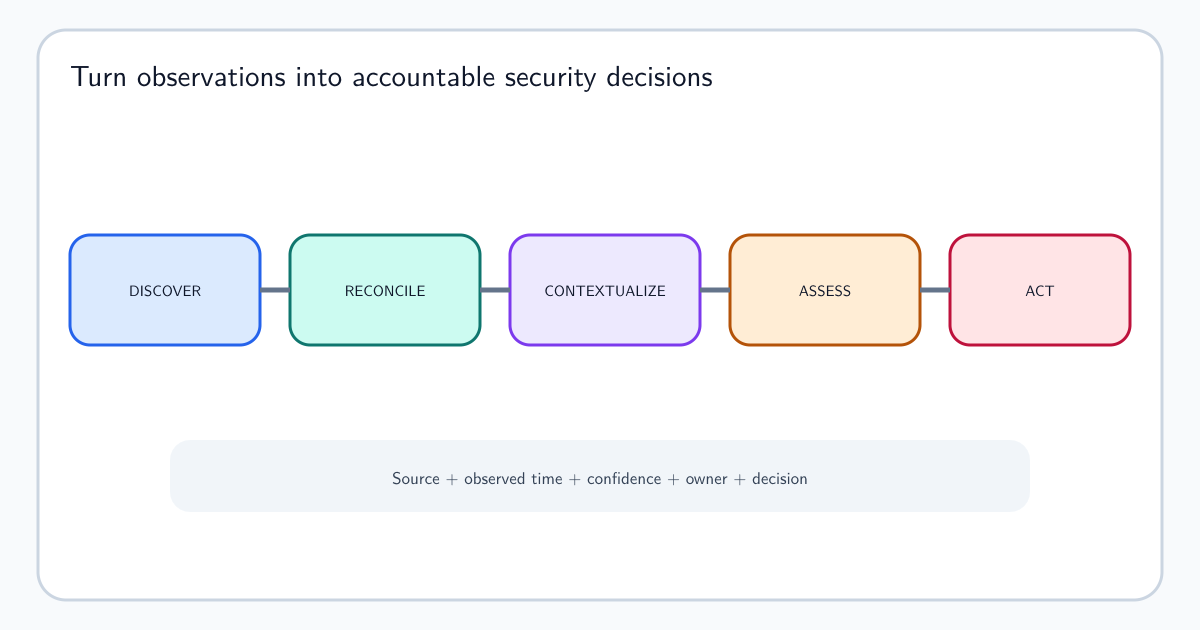
2. Validate affected exposure. Join inventory, scanning, configuration, reachability, identity, and business ownership. Use a governed cybersecurity asset intelligence workflow to reconcile identifiers, source conflicts, freshness, ownership, and dependencies before treating a scanner row as an affected asset.
3. Evaluate exploitation evidence. Distinguish proof of concept, tooling, attempts, confirmed use, relevant targeting, and internal signs.
4. Assess consequence. Model attacker access, privilege, blast radius, dependent services, and recovery.
5. Evaluate current controls. Test whether prevention, detection, response, and recovery actually cover the exploit path.
6. Select treatment and priority. Include patching, mitigation, monitoring, acceptance, owner, and deadline.
7. Communicate by audience. System owners need affected instances and change instructions; responders need behaviors and telemetry; leaders need exposed services, consequence, decision, and residual risk.
8. Verify completion. Confirm the fix or mitigation is deployed and effective, not merely ticketed.
9. Monitor for change. Review new exploitation, product, exposure, and control evidence.
10. Learn. Identify why inventory, exposure, ownership, testing, or communication delayed the decision and improve the process.
When exploitation behavior must become a hunt or analytic, use Indicators of Compromise and TTPs to preserve the evidence and translate it into testable coverage.
Vulnerability intelligence succeeds when limited remediation capacity is directed toward the most consequential and plausible risk—not when every scanner finding receives another score.
Frequently asked questions
What is vulnerability intelligence?
Vulnerability intelligence combines information about a weakness with exploitation activity, attacker interest, affected products, organizational exposure, controls, asset importance, and likely impact so a team can decide what to remediate, mitigate, monitor, accept, or investigate first.
Should the highest CVSS score always be patched first?
No. CVSS communicates vulnerability severity, not complete organizational risk or patch priority. A lower-severity vulnerability with active exploitation on an exposed critical asset may deserve action before a critical vulnerability that is absent, unreachable, or strongly mitigated.
What does inclusion in the CISA KEV catalog mean?
It means CISA has added the vulnerability to its catalog of vulnerabilities known to have been exploited in the wild. That is strong exploitation evidence and should raise priority, but organizations still need to identify affected assets, exposure, impact, controls, and the appropriate treatment.
Is EPSS a vulnerability risk score?
No. EPSS estimates the probability that a published CVE will be exploited in the wild in the next 30 days. It does not know whether your organization runs the product, whether an instance is reachable, which controls exist, or what the impact would be.
Does public proof-of-concept code prove active exploitation?
No. It shows that exploit logic or a demonstration is publicly available, with varying reliability and completeness. It can lower the barrier to exploitation, but evidence of use in real intrusions is a separate and stronger signal.
What if a critical system cannot be patched immediately?
Apply the strongest feasible interim controls based on the exploitation path, such as removing exposure, disabling a feature, restricting access, changing authentication, segmenting the service, adding detection, or increasing monitoring. Record the residual risk, owner, deadline, validation, and conditions for full remediation.
How should a newly disclosed vulnerability be prioritized when information is incomplete?
Use a provisional assessment. Confirm product presence and reachability, identify plausible impact and available mitigations, monitor exploitation evidence, state assumptions and confidence, assign a review time, and update the decision as better evidence arrives.