SBOMs in Practice
Use software bills of materials as maintained inventory evidence for component analysis, vulnerability triage, and supplier decisions.
An SBOM is inventory evidence
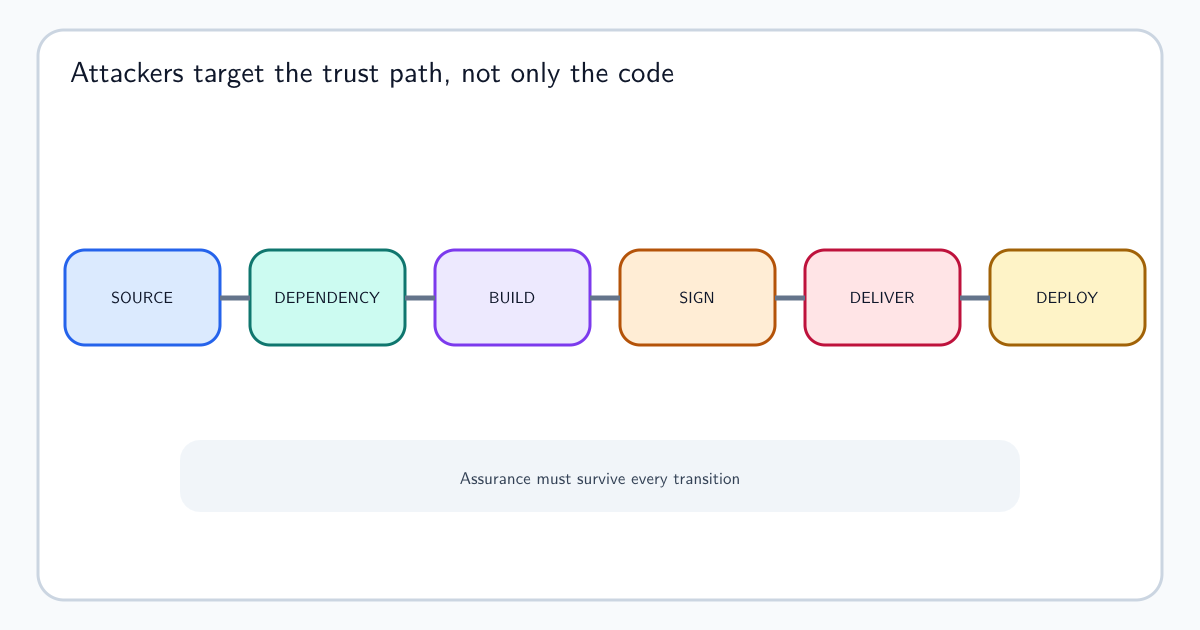
A software bill of materials records components associated with a product or release. It supports questions about dependency presence, versions, suppliers, and relationships, but it is not a certificate that software is secure. The broader software supply chain attacks guide shows where SBOM evidence fits among source, dependency, build, artifact, distribution, and deployment controls.
Tie each SBOM to a specific product, build, package, container, firmware image, or release using an immutable identifier where possible. Record when and how it was generated and which tool or supplier produced it. Different methods—source analysis, build integration, package inspection, and runtime observation—see different component sets. Define the decisions the inventory must support before choosing fields, formats, and collection points.
Identify components precisely
Useful records distinguish direct and transitive components, versions, package identities, hashes, relationships, build variants, and the product release they describe. Ambiguous names produce false matches and missed exposure.
Prefer recognized package coordinates and supplier or namespace context rather than a free-text library name. Preserve dependency relationships, scope, optional features, platform, and evidence of modification. Bundled, vendored, statically linked, generated, or renamed components can be missed by ordinary package-manager output. Where multiple records disagree, retain provenance and resolve the component identity rather than merging uncertain matches into a single confident version.
Maintain freshness and provenance
Generate or collect the SBOM close to the build, retain provenance, sign or protect it appropriately, and update it for each release. Compare declared and observed components where feasible and define ownership for corrections.
Store the inventory with the artifact or release record and make freshness visible. Supplier SBOMs need an ingestion and update process; a one-time document quickly becomes historical. Validate structure, required identifiers, duplicate components, broken relationships, and correspondence to the shipped artifact. Protect integrity through controlled storage, signatures, or attestations appropriate to the environment, while remembering that a valid signature authenticates the statement rather than proving completeness.
Use inventory for triage
When a vulnerability emerges, use the SBOM to identify potentially affected products, then validate reachability, configuration, deployment, compensating controls, exploitation, and business impact. Third-party vulnerability exposure still requires supplier and environment context.
Match advisories using product and package identity, version rules, platform, and vendor statements; do not rely only on a name or CPE guess. An inventory hit creates a candidate exposure. Confirm whether the component is shipped, enabled, reachable, and affected in the deployed configuration, then identify owners and remediation options. Record uncertain matches separately so teams neither ignore possible exposure nor report every imprecise match as confirmed.
Understand what an SBOM cannot prove
An SBOM does not prove source integrity, safe build practices, absence of malicious code, exploitability, or runtime use. Combine it with provenance, testing, vulnerability intelligence, supplier assurance, and operational evidence.
It may omit dynamic plugins, services reached over a network, build tools, firmware, proprietary modules, or files introduced after deployment. Conversely, it may list a library that cannot execute in the product’s configuration. Use the SBOM as one evidence source alongside artifact hashes, build provenance, signatures, deployment inventory, runtime observation, and supplier communication. Document known gaps and improve generation over time rather than treating format compliance as the outcome. For a hosted service, the customer may need a supplier assurance statement and incident process because a downloadable component list cannot describe every server-side dependency.