Malware Intelligence: Which Findings Should Change a Defensive Decision?
Turn malware analysis into CTI by selecting findings that improve scoping, detection, containment, prioritization, or warning.
Malware analysis becomes intelligence when a finding changes what someone investigates, detects, contains, repairs, or prepares for. A complete technical description can still fail if the reader cannot tell which assets matter or what to do next. The malware analysis workflow covers safe intake, static and dynamic techniques, reverse engineering, evidence, and reporting before those findings become intelligence.
Begin with the question and deadline. Incident responders may need configuration and persistence within an hour. Detection engineers may need stable behaviors. Strategic readers may need what the tool reveals about access, objectives, resourcing, or operational constraints.
Choose the Smallest Useful Analysis Depth
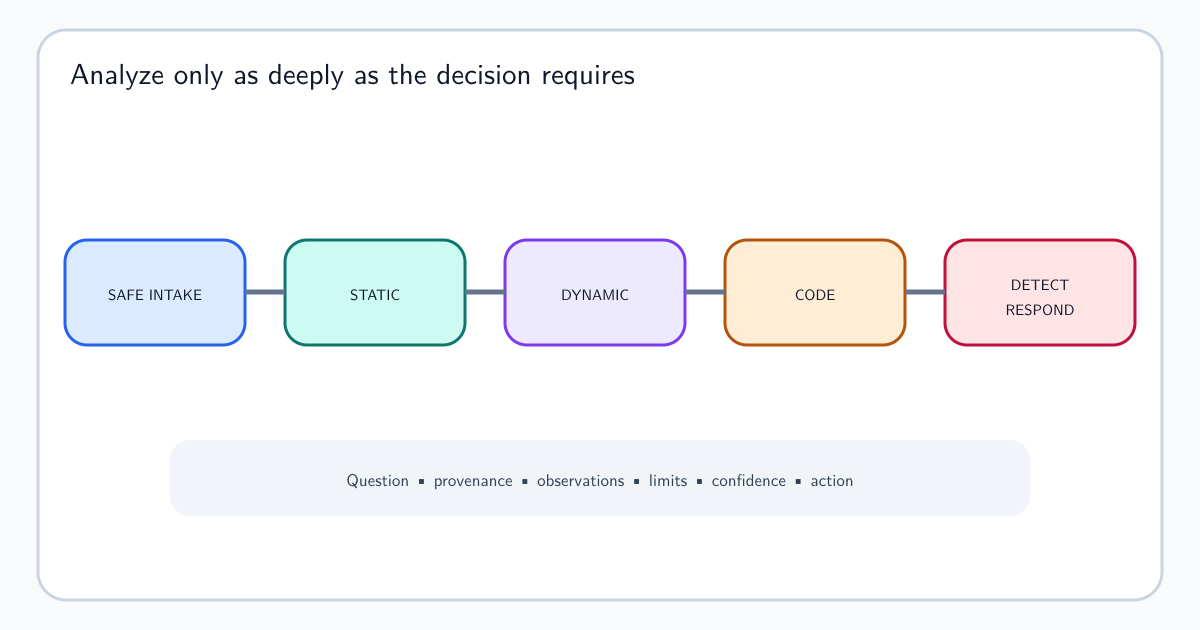
Triage identity and safety first, then choose static inspection, sandbox observation, configuration extraction, code analysis, or controlled emulation. Stop when the decision is supported. Deeper reversing is justified when hidden functionality, encryption, protocol behavior, or a reliable detector depends on it.
Record sample provenance, hashes, acquisition time, handling restrictions, execution conditions, and analysis limitations. Never assume a non-triggered behavior is absent.
Translate Findings by Decision
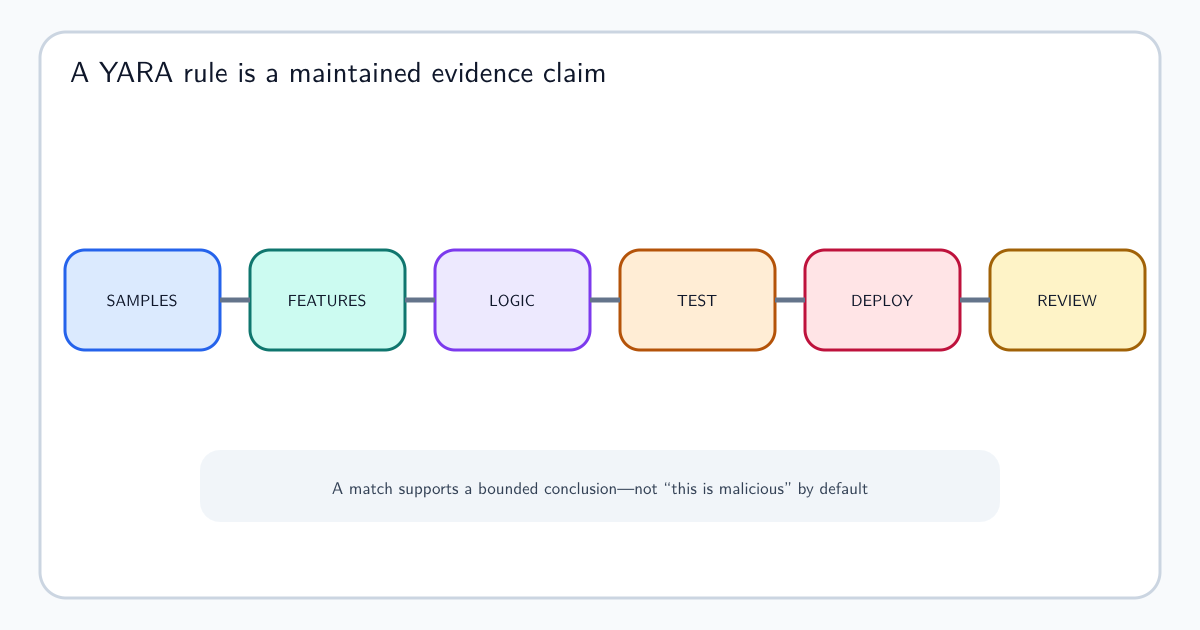
For scoping, prioritize execution evidence, persistence, lateral movement, credentials, and command paths. For detection, describe stable procedures, required data, expected noise, and test samples. When the output is file or memory matching, use the YARA writing, testing, and tuning workflow to turn sample features into a maintained rule. For containment, identify dependencies, fallback channels, destructive functions, and kill-switch risk. For warning, track builder changes, delivery partnerships, target filters, and infrastructure preparation.
Separate sample capability from observed use. Code may contain a feature the operator never enabled.
Package Evidence With Its Limits
Distinguish directly observed behavior, code-supported capability, inferred intent, and external reporting. Give timestamps and confidence. Note anti-analysis, missing network services, unpacking failures, and operating-system assumptions.
Provide observables with context and expiry, not a flat indicator dump. The IOC and TTP guide explains how to turn behavior into tests.
Lead With What Changes
Deliver a short judgment, affected conditions, recommended action, confidence, and the minimum technical evidence needed to verify it. Put detailed functions and strings in supporting material.
Retest detections and assumptions when the family changes. Malware intelligence is successful when responders act faster or more accurately—not when the analysis contains the most disassembly.
Frequently asked questions
Does every malware sample need full reverse engineering?
No. Analyze only as deeply as the decision requires; configuration extraction or behavior observation may answer the question faster.
Is a file hash useful CTI?
It is precise for confirming a known sample but fragile for broader detection. Pair it with behaviors, configuration, infrastructure, and context.
Does a malware family identify the threat actor?
No. Tools may be shared, sold, leaked, or used by affiliates. Family attribution is one input, not proof of operator identity.
Can analysts rely on sandbox results alone?
No. Evasion, missing dependencies, configuration, and environment differences can hide behavior. Corroborate important claims.
What malware findings are safest to share?
Share what recipients can use while respecting source sensitivity, victim privacy, licensing, and the risk that disclosure reveals collection or response.