Risk-Based Alerting and Evidence Accumulation
Accumulate related evidence into transparent, time-bounded risk without letting a convenient score erase provenance, uncertainty, or the distinction between suspicion and fact.
Risk-based alerting changes when attention is requested
A conventional alert often fires when one analytic crosses its own condition. Risk-based alerting lets several observations contribute to an entity’s risk over time, then requests attention when their combined meaning crosses a policy threshold.
This can reveal weak signals that matter together, such as an unusual grant, a new session origin, and privileged resource access. It can also reduce repeated notifications by presenting an accumulated story.
The benefit depends on preserving the story. A score of 83 has no inherent security meaning. Investigators need the contributing evidence, timing, entity links, weights, and reasons.
Entity resolution determines what can be combined
Evidence can accumulate only around an entity key: user, service principal, device, workload, application, or another governed identity. Entity resolution decides when identifiers refer to the same real object.
Mistaken merges transfer suspicion between unrelated entities. Missed joins fragment one sequence into harmless-looking pieces. Record resolution confidence, namespace, tenant, lifecycle, and time validity rather than joining on a display name.
Keep actor and target roles distinct. An administrator changing a user and the changed user are both present in the event, but their risk should not automatically receive the same contribution.
Weights and decay express policy assumptions
A weight expresses how much a contribution should influence attention under defined conditions. It may reflect evidence strength, behavior rarity, asset consequence, or corroboration, but those dimensions should not be blended invisibly.
Decay reduces a contribution as time weakens its relevance. Different behaviors need different horizons: a short burst may matter for minutes, while a persistent privilege change matters until reversed. Reset rules and state retention must match the security story.
Calibrate using reviewed histories and plausible scenarios, then document uncertainty. Do not choose numbers merely because they make queue volume convenient.
Thresholds allocate attention rather than prove compromise
The alert threshold expresses when accumulated evidence deserves a consumer decision. It should consider investigation capacity and cost of delay, but it must remain tied to an intended threat and response.
Test combinations near the boundary. Many low-quality signals should not necessarily outweigh one strong contradictory fact. Cap repeated identical contributions, handle duplicates, and prevent one noisy source from dominating the score.
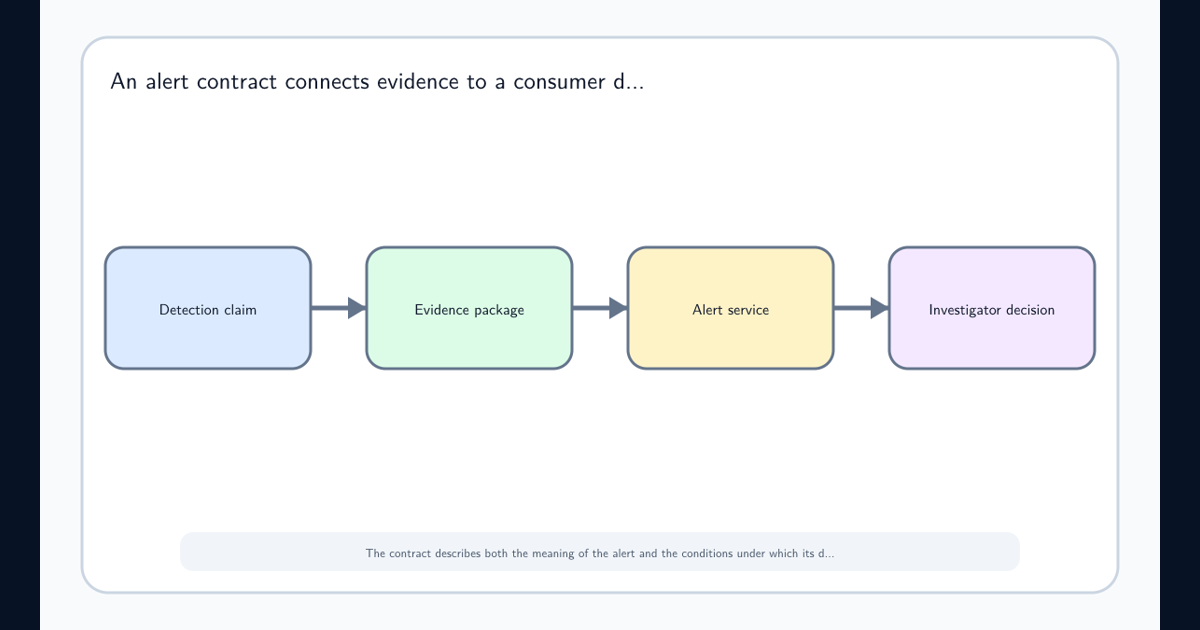
Expose why the threshold was crossed in the alert contract. The alert should distinguish observed contributions, the system’s risk assessment, and explanations that remain possible.
Governance prevents the score from becoming opaque authority
Version contribution rules, weights, decay, entity logic, thresholds, and exclusions. Monitor source health, score distributions, dominant contributors, time to disposition, and disparate effects across populations. A stable alert volume can hide a broken contributor.
Review explanations with investigators. If they cannot reconstruct why risk rose or which action would reduce it, the model is not operationally intelligible. Preserve scores as derived assessments alongside source evidence rather than overwriting that evidence.
When inputs degrade, weaken the claim and avoid pretending an incomplete score is comparable to a healthy one. Risk-based alerting is a way to organize uncertainty, not eliminate it.
Backtesting needs temporal honesty. Use the rules, identity relationships, and context that would have been available at the historical decision time rather than later facts. Otherwise the score gains knowledge it could not have possessed in production. Mark retrospective analysis separately from evidence about prospective performance.
Frequently asked questions
What makes risk-based alerting trustworthy?
Each contribution must retain provenance, entity and time semantics, calibration, decay, and explanation. The threshold should support a defined consumer decision, and a score must never be presented as proof of compromise.