Replay, Synthetic Telemetry, Simulation, and Emulation Compared
Choose replay, synthetic telemetry, simulation, or emulation by the assumptions you need to test, recognizing what each method introduces, bypasses, and can safely prove.
Start with the assumption that remains uncertain
If you do not know whether a parser preserves an enum, replay may be enough. If you do not know whether an endpoint sensor observes a behavior, replay cannot answer the question because it bypasses the source. If you need to know whether several actions form a usable incident story, a governed sequence may be necessary.
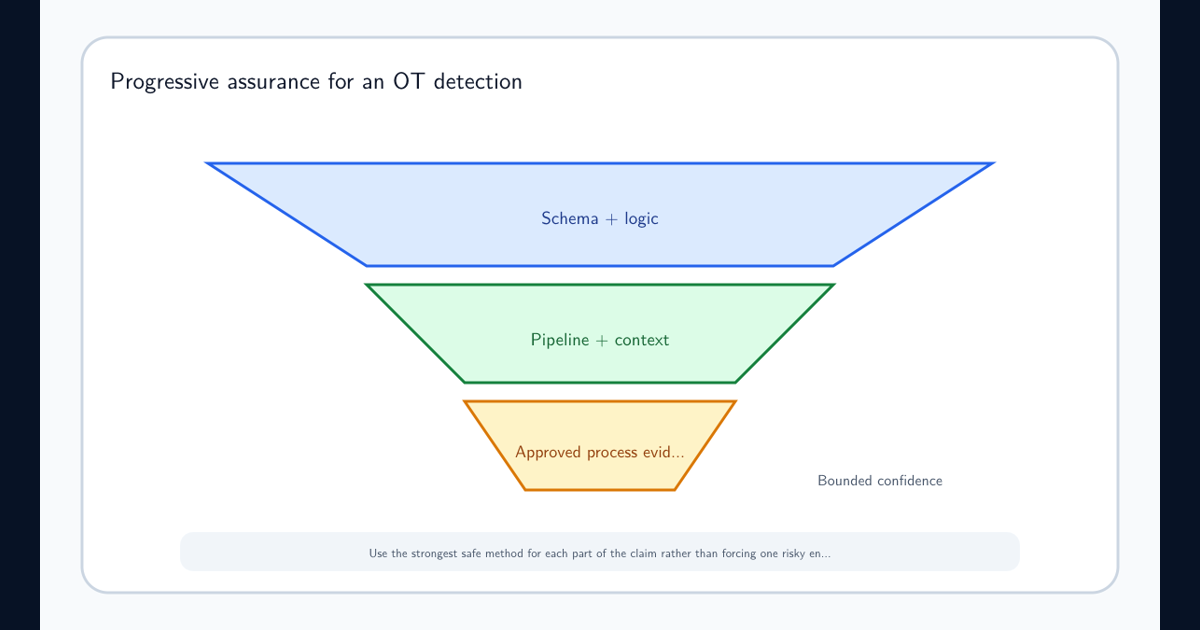
Validation method follows the claim. Write the expected evidence at each layer and identify the first unproven dependency. Then choose the method that includes that dependency without adding unnecessary risk.
More components create more realism and more failure causes. Precision and diagnosability are valuable forms of assurance, not signs that a test is weak.
Replay tests known evidence through a chosen path
Replay introduces captured or preserved records into a pipeline, backend, or analytic. It is reproducible and useful for parser, mapping, translation, state, and delivery behavior. The record can carry realistic complexity that a small fixture lacks.
Replay does not prove that a current sensor will generate the record, that live timing matches the capture, or that upstream collection works. State the injection point and components bypassed.
Protect captured data. Minimize or synthesize sensitive fields while preserving the semantics under test. Record source version and provenance so the fixture does not become unexplained test folklore.
Synthetic telemetry isolates structure and edge cases
Synthetic telemetry is deliberately constructed input that follows a source or normalized schema. It can produce exact nulls, boundary values, duplicates, clock offsets, and rare combinations safely and cheaply.
Its weakness is realism of production behavior and producer quirks. A handcrafted record may contain a field combination the real service never emits. Use data contracts and representative source examples to constrain construction.
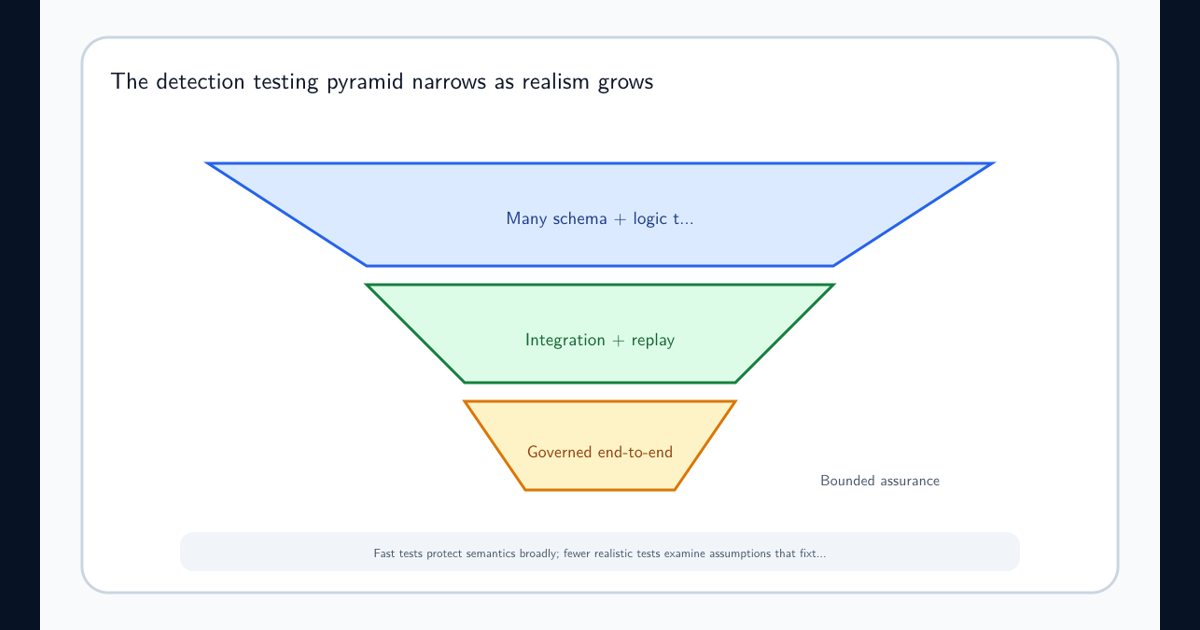
Synthetic evidence is especially strong for detection testing pyramid lower layers. It lets many cases run frequently while higher layers test whether real producers conform to the assumptions those cases encode.
Simulation causes a bounded behavior to create evidence
Simulation safely triggers a defined behavior so real systems and sensors produce telemetry. It can test observation, collection, time, and platform integration that replay bypasses.
The simulated behavior may use a benign substitute or constrained environment. Record how it differs from the threat behavior and whether the difference changes the expected evidence. An API test action may generate the same audit operation without reproducing attacker intent, which is usually appropriate because detection observes behavior, not motive.
Authorization, target scope, cleanup, side effects, rate, and stop conditions belong in the validation record. A useful test never assumes that benign intent makes every action safe.
Emulation connects several adversary-like actions
Emulation represents a multi-step behavior path using controlled adversary-like actions. It can test correlation, identity continuity, branching, alert grouping, investigation context, and response handoff.
Complexity makes interpretation harder. One final alert does not show that every expected event appeared or that each analytic behaved correctly. Record checkpoints and compare expected and actual evidence at every stage.
Emulation proves the chosen scenario under its conditions, not complete technique coverage. Convert discoveries into smaller regression tests and retain the end-to-end scenario for assumptions only the integrated path can exercise. That makes realism a source of durable learning rather than a one-time demonstration.
Frequently asked questions
Which detection validation method is most realistic?
Emulation may include more real behavior, but realism is not one-dimensional and does not make it universally best. The correct method is the safest one that exercises the unresolved assumption with interpretable evidence.