Email Message Trace and Authentication Evidence
Read message trace, authentication results, routing, delivery, and mailbox events as separate evidence so email detections do not confuse sender claims with verified origin or delivery with user action.
An email has claimed identities and observed identities
A message can display a familiar executive name while using an unrelated envelope sender and infrastructure. Another message can pass authentication because an attacker controls a legitimate vendor account. Treating the visible From field as the sender collapses several identities into one persuasive label.
Separate the display name, header From domain, envelope sender or return path, sending host, authenticated submission identity, signing domain, and provider account. Each is produced or verified at a different point. Some are chosen by the sender; others are observed by receiving infrastructure.
Detection begins by asking which identity matters to the claim. Brand impersonation concerns what the recipient sees. Infrastructure analysis concerns the transmitting system. Account compromise concerns the authenticated service or tenant. Preserve the differences instead of normalizing all of them into sender.
Authentication results are bounded protocol evidence
SPF evaluates whether a sending host is authorized for an envelope domain. DKIM verifies a signature over selected message content and identifies a signing domain. DMARC evaluates alignment between the visible From domain and authenticated SPF or DKIM identifiers under a published policy.
Pass and fail are not benign and malicious. Forwarding can disrupt SPF. Mailing lists can alter signed content. A compromised legitimate service can pass every check. A lookalike domain can authenticate perfectly. Preserve the evaluated domain, result, reason, policy, alignment mode, and receiver that performed the check.
Use authentication to test specific explanations. A failure may support spoofing of a protected domain. A pass may narrow spoofing alternatives while leaving account compromise and social engineering open.
Message trace describes provider handling
A message trace is the provider’s record of how a message moved through its service. It can show submission, transport rules, filtering, quarantine, redirection, delivery, rejection, or later remediation. It may use different message identifiers at different boundaries.
Relate the internet message identifier, provider trace identifier, tenant, sender, recipient, timestamps, routing events, filtering verdicts, and final disposition. Preserve all recipients separately; one message can be delivered to some, quarantined for others, and forwarded externally by a rule.
Delivery proves that a service placed the message into a destination state. It does not prove that the user saw, trusted, clicked, or acted on it. Those actions require mailbox, endpoint, browser, identity, or business-system evidence.
Correlate the message with actions without inventing causality
A link click after delivery can support a relationship when message, recipient, URL, browser session, and time align. It still may have been generated by a security scanner or preview service. A sign-in after a credential-harvesting click can strengthen concern without proving the message caused the authentication.
Label relationships as observed or inferred. Message delivery is observed by the mail service. A user click may be observed by safe-link infrastructure. Causality between the click and later account activity is an assessment supported by identity, device, session, and timing.
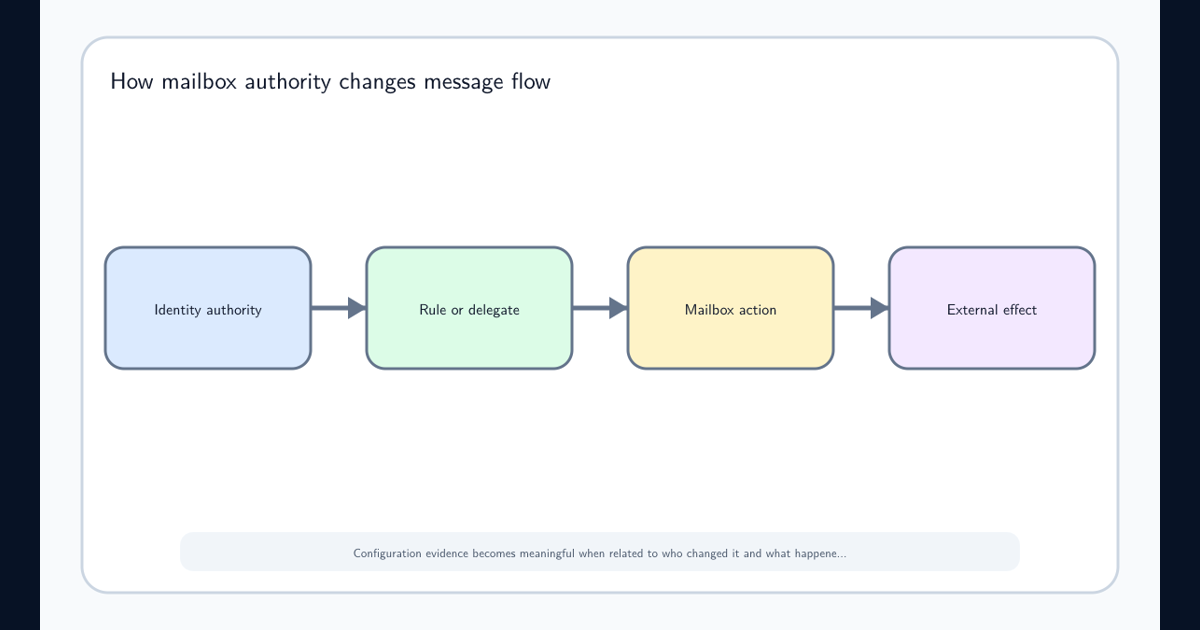
Keep mailbox rules and delegation in the chain. A message can be redirected, hidden, or accessed by a delegate after delivery, changing both exposure and the identities involved.
Give the consumer a reproducible message story
An investigation-ready result includes original and normalized sender identities, recipients, message and trace identifiers, authentication details, routing, filtering, final disposition, relevant URLs or attachments in safe representation, and source health. Preserve the raw headers or an authorized route to them.
State the fact before the assessment: a message claiming one domain was submitted through another service, failed alignment, was delivered to named recipients, and was followed by a protected link event. Then state the assessment and alternatives, such as forwarding or service compromise.
This structure lets the consumer verify origin, exposure, and subsequent action separately. It also prevents a single verdict field from replacing the evidence needed to decide whether to remove a message, investigate an account, or verify a business request.
Frequently asked questions
Does DMARC pass prove that an email is benign?
No. It shows that specified authentication and alignment checks passed for the evaluated identifiers. A compromised legitimate sender, abused service, or socially engineered message can pass and still be harmful.