Detection Health Monitoring and Silent Failure
Detect when a detection service stops observing, interpreting, or delivering expected evidence—even though no explicit platform error appears.
Silent failure is normal-looking absence
A silent failure occurs when a detection capability no longer provides the evidence or outcome it promises, yet no obvious error announces the loss. A disabled audit category, changed field meaning, stalled partition, empty enrichment, or broken route can leave dashboards green while useful visibility disappears.
The difficulty is that no alert may also be the correct result. You cannot distinguish a quiet environment from a broken service by counting alerts alone. You need independent expectations about the path that produces them.
Describe health as a chain of observable claims: the source emits expected records, transport delivers them, transformations preserve meaning, analytics execute, and consumers receive usable output.
Health indicators need a population and expectation
A health indicator is a measured property that bears on one service assumption. Examples include event arrival rate, source coverage, field population, unknown-value rate, processing lag, analytic run completion, control-signal detection, and delivery acknowledgement.
Every indicator needs a denominator and a reference population. “Ninety percent healthy” is meaningless unless you know whether it describes hosts, identities, tenants, partitions, records, or scheduled runs. Segment by the dimensions that can fail independently.
Expectations may be fixed, scheduled, or learned from a stable baseline. Each choice has limits. A learned baseline can normalize a long-running outage, so pair statistical change with configuration and control evidence.
Control signals make absence testable
A control signal is benign, expected evidence introduced or selected so the detection path has something known to observe. It might be a periodic administrative event, a synthetic record at an approved injection point, or a safely generated activity. Its expected cadence gives absence a clearer meaning.
Place controls according to the layer you want to test. A record injected after collection proves nothing about the sensor. A source-generated control can cover more of the path but may be harder to authorize and distinguish from production behavior.
Label controls so they cannot be mistaken for hostile activity, exclude them from performance conclusions where appropriate, and monitor the mechanism that creates them. A failed control generator can otherwise imitate a failed detection.
Diagnosis starts at the earliest broken expectation
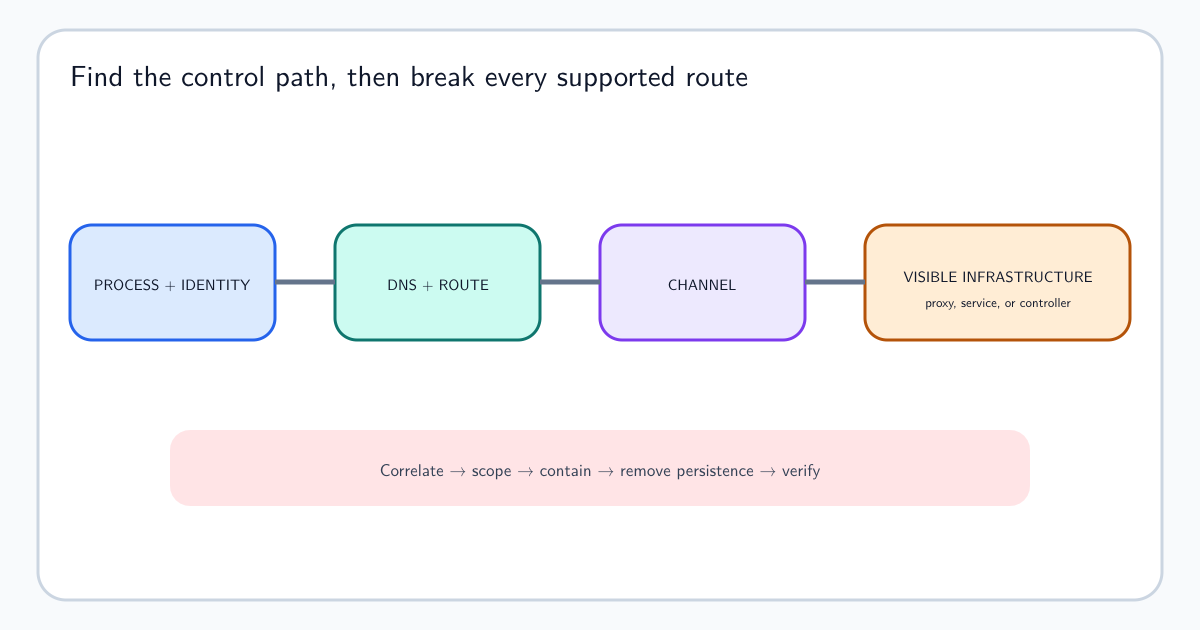
When a health condition fails, compare expected and actual evidence from the source forward. Check scope and configuration before volume, then field meaning, timing, execution, state, and delivery. The first divergence usually identifies the narrowest failure domain.
Avoid tuning the detection merely to make a health alarm disappear. If a provider renamed an operation, broadening a query may hide the symptom while changing the intended analytic. Repair the contract or explicitly revise the claim.
Record impact in consumer terms: which behavior, population, time interval, and decisions are affected. “Connector degraded” is a technical fact; “we cannot reliably assess privileged changes for these tenants since 09:20” is an operationally useful assessment.
Health changes the strength of the coverage claim
Health monitoring matters because coverage is conditional. When a required source, field, enrichment, state store, or route degrades, the honest response is to weaken the affected coverage claim and tell its consumers. A detection inventory should not remain green because the rule file still exists.
Separate facts, assessment, and uncertainty in the health record. Facts include missing partitions and last successful delivery. The assessment states affected capability and severity. Uncertainty states what has not yet been isolated or whether evidence may arrive late.
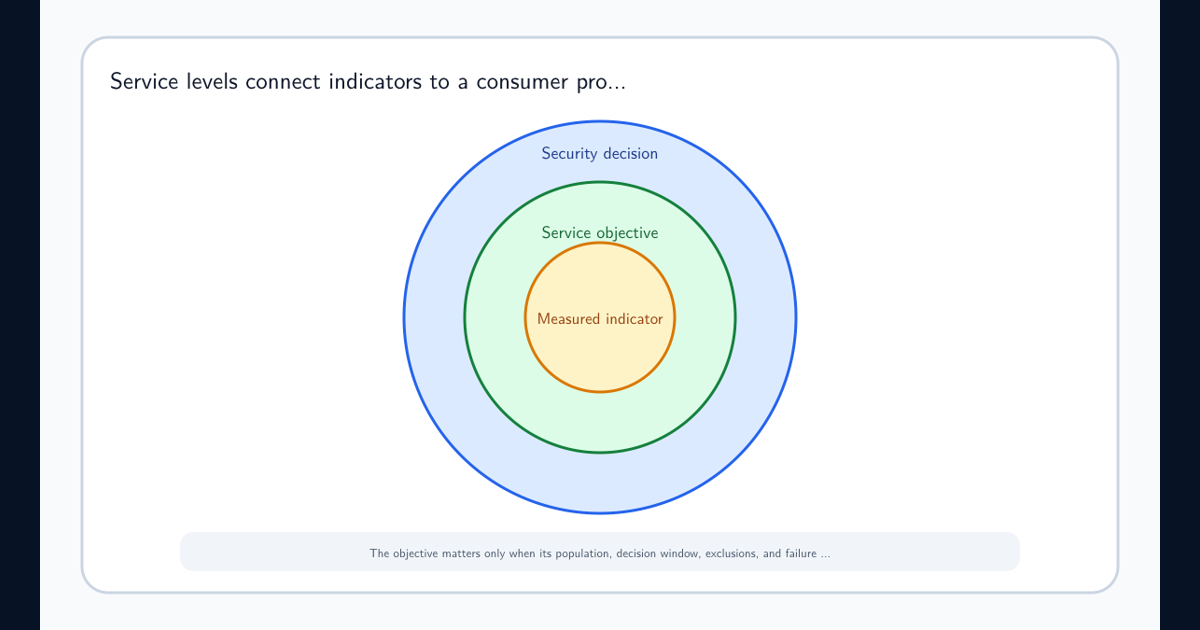
Connect thresholds and response times to detection service levels. That turns monitoring from a dashboard into an agreement about how quickly loss becomes visible, owned, and restored.
Frequently asked questions
Why is an absence of alerts not enough to identify silent failure?
Because silence can mean no relevant behavior occurred. Health monitoring needs independent expectations about telemetry arrival, field quality, analytic execution, known control signals, and delivery so absence becomes interpretable.