Data Access Baselines and Sensitive-Object Context
Interpret access to sensitive objects through subject, object, operation, purpose, peer context, and history without turning statistical deviation into a claim of malicious intent.
An access event records an operation, not a motive
A database audit record shows that an identity read a customer table. You know which operation the service recorded. You do not yet know whether the user viewed one row, exported millions, acted for an approved case, or intended to steal data.
Define the subject, object, operation, result, time, application or client, session, tenant, and observation point. For files, distinguish metadata read, content read, copy, rename, and permission change. For databases, distinguish query execution, rows returned, export, and administrative access where the source permits it.
The same verb can carry different consequence across objects. Add classification, owner, business process, record population, residency, and event-time sensitivity. Today’s classification should not silently rewrite the meaning of last month’s access.
A baseline is a comparison population with memory
A baseline describes expected behavior for a defined entity or peer group over a defined historical period. It can reveal a first-time repository, unusual hour, new query pattern, or change in volume. It does not reveal intent.
Choose the comparison deliberately. One employee’s history can reflect role changes and sparse activity. A department peer group can hide privileged specialists. A global population can make ordinary regional work appear rare. Record membership rules, history length, update cadence, minimum sample, and treatment of new identities.
Keep seasonal and event context. Quarter-end finance, legal discovery, incident response, migration, and machine-learning training can transform normal access temporarily. A baseline that learns compromised behavior too quickly can normalize the very change it should surface.
Measure behavior in dimensions the source can support
Useful features include object count, bytes returned, distinct sensitivity classes, operation mix, query breadth, access rate, time of day, client, source environment, and the novelty of subject-object relationships. Explain how each feature relates to the concern.
Volume can be misleading. Compression, database queries, snapshots, and cloud-side copies may move large logical datasets with little observed network traffic. Repeated small reads can remain below thresholds. Counts can inflate through retries or pagination.
Preserve denominators and units. “Ten times normal” is meaningless without the entity, comparison period, minimum history, and whether zero or missing observations were excluded. The analyst should be able to see the raw observations behind a derived deviation.
Sequence separates exploration, collection, and ordinary work
Access becomes more concerning when it follows a new privilege grant, expands rapidly across sensitive objects, concentrates selected data, creates an archive, changes sharing, or precedes an external transfer. These relationships describe a possible behavior path.
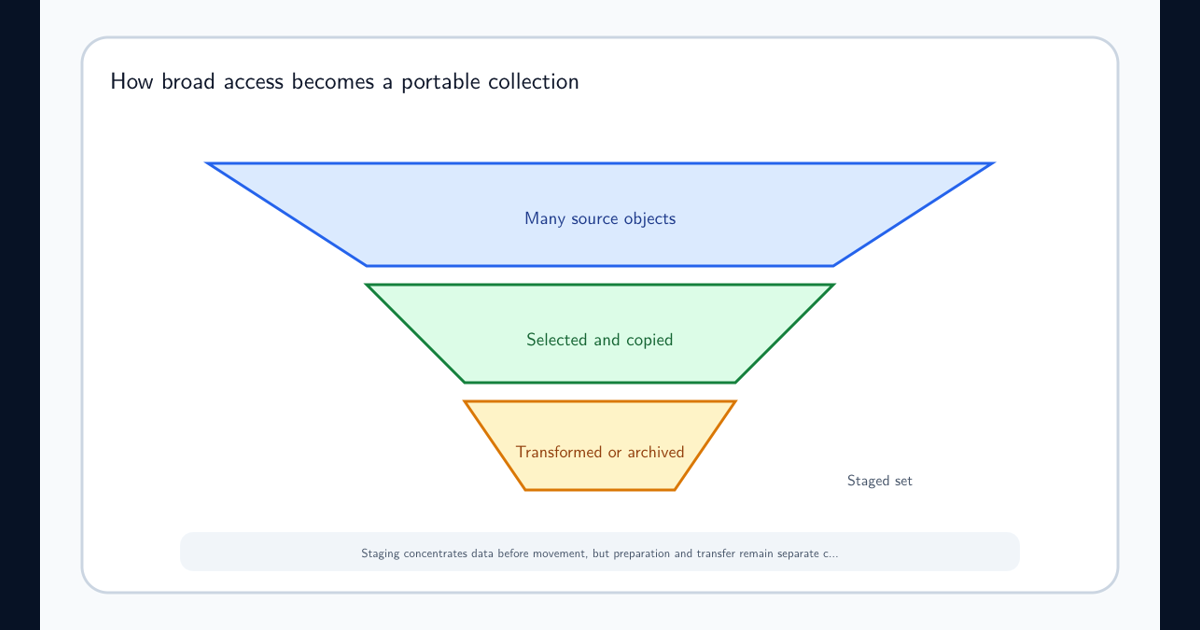
The staging and bulk collection stage is important because direct access and later transfer may occur in different systems. Preserve entity and object lineage across query results, local copies, archives, snapshots, and exports where possible.
Order supports an assessment but does not prove causality. A backup or approved investigation can create the same sequence. Work records, data owner approval, application identity, and destination context help distinguish alternatives.
Report deviation, consequence, and uncertainty separately
An alert should show the access facts, the comparison used, the degree and dimensions of deviation, object sensitivity, authorization, recent changes, related staging or transfer, source health, and known business context. Do not collapse them into an opaque anomaly score.
State the assessment at the supported strength: this identity accessed a new set of highly sensitive objects at a rate outside its recorded peer and personal history, shortly after a privilege change. The evidence does not yet establish content theft or actor intent.
That wording gives the consumer a useful question: verify purpose and trace what happened to the selected data. It also keeps the baseline reviewable when roles, sources, or historical populations change.
Frequently asked questions
Does unusual data access mean data theft?
No. It establishes deviation from a defined expectation. Investigation still needs object sensitivity, authorization, business purpose, sequence, destination, and evidence that data was collected or transferred.