Personal Data, Privacy, Sharing, and Backups
Reduce unnecessary data exposure, share deliberately, manage permissions and retention, and maintain backups that can actually restore what matters.
Know which data deserves special care
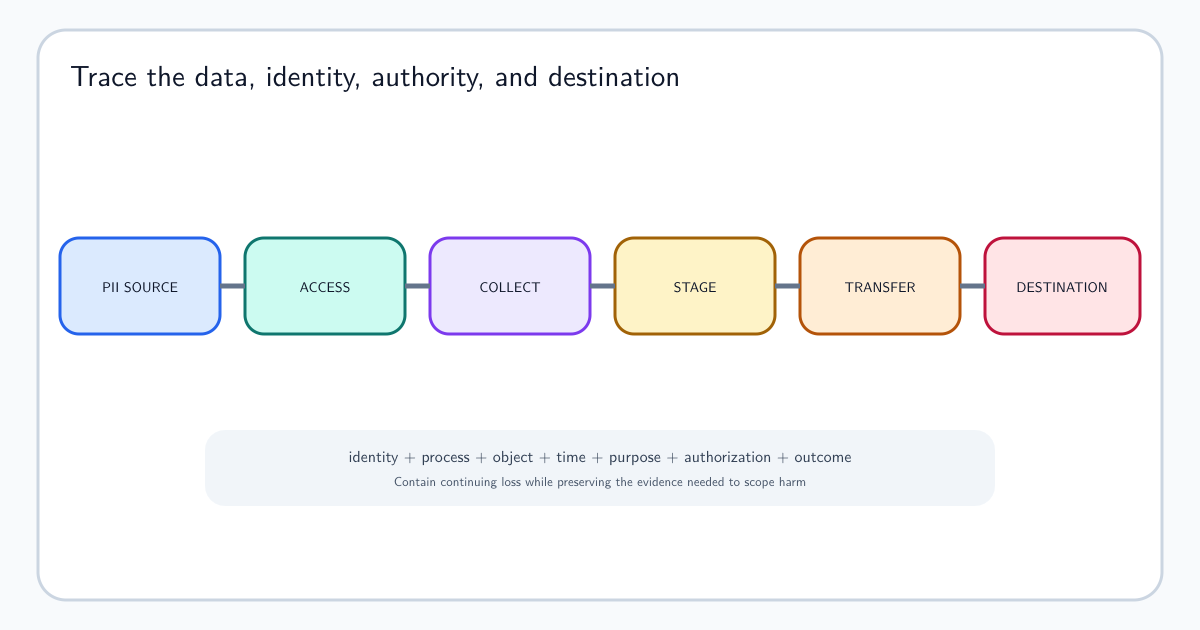
Personal data can identify, locate, contact, describe, or make decisions about someone. Financial, health, identity, authentication, location, employment, and children’s information can create serious harm when misused. Business data may also be sensitive because it affects customers, contracts, intellectual property, investigations, or safety. The PII data-theft guide explains how defenders trace unauthorized access, collection, staging, transfer, and affected people when these protections fail.
Make a small inventory of important collections: what they contain, why they exist, who controls them, where copies live, who can access them, how long they are needed, and how they are recovered. Classification labels can help, but context matters. A public name may become sensitive when combined with a private schedule, address, or account-recovery detail.
Collect and retain less when less is enough
Data that was never collected cannot be stolen from that system, accidentally shared, or retained beyond its purpose. Ask whether each field is necessary, whether a less precise value works, who benefits, and what consequence follows from refusal. Application permissions deserve the same review: a useful feature may need one photograph, not permanent access to the entire library.
Retention should match a real purpose, obligation, or recovery need. Keeping every export and message forever expands breach impact and makes accurate deletion difficult. Deletion must include known copies and shared locations where feasible, while preserving records that law, safety, or an active investigation requires. Document exceptions instead of silently accumulating data.
Share with an explicit recipient and lifetime
Before sharing, confirm the recipient, purpose, exact material, permission level, onward-sharing expectation, and expiry. Prefer named access over public links and view-only access over editing when sufficient. Remove old collaborators and links after projects end. A familiar service does not make every folder or recipient appropriate.
Verify unusual requests through a channel the requester did not provide, particularly for identity documents, payroll, customer lists, or investigative data. Avoid copying sensitive information into unapproved assistants, forms, or personal accounts. When sending to the wrong person, report promptly rather than attempting a silent cleanup; downloads, synchronization, and notifications may have created copies already.
Build backups around restoration
A backup is a separate recoverable copy, not merely synchronization. Synchronization can reproduce accidental deletion, corruption, or attacker changes. Choose what must be recoverable, acceptable data loss, restoration time, copy locations, protection, retention, and owner. Keep at least one copy separated from the authority that controls the live data when the consequence justifies it.
Automate regular copies where practical, protect backup accounts and deletion settings, and monitor failures. Test a representative restore and inspect the result. Ransomware recovery requires trustworthy identities, configurations, applications, and dependencies as well as files. A dashboard reporting “successful backup” is useful evidence only when restoration has also been demonstrated.
Respond to exposure, deletion, or loss proportionately
A first response to suspected data exposure should stop further sharing, preserve the message, link, audit record, device, and time, notify the correct owner, and identify recipients and copies. Do not erase evidence or promise deletion before confirming what systems can do. Device loss may require remote lock, session revocation, and assessment of encryption and local data.
For deletion or corruption, protect remaining copies before restoration and establish the cause so synchronization does not destroy the recovery copy. Record what was restored and from which point. After the event, correct the weak permission, excessive retention, missing separation, or untested procedure that increased harm. Recovery is complete when important data is trustworthy and residual exposure has an owner.