Civilian Harm and Reverberating Effects in Cyber Operations
Trace cyber effects through shared systems and essential services, identify civilian consequences, and build precautions, monitoring, and stop conditions into operational design.
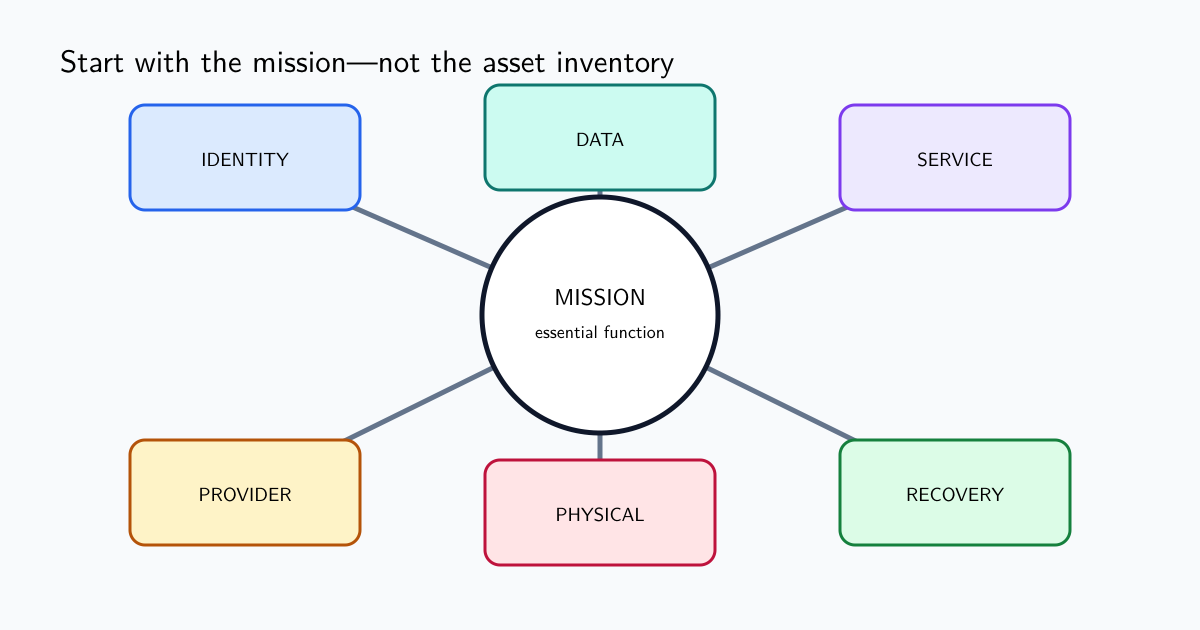
Start with people and essential functions, not server labels
Civilian-harm analysis asks how a cyber operation may affect people, civilian objects, and services they rely on. Begin with who uses the function, for what essential purpose, at what time, and with which alternatives. Patients, water customers, displaced people, emergency workers, financial beneficiaries, and communities outside the target state may experience different consequences from the same service degradation.
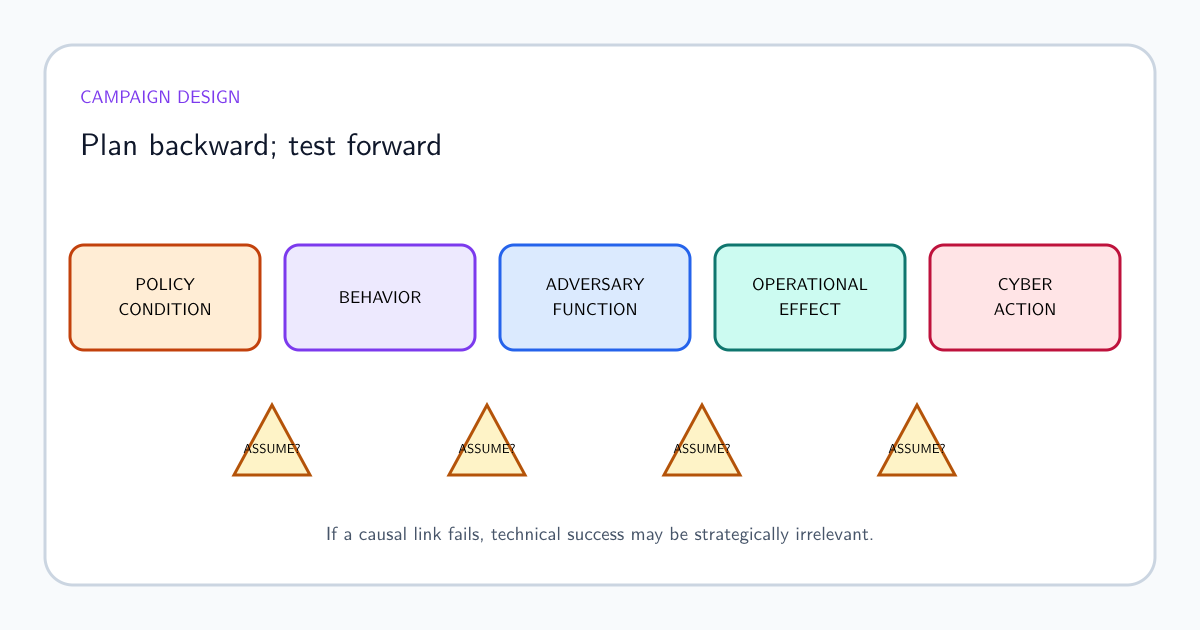
Trace the chain from cyber action to component change, service effect, operational response, dependency propagation, and human consequence. Include direct, indirect, delayed, cumulative, cross-border, and recovery-related effects. A loss of identity services may prevent hospital staff from accessing records; the rushed workaround may introduce medication or privacy risk; delayed restoration can shift burden to facilities already operating near capacity.
Avoid treating “no physical damage” as “no harm.” Operational disruption, data loss or manipulation, impaired humanitarian action, fear, exposure of vulnerable people, and loss of trusted information can have serious consequences. Whether a consequence satisfies a particular legal threshold is a separate question for the applicable authority and counsel. The operational duty is to identify credible pathways early enough to change the design.
Map direct and reverberating effects
A direct technical effect occurs on the affected component or data. A functional effect changes what a system or service can do. Reverberating effects travel through dependencies and responses: electricity loss affects communications; communications impair dispatch; delayed dispatch affects medical care; restoration competes for fuel, staff, and secure connectivity. Each arrow is a causal claim that should be evidenced and challenged.
Build the map with system operators, safety engineers, service owners, community experts, humanitarian advisers, legal counsel, and recovery staff. Cyber key terrain analysis identifies decisive technical and human dependencies; civilian-harm analysis asks who else depends on them and what happens under loss, manipulation, uncertainty, or delayed recovery. Include external providers, neighboring jurisdictions, shared clouds, and cross-border networks.
For every pathway, record onset, duration, geographic reach, population, severity, reversibility, confidence, and alternatives. Test common-mode failure: several backups may depend on the same identity provider, power source, network route, or vendor. Model degraded and manual modes realistically. A paper procedure that has not been staffed or exercised is an assumption, not a mitigation.
Keep legal frameworks and disputed questions explicit
International humanitarian law applies to cyber operations conducted in connection with armed conflict. Core conduct-of-hostilities principles include distinction, proportionality, and precautions. The ICRC position on IHL and cyber operations explains its view that foreseeable direct and indirect effects must be considered and that operations designed to disable computers or networks qualify as attacks, while also documenting areas where state views differ.
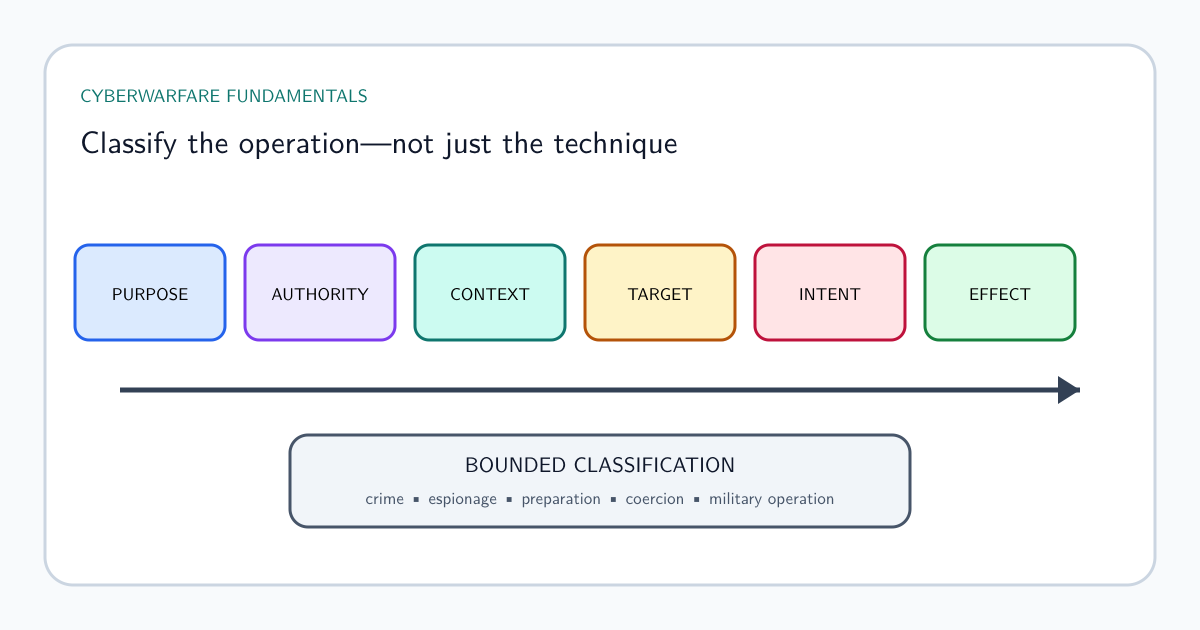
Do not present one institution’s position, an expert manual, or a course summary as universally settled law. Questions remain concerning loss of functionality, protection of civilian data as an object, sovereignty, thresholds, and application to particular facts. Identify the relevant state’s legal position and obtain counsel. Distinguish jus ad bellum, which concerns resort to force and self-defence, from IHL, which governs conduct during armed conflict, and from domestic authority.
Operational caution should not depend on the narrowest disputed definition. If an action could foreseeably interrupt medical care, water, food distribution, humanitarian relief, or civilian communications, analyze and reduce that risk. Legal compliance is a floor; policy, ethics, partner commitments, mission legitimacy, and strategic consequence may require stronger protection.
Engineer feasible precautions across the lifecycle
Precaution begins before execution. Verify the target’s current function, ownership, location, co-use, configuration, and relationship to the military objective. Validate intelligence freshness and define what must remain true. Compare non-cyber alternatives and narrower designs. Limit scope by identity, function, protocol, geography, duration, rate, sequence, or environment where feasible.
Test the effect in a representative model and independently challenge assumptions. Design continuous observation from multiple sources because target telemetry may be deceptive or disappear. Establish abort conditions for target change, unexpected propagation, civilian-service degradation, partner objection, loss of authority, or inability to assess. Assign a named stop authority and ensure the technical mechanism can actually stop or reverse the action.
Prepare recovery assistance and communication where lawful and appropriate. Monitor delayed effects after technical completion. Preserve decision records, model versions, evidence, counsel, approvals, telemetry, and deviations. Precautions are not a checklist signed once; they are controls attached to changing facts throughout cyber campaign design, execution, termination, and review.
Use NotPetya as a propagation and consequence case
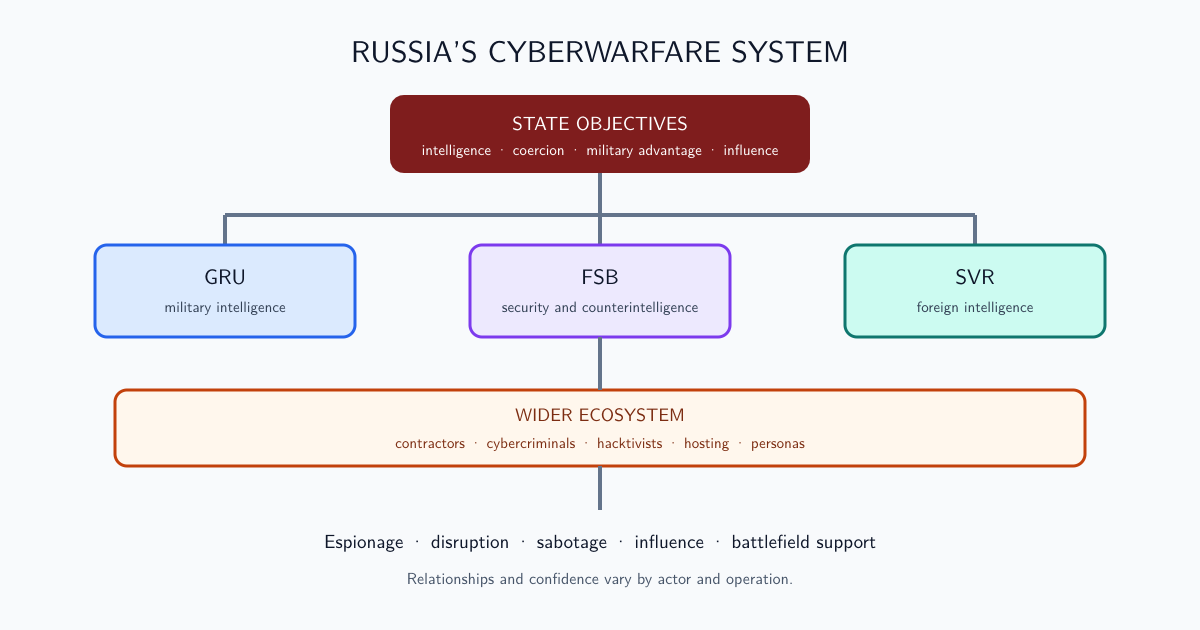
NotPetya demonstrates why technical targeting and actual consequence can diverge. The 2017 operation entered through a compromised Ukrainian software-update mechanism, used credential and propagation techniques, and produced destructive effects while appearing as ransomware. It affected organizations across borders and sectors, including shipping, logistics, healthcare-related operations, and manufacturing. Public attributions connected it to Russia’s military intelligence.
Analyze the case as an effects system rather than a malware legend. The trusted update relationship created distribution. Enterprise connectivity and credential exposure enabled movement. Global business networks carried disruption beyond the immediate political context. Recovery demanded clean systems, logistics, staff, communications, and time. Financial loss is only one proxy for human and operational burden.
The transferable lesson is not that every update compromise becomes NotPetya. It is that self-propagation, shared identity, common management, supplier trust, and multinational dependencies can overwhelm geographic or organizational intent. A design review must test where code or commands can travel, what they can change, how failures compound, and whether an operator can observe and stop the effect before unacceptable harm occurs.
Create a civilian-harm estimate and reassessment record
Document the proposed action, military or policy objective, target verification, expected technical and functional effects, affected populations, direct and reverberating pathways, duration, severity, uncertainty, vulnerable groups, protected functions, shared infrastructure, alternatives, precautions, monitoring, abort rules, reversibility, and recovery plan. Identify the owner and evidence for every major assumption.
Use ranges and scenarios rather than false point estimates. Compare best-supported, plausible-worse, and low-probability catastrophic outcomes. Explain which dependencies dominate uncertainty and what additional collection could reduce it before the decision. Ensure legal advisers receive the technical and human facts needed for their review; avoid asking them to infer architecture from tool names.
Reassess when configuration, users, conflict status, intelligence, partner participation, or service demand changes. After action, compare predicted and observed effects, including burdens shifted to responders and civilians. Feed findings into models, target folders, rules, training, and future precautions. Professional cyber operations protect civilians by making consequence a continuously observed design variable, not an appendix added after technical planning.
Frequently asked questions
What are reverberating effects in cyber operations?
Reverberating effects are indirect consequences that propagate through dependencies after an initial cyber effect. Loss of electricity may affect communications, water, hospitals, transport, and recovery. Analysis must define causal pathways, time, geography, affected populations, uncertainty, and feasible precautions.
Does international humanitarian law apply to cyber operations?
International humanitarian law applies to cyber operations conducted in connection with an armed conflict, although important questions about how particular rules apply remain debated. Domestic authority, peacetime international law, policy, and professional ethics are separate reviews.
Is loss of data or functionality legally an attack?
State and expert positions differ on aspects of loss of functionality and civilian data. Physical damage, injury, and death are widely accepted consequences relevant to attack analysis. Operational teams should identify the applicable position with counsel and design precautions around human consequence rather than assuming a disputed threshold.
How can cyber effects be bounded?
Bounding can use target verification, account or function scope, time windows, protocol limits, rate controls, isolation, simulation, staged release, continuous observation, abort criteria, reversibility, recovery support, and independent challenge. No control guarantees that a highly connected effect will remain local.