Traffic Distribution Systems in Cybercrime
Analyze traffic distribution systems as conditional routing layers without confusing dual-use technology, infrastructure, and criminal operations.
A TDS is a decision layer
A traffic distribution system receives a visitor and chooses a destination using attributes such as source, device, language, referrer, geography, cookies, timing, or prior activity. The routing function may be legitimate; maliciousness belongs to the observed operation.
Advertising, experimentation, localization, fraud prevention, and load management use similar decision logic. In criminal operations, the layer may separate acquisition from delivery, route affiliates, avoid researchers, or send selected visitors to credential theft or malware. Identify the inputs, rules, operator relationships, and outcomes before labeling a platform. Product names, geofencing, and redirects are not by themselves proof of criminal use.
Observe the complete delivery chain
Map the chain from lure or compromised site through redirects, filtering, landing pages, payload delivery, and follow-on access. The visible page may be a decoy while a different visitor receives another route.
Treat each request and response as a node with time, URL, status, content, headers, script behavior, and relationship to the previous step. Include advertisements, compromised web content, shortened links, tracking services, cloaking gates, exploit or credential pages, downloads, and command-and-control only where observed. Avoid collapsing the whole chain into the final domain; intermediate accounts and infrastructure may offer different disruption and ownership options.
Preserve conditions and time
Record URL, referrer, headers, resolver path, address, response, cookies, browser profile, location, time, and collection method. Divergent results can reflect targeting, rotation, takedown, caching, error, or researcher exclusion.
Preserve a controlled capture of redirects, scripts, certificates, DNS answers, and payload hashes without exposing an ordinary analyst workstation. Record whether the visit was direct or followed the original lure, because tokens and referrers may be required. Repeat collection only with authorization and a purpose, varying one condition at a time. A blank page is an observation under stated conditions, not proof that the operation ended.
Separate technology from operation
Distinguish software, service, operator, affiliate, infrastructure provider, campaign, and malware. Shared hosting and dual-use platforms reduce the attribution value of one indicator. Threat infrastructure analysis should remain time-bounded.
A TDS operator may provide routing to several customers; an affiliate may acquire traffic; a hosting provider may be unaware; a campaign may switch platforms; and one software package may appear in legitimate and abusive deployments. State the supported relationship and confidence instead of using one label for all parties. Infrastructure reuse, common templates, and co-hosting support pivots, but stronger attribution requires independent behavioral, administrative, financial, or operational evidence.
Disrupt several layers
Controls may involve the compromised site, account, redirect, domain, hosting layer, advertisement, payload, endpoint behavior, or monetization path. Coordinated disruption is more resilient than blocking the last visible address.
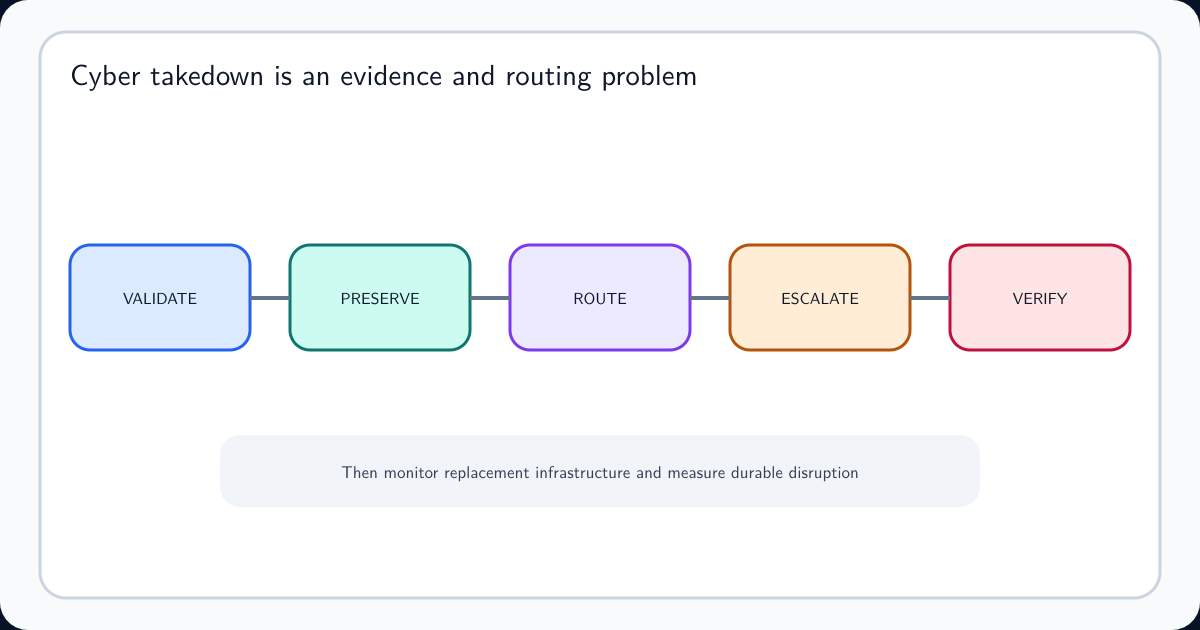
Match action to authority and evidence: remove injected code, suspend an abused account, notify a registrar or host, reject malicious advertising, block a precise route, detect endpoint behavior, or protect targeted identities. The cyber takedown services guide explains how to package, route, escalate, and verify those external requests. Preserve evidence and assess collateral impact, especially for shared infrastructure. Monitor replacement domains, changed redirect logic, and alternate affiliates after action. Measure whether harmful delivery declined, not merely whether one indicator disappeared. A redirect-domain block may be fast but temporary; removing the compromised publisher account can take longer while addressing the control point that repeatedly recreates the path.