
Introduction
Deploying AI features in Microsoft Purview is a technical project. Scaling them across a large organisation is an organisational challenge. The same classifier that works perfectly for the legal department may fail on engineering documents. The Copilot prompts that accelerate investigations for the SOC may confuse the HR team. The AI governance framework that satisfies your compliance officer may not satisfy an external auditor.
A Compliance Center of Excellence – a CoE – is the organisational structure that solves these problems. It centralises AI expertise, standardises deployment patterns, trains teams across departments, and measures whether the AI investment is actually paying off. This guide covers how to build one, based on CoEs I have helped establish at three organisations scaling Purview AI from pilot to enterprise-wide deployment.
If you are still building individual AI features, start with the AI-powered compliance guide and the end-to-end pipeline guide. Return here when you are ready to scale from one team to the entire organisation.
The Four Pillars of an AI Compliance CoE
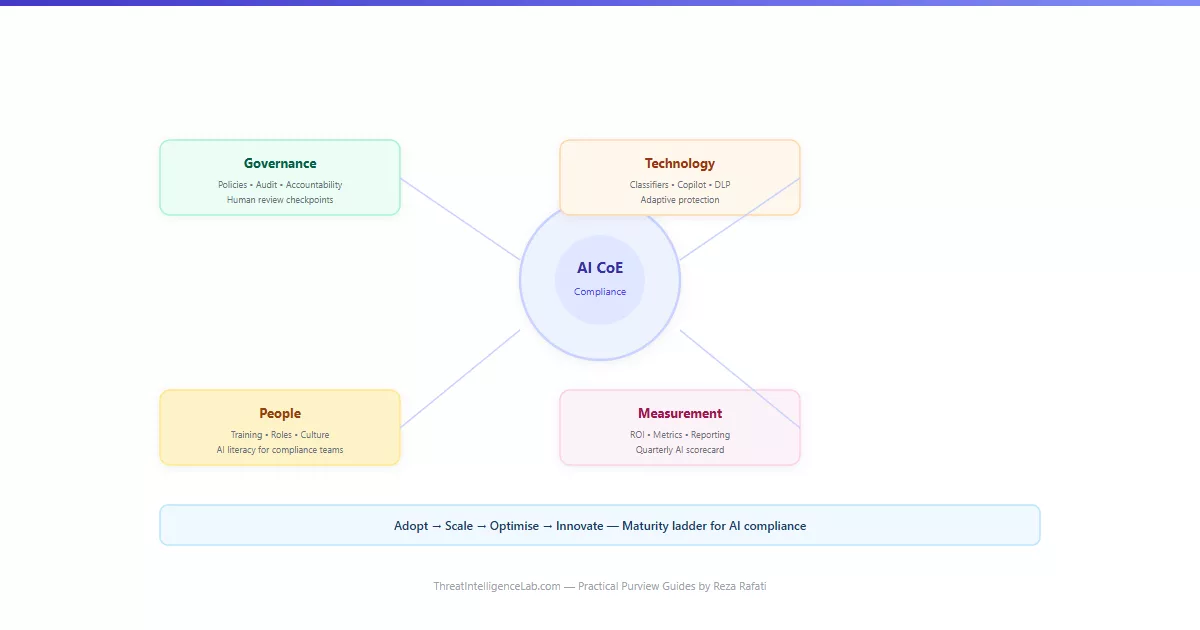
A CoE is not a department. It is a cross-functional team with members from compliance, legal, IT, and the business units that consume AI compliance services. The four pillars below define what the CoE owns versus what individual teams handle themselves.
Governance pillar. Owns AI audit standards, model documentation requirements, bias testing protocols, and the human review checkpoints described in the responsible AI governance guide. This pillar ensures every AI feature deployed in Purview meets the same governance standards regardless of which department uses it. One person, typically from compliance or legal, chairs this pillar.
Technology pillar. Owns the technical deployment of AI features – trainable classifiers, adaptive protection, Copilot configuration. This pillar builds reusable deployment templates, maintains the end-to-end pipeline, and troubleshoots issues using the AI troubleshooting guide.
People pillar. Owns training, role definitions, and AI literacy for compliance teams. This pillar ensures analysts know how to use Copilot prompts effectively, how to review AI-generated alerts, and when to escalate versus dismiss. Training is not a one-time event – the People pillar runs quarterly refreshers as AI features evolve.
Measurement pillar. Owns the ROI metrics, quarterly scorecards, and reporting to leadership. This pillar tracks the four metrics from the ROI guide – time saved, risk prevented, throughput gained, and audit readiness improved – and produces the one-page quarterly report for the board. Without this pillar, the CoE cannot justify its existence at budget time.
The AI Compliance Maturity Ladder: Where Is Your Organisation Today?
Every organisation I have worked with passes through the same four stages on the path to AI compliance maturity. Knowing which stage you are in prevents you from attempting stage-four initiatives with stage-one capabilities.
Stage 1: Adopt. One team is piloting one AI feature – probably trainable classifiers or adaptive protection. The deployment is scoped to a single department. There is no CoE. Success is measured by whether the feature works at all. Most organisations stay here for 3-6 months.
Stage 2: Scale. Multiple teams are using multiple AI features. The legal department has predictive coding. The compliance team has Communication Compliance classifiers. The SOC has Copilot. Deployments are still independent, and standards vary. The CoE forms at this stage to prevent divergence. Organisations typically reach this stage 6-12 months after initial adoption.
Stage 3: Optimise. The CoE has standardised deployment patterns, governance frameworks, and training programmes. AI features are connected through the end-to-end pipeline. Quarterly ROI reporting is established. Model drift monitoring is automated. Most organisations reach this stage 12-24 months in.
Stage 4: Innovate. The organisation is building custom AI applications on top of Purview – combining audit log data with Power BI for custom dashboards, using Copilot’s API for automated investigation workflows, contributing feedback to Microsoft’s pre-trained models. The CoE shifts from governing AI to enabling it. Few organisations are here today. Most will arrive in the next 2-3 years as the tooling matures.
Do not skip stages. A stage-one organisation that tries to build a stage-four custom AI application will fail because they lack the governance, training, and measurement infrastructure to sustain it. The CoE’s first job is to honestly assess which stage you are in and build the roadmap to the next one.
The CoE does not need to be large. At one organisation, a team of three – a compliance lead, an IT architect, and a training coordinator – supported AI compliance across 3,000 employees. What matters is not headcount but mandate. The CoE must have the authority to set standards that individual teams must follow, or it becomes an advisory body that teams ignore.
Start small. Form the CoE with two people – one from compliance, one from IT. Define the governance standards first, because everything else depends on them. Deploy one AI feature using the standardised approach. Document what worked. Train one additional team. Measure the results. Then expand. The ROI guide gives you the numbers to justify expanding the CoE. The AI-powered compliance guide gives you the technical foundation to deploy what the CoE standardises.
Leave a Reply
You must be logged in to post a comment.