OCSF 1.9 for Detection Engineers
Use OCSF 1.9 as a shared security-event language while keeping observation, profile conformance, extensions, mappings, and local validation separate from coverage claims.
OCSF describes how security events are represented
The Open Cybersecurity Schema Framework organizes events into categories and classes with typed objects, attributes, activities, observables, profiles, and extensions. The structure helps producers and consumers share concepts such as an actor, resource, device, policy, or finding.
A category groups broad event families. An event class defines a particular kind of record and its expected semantics. Activity identifies what occurred within that class. Objects and attributes describe participants and context. Profiles add cross-cutting requirements, while extensions represent additional domains or vendor needs.
These layers are a language. They do not make a source observe an event it never produced, nor do they guarantee that a local mapping selected the right actor, outcome, or time.
Choose the class from event meaning
Do not select a class because its name resembles a source table. Describe the producer’s observation first: who performed which operation on what target, what result occurred, and where the source sits in the behavior.
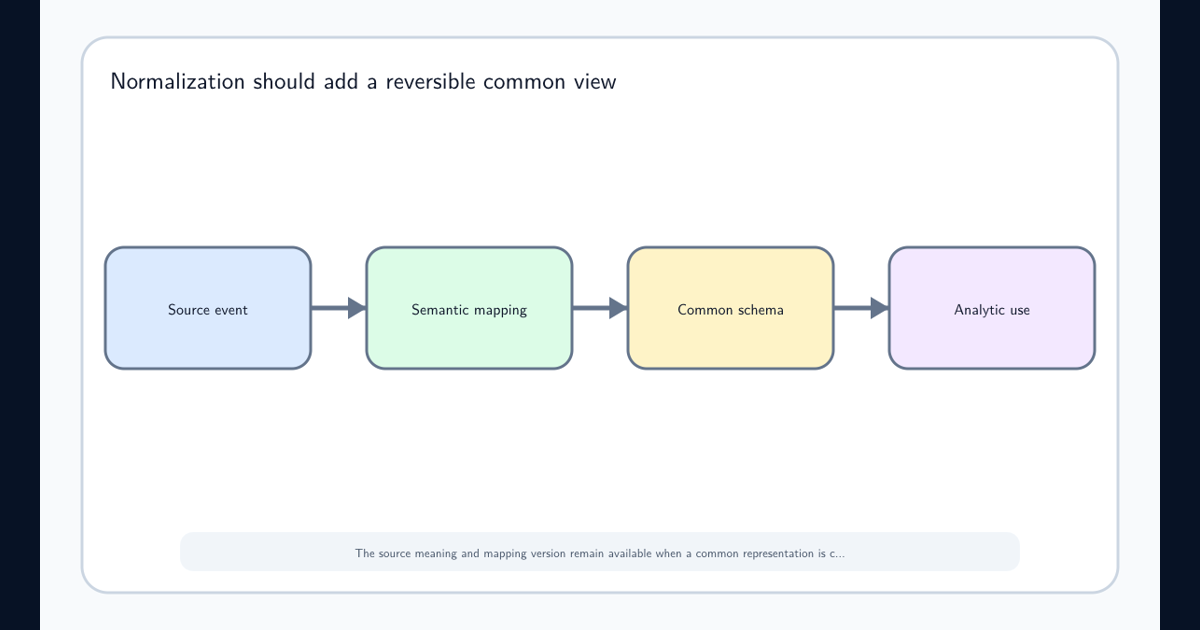
Compare that statement with class and activity definitions. If a provider event combines several actions, decide whether it should produce multiple normalized events or retain a compound source representation. If the class cannot express a provider distinction needed by detections, use an appropriate extension or preserve source context.
Record why the class was chosen and which source operations map to each activity. This makes the mapping reviewable when OCSF or the provider evolves.
Profiles and extensions make conditional promises
A profile says that additional attributes or objects are expected when an event claims that profile. Applying the label without satisfying its requirements gives consumers false confidence. Validate required and recommended fields and document conditional absence.
Extensions can add domain or vendor concepts that the core schema does not capture. They are useful when they preserve meaningful distinctions, not when they become a second ungoverned dumping ground. Version extension definitions and identify consumers that depend on them.
OCSF 1.9 adds and evolves concepts relevant to modern cloud, identity, integrity, and AI operations. Treat release notes and schema definitions as source facts; treat the way your organization maps and uses them as a local design subject to testing.
Observables support pivots but do not replace entities
An observable marks a value useful for matching, pivoting, or investigation, such as an address, hash, hostname, or user identifier. The observable value may be shared, reused, or ambiguous. It should remain attached to its typed object and context.
An IP address observed as a source endpoint is not automatically a device identity. A hash identifies content, not the intent of the process that loaded it. A user name without tenant and authority can collide.
Use observables to find related records, then evaluate the relationship through entity type, namespace, time, and source. This keeps convenient pivots from becoming unsupported attribution.
Conformance is the beginning of local assurance
Preserve OCSF version, source-to-class mapping, unmapped values, profiles, extensions, enum handling, raw identifiers, transformation lineage, and representative fixtures. Monitor completeness and unknown values by source and class.
Test intended events, ordinary alternatives, source changes, late data, missing required context, and consuming analytics. Compare with normalization without losing source fidelity: a successful schema validation can coexist with a semantically wrong mapping.
The honest conclusion is bounded. OCSF gives the program a common event language. Local observation, mapping, quality, health, and analytic validation determine whether that language currently supports a particular detection decision.
Frequently asked questions
Does OCSF 1.9 conformance establish detection coverage?
No. Conformance describes representation. Coverage also requires the producer to observe the needed behavior, mappings to preserve meaning, required fields and timing to remain healthy, and the analytic and delivery path to be tested.