CTI Metrics That Show Whether Intelligence Changed a Decision
Measure service reliability, decision use, risk reduction signals, and learning without rewarding report volume or unexamined indicator counts.
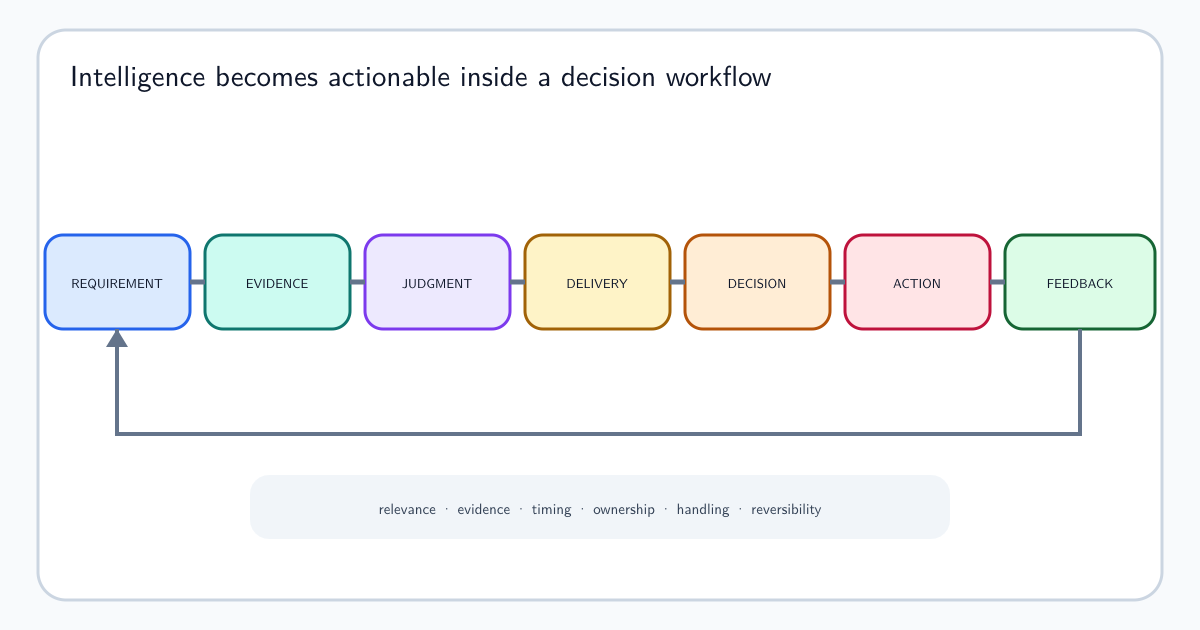
CTI metrics should help leaders decide whether to continue, change, scale, or stop a service. Counts of reports, alerts, or indicators show activity but can reward noise. Start with the decision chain: was the service reliable, did the intended consumer use it, did it change a choice, and is there evidence the choice improved preparedness or reduced exposure?
Choose a small balanced set per service. The closer a measure gets to business outcome, the more carefully you must explain shared causation and uncertainty.
Use Four Levels of Evidence
Track inputs and process for capacity: analyst time, source availability, queue age. Track service quality: timeliness, rework, accuracy, provenance, requirement coverage. Track use: recipient reached, action acknowledged, decision deadline met. Track outcome signals: exposure removed, investigation narrowed, warning time gained, or investment reprioritized.
Pair numbers with a few auditable decision cases.
Define Each Metric Before Collecting It
Give every metric an owner, formula, source, frequency, baseline, target or interpretation, known bias, and management action. Segment by service and consumer; an average can hide a failed urgent-warning service behind routine delivery.
Guard against gaming. If speed is rewarded alone, analysts may publish before validation. Balance timeliness with correction, usefulness, and evidence quality.
Hold an Outcome Review
Sample decisions quarterly. Ask what the consumer knew before, what CTI changed, what action followed, what happened, and what other factors contributed. Include cases where intelligence was ignored or wrong and change the service accordingly.
Link measures to the CTI service catalog. Stop collecting a metric when it no longer changes management behavior.
Frequently asked questions
Can CTI calculate a precise financial ROI?
Sometimes for bounded cases, but broad claims often depend on speculative avoided loss. Combine defensible cost and outcome evidence with decision narratives.
Is the number of indicators delivered a useful metric?
It measures output volume, not relevance or value. Use it only for capacity or pipeline health with quality and outcome measures.
Is stakeholder satisfaction enough?
No. Satisfaction helps diagnose service quality but should be paired with observed use, timeliness, decision change, and risk indicators.
How can CTI claim credit for a shared outcome?
Describe contribution rather than sole attribution and record the other controls, teams, and assumptions involved.
How often should metrics be reviewed?
Operational measures may be frequent; outcome reviews should match decision cycles and include periodic qualitative case review.