
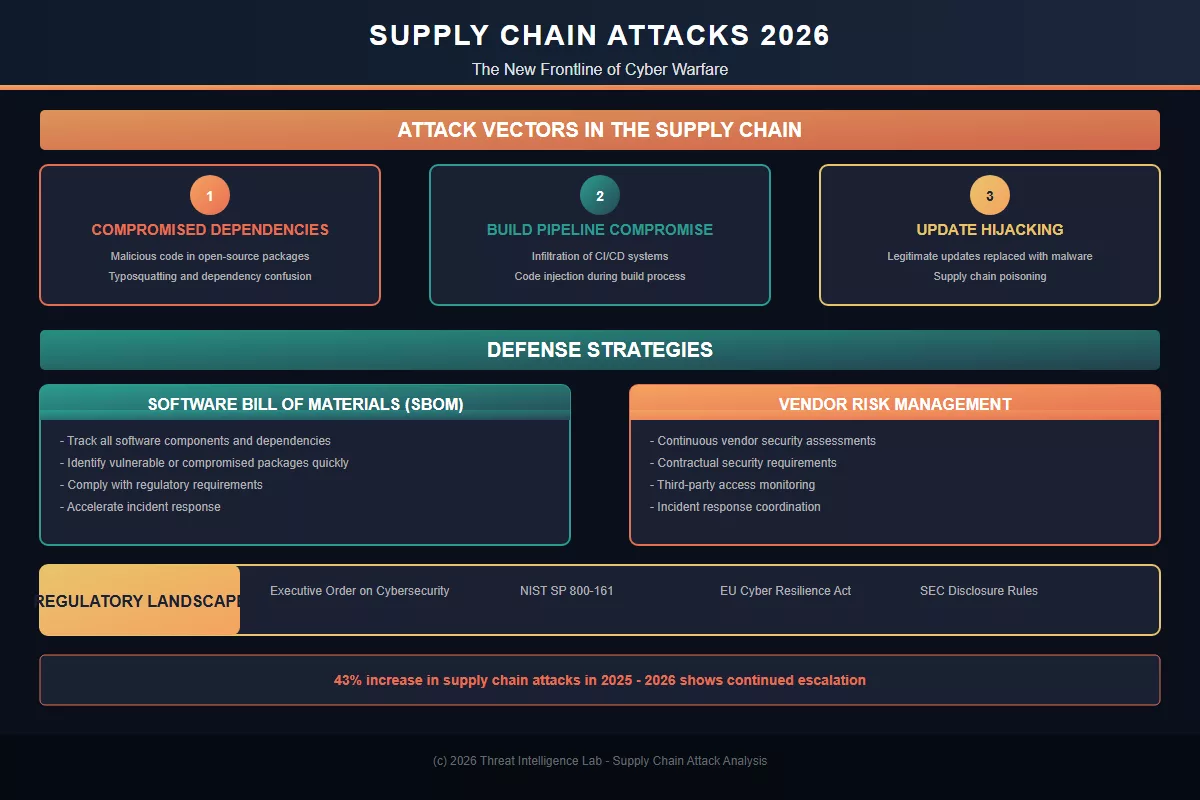
Supply chain attacks have emerged as one of the most devastating cybersecurity threats in 2026. By compromising trusted software and hardware vendors, attackers can infiltrate thousands of organizations simultaneously. As we explored in our previous analysis on supply chain risks, vendor vulnerabilities represent one of the most significant threats to modern enterprises.
The Growing Supply Chain Threat Landscape
Supply chain attacks increased by 43% in 2025, with 2026 showing no signs of slowing down. Attackers are increasingly targeting the software development lifecycle, open-source dependencies, and third-party service providers to gain access to their ultimate targets. For deeper insights into software supply chain attacks and defense strategies, refer to our comprehensive guide.
Software Supply Chain Attacks
Software supply chain attacks involve compromising the development or distribution process of software. Common vectors include:
- Compromised dependencies – Malicious code injected into open-source packages
- Build pipeline compromises – Attackers infiltrate CI/CD systems
- Update hijacking – Legitimate software updates are replaced with malware
- Certificate theft – Stolen code-signing certificates used to sign malicious software
High-Profile Supply Chain Attacks in 2026
The NPM Ecosystem Breach
Earlier this year, a sophisticated attack targeted the NPM registry, compromising popular packages that are downloaded millions of times weekly. The attackers used typosquatting and dependency confusion techniques to distribute malicious code that harvested environment variables and credentials. Understanding malware analysis techniques is crucial for detecting such threats.
Cloud Provider Targeting
Attackers are increasingly targeting cloud service providers to compromise multiple customers simultaneously. Recent incidents have involved compromised API keys, misconfigured storage buckets, and exploitation of cloud service vulnerabilities.
Defense Strategies for Supply Chain Security
Software Bill of Materials (SBOM)
Implementing and maintaining an accurate Software Bill of Materials is essential for visibility into your software supply chain. SBOMs enable organizations to:
- Track all software components and dependencies
- Identify vulnerable or compromised packages quickly
- Comply with regulatory requirements
- Accelerate incident response during supply chain attacks
Vendor Risk Management
Organizations must implement comprehensive vendor risk management programs that include:
- Continuous vendor security assessments
- Contractual security requirements
- Third-party access monitoring
- Incident response coordination
Regulatory Landscape for Supply Chain Security
Governments are increasingly mandating supply chain security measures. Key regulations include:
- Executive Order on Improving the Nation’s Cybersecurity
- NIST SP 800-161 Supply Chain Risk Management
- EU Cyber Resilience Act
- SEC cybersecurity disclosure rules
Conclusion: Securing the Supply Chain
Supply chain security requires a proactive, multi-layered approach. By implementing SBOMs, vendor risk management, and continuous monitoring, organizations can significantly reduce their exposure to supply chain attacks. For more insights on related threats, explore our articles on hack and leak crime tactics and the latest ransomware evolution.
Stay informed about supply chain security developments by following Threat Intelligence Lab for regular updates, analysis, and actionable intelligence.
Leave a Reply
You must be logged in to post a comment.